Short Film: “Seeds of the Mission”
The backstory on a wonderful, inspiring animated movie which speaks to our contentious times.
The backstory on a wonderful, inspiring animated movie which speaks to our contentious times.
Since the fall of 2016, I have been an assistant professor of screenwriting at the DePaul University School of Cinematic Arts. It was quite a transition from nearly three decades of professional experience as a screenwriter and television producer, but I have discovered I love teaching in a film school environment. The students are amazing with over 1,000 of them majoring in 11 areas of concentration, a truly diverse community with over 50% identifying as female and nearly 50% non-white. The breadth of their collective life experiences creates a remarkable ongoing conversation exhibited in the screenplays and films they create.
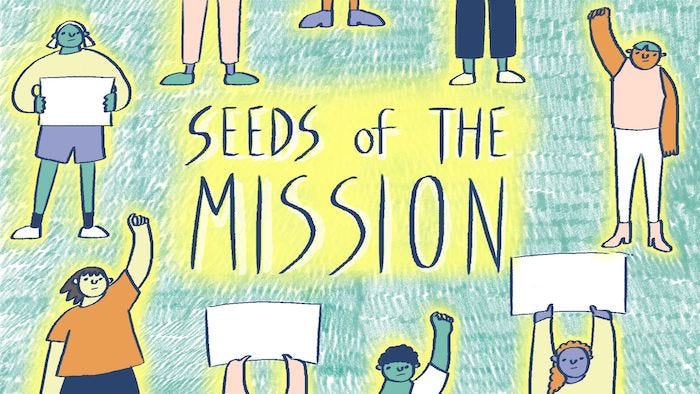
Case in point, a three-minute animation which recently went live: Seeds of the Mission. It’s wonderful and so timely for our contentious times. I was so impressed with it, I reached out to Liliane Calfee, one of my colleagues at DePaul who spearheaded the Seeds project for a Q&A.
Scott: What was the genesis and goal of this project?
Liliane: The genesis of the animation came at the start of a campaign where Mission & Ministry collected stories from across DePaul University to see where purpose-driven/mission work was alive in our faculty, staff, and student body. This acted as the precursor to a series of dialogues centered on reviewing and possibly revising DePaul’s mission statement. Originally, the animation was commissioned as a personal invitation to the deans across the university. We hoped to inspire them to share the campaign within their colleges and encourage full participation in this important step of reflecting on who we have been, who we are now, so we may transform into who we are called to be in the twenty-first century. Well Scott, I really blew through my deadlines. We were so limited in what we could film during a pandemic, so I decided to give animation a go. I had no idea the incredible effort and time it takes to produce a 3-minute piece. I’m grateful to the talented animator Zoe Pham for being patience with me through the process. It ended up being one of the most rewarding creative experiences I’ve ever had.
Scott: You and I met at the conceptual stage of the process and as you were sharing with me the nature of the project, I thought the story needed a visual metaphor. That’s when we hit on the idea of seeds. What was it about that concept of seeds which appealed to you?
Liliane: We always knew that the seed metaphor would be central to the story. The seeds in the story represent hope and the change we want to see as a University dedicated to the dignity of human life. From a theological perspective (we are a Catholic Vincentian University after all), the concept is traced back to a famous second-century Christian philosopher and martyr named Justin, who introduced the idea of “seeds of the Word of God” which was used later by the Catholic Church to encourage people of faith to “…gladly and reverently lay bare the seeds of the Word which lie hidden among their fellows.” According to this understanding, the seeds of the Word are present in the heart of every person, and in any human initiative, that strives toward justice, mercy, and compassion. The question I brought to you Scott was how to develop a story structure around that concept? That’s when you came up with the brilliant idea of connecting the seed to the four elements needed for life. It would allow us to move through phases and act as a metaphor for growth in the individual and the impact they can have on others. I remember you saying right away, “the sun could be knowledge or education, for example.” From there, the development of the story became easy and organic… sun as education, air as our urban environment, soil as service to community, and water as the ripple effect of social activism.
Scott: The process of germination — plant the seed, water the seed, the seed develops, pokes through the surface, grows and matures — provides a story structure. Did that feel natural to you as you developed the narrative around it?
Liliane: Once we developed the story structure, we had to figure out how to bring that to life visually. That was the challenging part. I’m still laughing at the earlier renditions. We really wrestled with how to show the seed within. At first, I asked Zoe for a literal version where she drew the seed in the characters’ chest and that certainly did not look good, haha. Eventually we came up with the idea of the glow which worked much better.
Scott: You worked with one of our colleagues, Meghann Artes, an animation professor. What was the focus of your interactions with Meg?
Liliane: The second big “aha” moment came after talking to Meg. At that point, we had characters doing good and glowing at various points in the story but no visual representation of the seed throughout. She felt that it was too much of a stretch for people to make the connection of glow and inner seed. She also thought the four elements weren’t consistently obvious. She recommended we punctuate with a visual of the seed growing as a transition. That was so helpful to the story. After those seed growth scenes were added, we just needed an ending. We struggled deciding between two concepts. Do we show the plant having its final growth into DePaul’s most recognizable emblem, the Tree of Wisdom? Or, do we focus on the ripple effect social activism can have in our community, country, and world? In the end, it was the mission story that gave us our answer. We asked our pastoral team what quote they would like to end with and they selected the following by St. Vincent de Paul, “May your words be like seeds sown in their hearts, bearing a hundredfold the fruits of charity.” That was the third “aha” moment where we realized we could do BOTH endings by having the tree bear fruit and metaphorically multiply the good work!
Scott: The main creative in the process is a DePaul animation student is Zoe Pham. How was that experience?
Liliane: When I reached out to Meghann Artes to refer me to a recent animation alumnus she was quick to suggest Zoe for her talent, drive, energetic demeanor, and ability to take feed-back well. I have to be honest Scott, it feels like a unique privilege when I get to collaborate with young adults packing this much talent. What I loved about Zoe is that her creative process feels so fluid. Every time she delivered me a new animatic to review, it felt like Christmas morning. There is something so intuitive about the way she gives life and personality to her characters. And her transitions are so clever; putting on a shirt and transitioning to being in the garden…the social media feed transitioning to the actual protest…the seeds popping out and becoming people. These details are part of what makes this short film feel so effortless and beautiful.
I also have to thank another recent alumnus Dylan Smith, the sound designer. I tasked Dylan with scoring the animation with music that builds, but breathes, and feels inspirational. I asked that he blend classical instruments that would appeal to an older demographic with lofi beats that would keep it feeling young and fresh. I spent a couple days looking all over stock sites to give him examples of the sound I was looking for, but it didn’t even seem to exist! I’m beyond grateful to Dylan for also being patient with me and for creating exactly what I had in my head. He really nailed all the sound effects too. We knew the glow sound would be very important. We didn’t want to make it sound too cartoonish or over-the-top. We needed it to blend well with the music. I was so impressed with the way he layered the glow sounds and tuned them to the score. Again, what a pleasure to work with such talent!
Scott: Now that the project is complete, what has the response been to the animation?
Liliane: Scott, we couldn’t have asked for a better reception. When it was completed, I sent it over to the person heading up University Marketing and Communications. I was both eager and nervous to know how it would be received given that it does explicitly state what side of history we’re on. Sadly, caring for the human dignity of those on the margins has become a bi-partisan issue. So when their team came to me days later saying they wanted to close the president’s State of the University address to all faculty and staff with the animation, I got a bit emotional. And the good news kept rolling in. A number of the directors within Mission and Ministry and even faculty shared with me that not only did they love the animation, but their teenaged children thought it was fantastic too. Even my one-year old kept her eyes glued for the entire three-minutes and spontaneously clapped at the end. It’s just a simple message of the power of kindness and service to others; what a wonderful story to share during these politically charged and polarized times.
Here is the short film Seeds of the Mission:
There are specific narrative elements which speak to the DePaul community, but the overall story extends to a wider audience — the need for empathy, connection to the human family, concern and care for others. As I tweeted back in July 2018:
Seeds of the Mission most definitely speaks to that!