Separation as a Theme in Pixar Movies
“When we step back from the movies Pixar has produced and look at them with a meta view, it is surprisingly — and blindingly — obvious how…
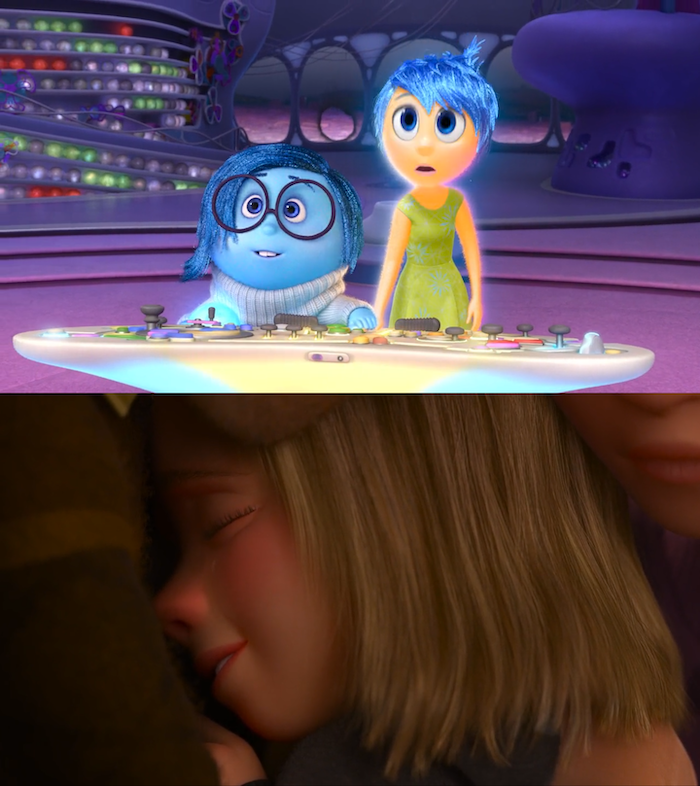
“When we step back from the movies Pixar has produced and look at them with a meta view, it is surprisingly — and blindingly — obvious how key this dynamic of separation is in virtually all of their stories.”
In most ancient cosmologies, everything begins with One. God, Unity, All Being in balance as a single entity.
Then something happens. In many traditions, it is what is known as creation. And in that act wherein the corporeal world comes into being, there is the very first moment of separation: Humanity from Divinity, Material from Immaterial, Mortality from Immorality, Night from Day, Land from Sky, and so on.
A variation of this story is Adam and Eve in Eden. For the briefest of times, they exist as One. Then the Forbidden Fruit. And the first humans are cast out of paradise.
In other words, Paradise Falls.

In the Pixar movie Up, when Carl is together with Ellie, they exist in a state of Unity. After her death — when she is separated from him physically — Carl tries to keep Ellie with him through a host of objects: furniture, photographs, souvenirs, and most notably the house where they had met when they were children and lived in since the day they were married. But that arrangement is fundamentally unsatisfactory and belies a deeper truth: Without Ellie, Carl is losing his very life essence.
And so with the journey, Carl commits to fulfilling a promise he made to Ellie numerous times: To get her to Paradise Falls.
When we step back from the movies Pixar has produced and look at them with a meta view, it is surprisingly — and blindingly — obvious how key this dynamic of separation is in virtually all of their stories. It can be an actual physical separation, the threat of a physical separation, a psychological separation, a symbolic separation, a separation that has taken place in the past, is taking place now, or about to take place in the future, but time and time — and time! — again, we see this narrative theme at work in Pixar stories.
There are at least three ways the filmmakers at Pixar have used separation as a story dynamic:
- Separation as loss
- Separation as problem
- Separation as transition
Let’s look at examples for each of these three approaches.
Separation as loss
If something is of great value to a character, then their separation from it, actual, perceived or threatened, can evoke a powerful experience of loss.
Toy Story: The core of Woody’s self-understanding is that he is Andy’s favorite toy. When Buzz Lightyear shows up and Andy sets Buzz in the spot on his bed where he has always put Woody, the cowboy’s separation anxiety — that he will lose his role to Buzz — escalates to the point where he accidentally sends Buzz toppling out the window, setting into motion the Strange Sojourners’ hero’s journey. Dynamic: Separation as threat.
Up: When Ellie dies, Carl is alone, separated from the one person he loved most in life. Overcome by the loss, Carl has devolved into a state where he is sullen, bitter, and in effect life-less. Threatened with eviction from the home he shared with Ellie for decades, Carl takes off to deliver the house to Paradise Falls, fulfilling his pledge to his deceased wife… then he discovers a stowaway Russell. Dynamic: Separation as grief.
Cars 2: Traveling to Europe to compete in the World Grand Prix, Mater accidentally gets pulled into the middle of an espionage caper and in the process causes McQueen to lose a race. McQueen angrily dismisses Mater from the race car team. Upset at being separated from his best friend, Mater figures he will handle his loss by heading home to Radiator Springs — until competing spies get in the way. Dynamic: Separation as rejection.
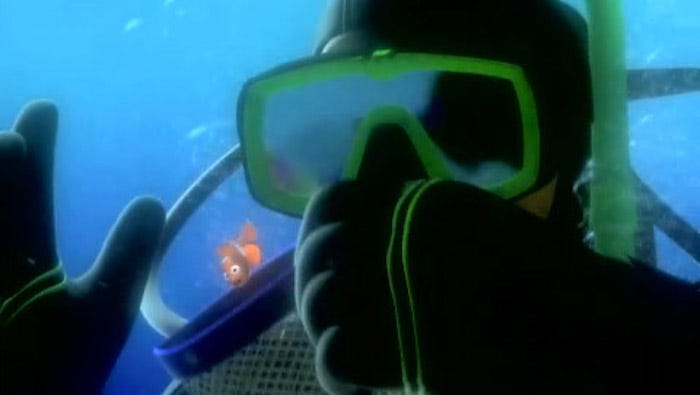
Finding Nemo: Disobeying his father’s warnings, Nemo ventures into the open sea only to be captured by a scuba diver, eventually ending up in the fish tank of dentist in Sydney, Australia. Confronted with this separation, Nemo’s father Marlin, who has been overly protective of his son to the point of extremity, sets off to rescue Nemo, beset by worries about his potential loss. Dynamic: Separation as fear.
Separation as problem
Separation is a departure from the norm and thus can create all sorts of problems for the Protagonist.
A Bug’s Life: Flik is found to be responsible for causing the grasshoppers to double the size of the seasonal ant offering to them, so he is forced to separate from the village in an attempt to redeem himself by finding bigger bugs to help repel the annual threat. But there’s a problem: How and where to find such allies? Dynamic: Separation as quandary.
Wall-E: After thousands of years of mistreating their home planet, the entire human race departs Earth, leaving behind Wall-E who day after day tirelessly goes about his job: cleaning up the place. The human’s separation from the planet creates a problem: Wall-E is lonely and longing for companionship. Dynamic: Separation as alienation.
Cars: When headstrong, hotshot rookie race car driver Lightning McQueen accidentally ends up getting stuck in the dusty backwater town of Radiator Springs, he is separated from everything he knows. Plus there’s this problem: If he doesn’t get to California within a week, he won’t be able to win the Piston Cup. Dynamic: Separation as captivity.
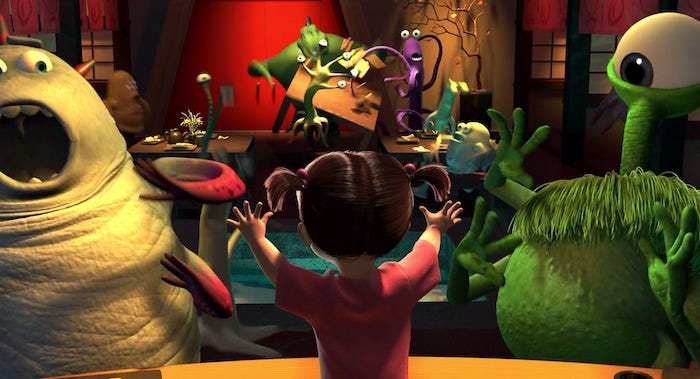
Monsters, Inc.: When Boo is separated from the human world and accidentally ends up in Monstropolis with Sully, this presents a problem because there is supposed to be no interaction between the monsters and people. That means the CDA (Child Detection Agency) is out to find her. Dynamic: Separation as disruption.
Separation as transition
A fundamental aspect of separation is change. If a character is separated from their home, the new environment is different. If two characters are separated from each other, that can create shifts in emotions, even behaviors. Over time, separation can result in a character’s transition.
Toy Story 2: When Woody is stolen by a toy collector, Buzz and his friends vow to rescue him, but Woody finds the idea of immortality in a museum tempting. This separation gives Woody a choice for the first time, an alternative lifestyle to just being Andy’s toy, and a transition in his self-awareness. Dynamic: Separation as choice.
The Incredibles: Because superheroes have gotten a bad rap in the press, the Parr family sets aside their superpowers and tries to live a ‘normal’ suburban life. This separation from their past forces the family, both individually and collectively, to confront personal issues, marking a transition in how they interact. Dynamic: Separation as repression.
Ratatouille: When Remy gets lost in the sewers and is separated from his rat family, he ends up at the restaurant of his hero, the chef Gusteau who has recently died. Befriending Linguini, the unlikely pair take on the task of a culinary crash course, translating into a transition for Remy from dreamer to doer. Dynamic: Separation as opportunity.
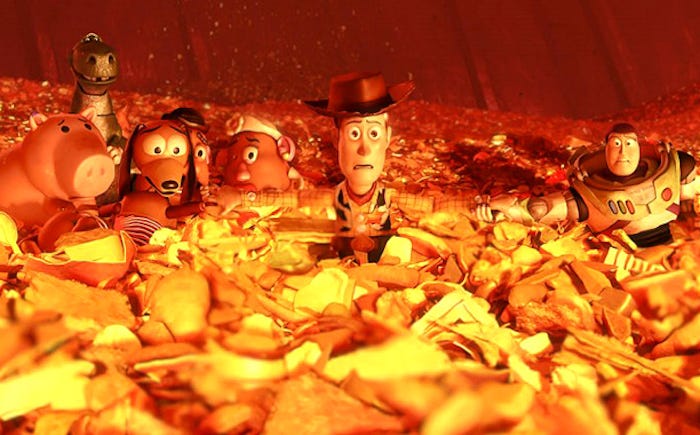
Toy Story 3: On the eve of Andy departing home for college, the toys are mistakenly delivered to a day-care center, leaving them feeling abandoned, despite Woody’s claims that it was all a mistake. This separation serves as a transition when the toys confront their own demise. Dynamic: Separation as mortality.
Actually, it’s possible to look at all three Toy Story movies as an exploration of Woody’s maturation process. Screenwriter Michael Arndt, who wrote Toy Story 3, had this to say:
Arndt explains Woody’s personal development by comparing his emotional progress in the films with that of a child. “In Toy Story, Woody is learning to share the spotlight with Buzz,” he explains. “He’s like a child who gets a new sibling and has to realize he doesn’t always have to be the favorite. That tracks emotionally with someone who is 5 or 6 years old.
“In Toy Story 2,” Arndt continues, “Woody has to deal with and accept his mortality. That tracks with a child who is 8 to 10 years old.” With the plot devised for Toy Story 3, Woody needed to progress to a more mature sentiment — that of a teenager — in order for the film to have the correct impact. “Woody learns about the impermanence of things and the necessity for letting go and moving on,” Arndt says. “So there’s an arc to his development across the trilogy. Even though there are common elements in all three films, I do think we’re telling a different story in each of them, as well as one big over-arching story that spans the trilogy.”
What makes this doubly interesting is the fact that the key narrative dynamic Pixar storytellers use to fuel Woody’s metamorphosis is separation, present in an overt way in every single Toy Story movie.
It’s possible to dig down into each Pixar film and find even other ways, large and small, that separation appears. I asked Mary Coleman, head of the company’s story development department about this recurring theme, if separation was something they had in mind to bring into their stories. Her response:
No, that’s not conscious at all… In terms of separation, I think it’s because we want our movies to express some kind of emotional yearning, separation unfolds naturally from that. What is the character yearning for?
Good point. What better way to bring into stark relief what a character truly wants and needs than by creating some distance between them and their goal?
There’s also this: Whenever a writer separates a character from their Old World, whether physically by transporting them somewhere else or emotionally through events that transform their experience into a new one, that creates both an opportunity and a danger. The opportunity is that this different circumstance could lead to bigger, better things for the character. The danger is that it could also lead to scarier, more threatening things.
Such is the power of separation and thus, we can understand why storytellers throughout time including Pixar have used it to heighten a narrative’s drama.
In addition to all of the movies we’ve touched on thus far, it’s interesting to note that separation is a key feature in the last several Pixar movies:
- Toy Story 4: There are so many story levels in which separation plays a role, a major one Forky’s disconnect from his sense of self as trash.
- Incredibles 2: Bob and Helen separated from their traditional roles as Helen becomes the superhero while Bob is a stay-at-home dad.
- Coco: Miguel has a Wizard of Oz adventure in which he visits the Land of the Dead and is separated from his family.
- Cars 3: When Lightning McQueen crashes, he is separated from his old life as a race car driver and with it fame.
- Finding Dory: Dory starts to remember her mother and father, and with that growing consciousness realizes she is separated from them.
- The Good Dinosaur: Arlo separated from his family, Spot an orphan, separated from his family through death, Arlo separated from his courage.
Of all the Pixar movies, separation may play the biggest role as a narrative dynamic in the movie Inside Out:
- Riley being separated from her home in Minnesota…
- Which creates an emotional separation between she and her parents.
- Joy and Sadness being separated from the other emotions.
- Indeed, the central conceit of the movie is two parallel realms — Riley’s outer life and inner life which are connected, yet separate.
The most fascinating thing to me about separation is that it happens in Pixar movies precisely in order to lead characters on the road to connection.
Think about it: Why do Riley and Joy need to go on their journeys, why do they need to separate from their Ordinary World of Experience?
- Riley and her family need to process the move more deeply, not just put on a happy face, but acknowledge their shared sadness about being separated from their old home in Minnesota.
- Joy needs to see that life is not all black and white, or more appropriately, experiences and memories are not all one color. Joy, Sadness, Anger, Disgust, Fear. We experience life, any given moment, with layers of feelings and emotions. Hence, the importance of the multicolored memory balls. It’s a more mature way of looking at life. The only way Joy can grasp this more nuanced perspective is by being separated from her old ways of thinking and being.
Which brings us right back to Joseph Campbell and the Hero’s Journey. None of this would happen without Separation, leaving the Old World, going into the New World, then experiencing the adventure the Hero / Heroine needs to experience to leave behind old ways of acting and thinking, and embrace their True Self and move toward Unity.
Takeaway: In terms of your own writing, consider your stories: Does it feature separation? If so, how? If your story does include some separation dynamic, are there ways to increase its impact on the narrative? If your story does not involve separation, can you brainstorm possibilities of how to do so to the advantage of your narrative?
Take a tip from the master storytellers at Pixar. Use separation as a narrative dynamic to explore the psychological lives of your characters and create drama in the plot.