Script To Screen: “Vertigo”
An oldie but goodie: The 1958 movie Vertigo, screenplay by Alec Coppel and Samuel A. Taylor, based on a novel by Pierre Boileau and Thomas…
An oldie but goodie: The 1958 movie Vertigo, screenplay by Alec Coppel and Samuel A. Taylor, based on a novel by Pierre Boileau and Thomas Narcejac. Directed by Alfred Hitchcock, it is a taut thriller.
Plot description: John “Scottie” Ferguson is a retired San Francisco police detective who suffers from acrophobia and Madeleine is the lady who leads him to high places. A wealthy shipbuilder who is an acquaintance from college days approaches Scottie and asks him to follow his beautiful wife, Madeleine. He fears she is going insane, maybe even contemplating suicide, because she believes she is possessed by a dead ancestor. Scottie is skeptical, but agrees after he sees the beautiful Madeleine.
Setup: Scottie [James Stewart] is asleep and starts to dream…
EXT. SAN FRANCISCO - (NIGHT) A foggy night, the city hidden in mist. The flash of
beacons; fingers of fog; the spasmodic growls and cries of
fog horns. INT. SCOTTIE'S BEDROOM - (NIGHT) Scottie in bed, sleeping restlessly. His head fills the
screen, rolls from, side to side. In a SLOW DISSOLVE while
his head remains on the screen, there comes into focus and
is superimposed as it gets closer the head and shoulders of
the portrait of Carlotta. The CAMERA PANS DOWN until it
reveals the nosegay. The portrait is cleared from the
screen, a new image is superimposed; the final scene at the
inquest between Scottie and Gavin Elster. But this time,
though it is not distinct, a woman's head can be discerned
on Elster's shoulder. Elster turns to the woman and says:
"Tell him he's not to blame; tell him." The woman turns her
head to smile at Scottie. It is Carlotta Valdes again,
dressed as in the portrait, with the necklace at her
throats, and she is alive. The picture fades away. Scottie's
restless head is alone on the screen again. Another scene dissolves to the screen: the graveyard at
Mission Dolores. The CAMERA IS APPROACHING the grave of
Carlotta Valdes. Now we see Scottie approaching the grave.
Now the CAMERA REVERSES, MOVING closer to the grave. It is
open; there is a great black abyss, with the headstone to
mark it. A CLOSEUP OF SCOTTIE coming to a stop as he stares down. The
black depths of the grave fill the screen, and now, suddenly
we start to fall. A BIG CLOSEUP OF SCOTTIE, his hair
windswept, staring down in horror as he falls. REVERSE
ANGLE: he is still falling, but now from the tower of the
Mission at San Juan onto the roof where Madeleine fell, and
at the moment of impact the picture clears, and Scottie is
sitting up in bed, staring ahead in horror, awakened by the
sound of his own scream. The scream is echoed by a fog horn
in the distance.
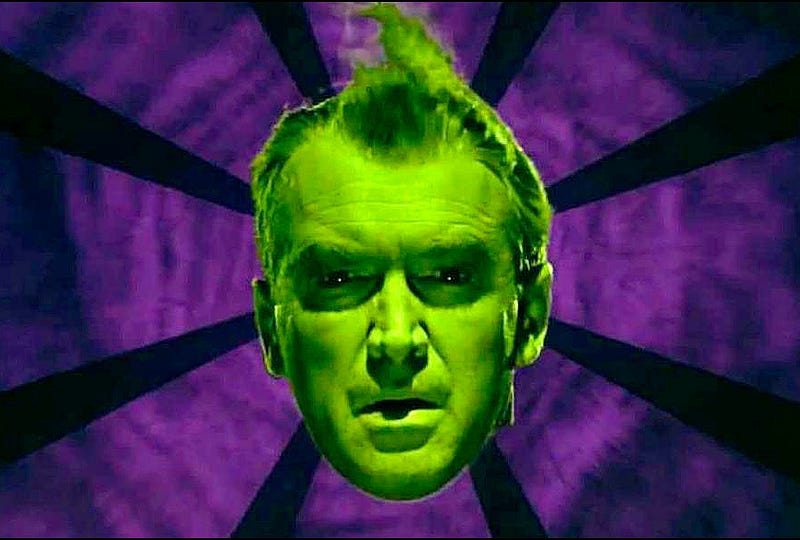
Here is the version of the scene in the movie:
Apart from lots of visual tricks, the most noticeable difference from script to screen is there’s no dialogue in the movie scene. Speaks yet again to the fact that movies are primarily a visual medium.
By the way, we would almost never see scene description like that today: 15 line paragraphs, camera shots. Once again showing that screenplay format and style is an ever evolving, organic thing. Remember: Today’s screenplay ‘rules’ are tomorrow’s folly.
One of the single best things you can do to learn the craft of screenwriting is to read the script while watching the movie. After all a screenplay is a blueprint to make a movie and it’s that magic of what happens between printed page and final print that can inform how you approach writing scenes. That is the purpose of Script to Screen, a weekly series on GITS where we analyze a memorable movie scene and the script pages that inspired it.
For more articles in the Script To Screen series, go here.