Script To Screen: “The Day The Earth Stood Still” (1951)
One of the most memorable science fiction movies of all time, The Day The Earth Stood Still, screenplay by Edmund H. North, story by Harry…
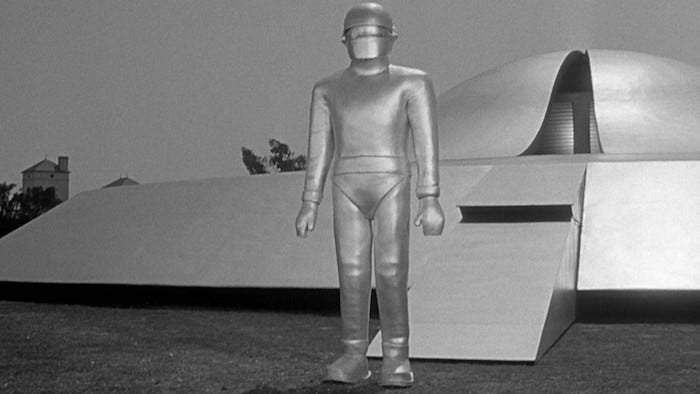
One of the most memorable science fiction movies of all time, The Day The Earth Stood Still, screenplay by Edmund H. North, story by Harry Bates, has a great story conceit: Aliens visit the Earth, not to destroy humanity, but save us from ourselves, specifically nuclear destruction.
Setup: The alien Klaatu (Michael Rennie) disembarks from his space ship to meet naturally fearful soldiers.
MED. SHOTKlaatu starts toward the platoon leader, raising the object he
holds toward the man, trying to make clear his intentions. Misinterpreting this as a menacing gesture, the platoon leader raises his carbine to his shoulder.MED. CLOSE SHOTof one of the tank commanders in the turret of his tank. He is watching Klaatu advancing toward the platoon leader and
he has drawn his pistol. Convinced that the lieutenant is in
jeopardy, the tank commander aims at Klaatu and fires.MED. SHOTas Klaatu falls to the ground wounded. The object he was
holding has dropped from his hand and smashed. The soldiers
start to gather around Klaatu excitedly when suddenly there
appears in the entrance to the space ship a huge robot. There
is a gasp of amazement from the crowd and the solders draw
back at sight of him. The robot is ten feet tall, is made in
the almost-perfect image of a man. He is to be played by an
actor and his flesh appears to be made of a greenish metal.
His eyes flash as though lighted internally. His perfectly-
fashioned, muscular body is covered only with a loincloth.
This is GORT.There are cries of amazement as Gort walks slowly ponderously,
down the ramp to the ground. As he does so, the ramp closes
behind him. Gort's face is, and always remains, utterly
expressionless. He stops to look at Klaatu, lying on the
ground. Then he looks around at the soldiers, the tanks and
guns. All the guns have been traversing to follow him.CLOSE SHOT - GORTFrom inside him there comes an ominous crackling sound, as
though power were being generated within him. His eyes flash
toward the tank from which Klaatu was shot.MED. CLOSE SHOT - TANKThere is a great metallic clatter and the Sherman tank is
suddenly reduced to a pile of junk metal, its parts completely
disintegrated. Only a piece of tank track and twisted gun
barrel emerge from the heap on the ground to identify what
had been there. The tank's crew has remained unharmed.CLOSE SHOT - GORTThe crackling sound continues as his eyes start to sweep in
|a semicircle taking in all the troops.MED. SHOT - THE TROOPSSHOOTING FROM BEHIND Gort, with the back of his head in f.g.,
CAMERA PANS to follow Gort's sweeping gaze. In a growing
crash and clatter of metal, every weapon in sight is
destroyed. The two machine guns are little heaps of junk.
The 75's are larger heaps. The second tank, like the first,
is a three-foot pile of scrap. Rifles have dropped from the
soldier's hands and lie on the ground as little mounds of
wood and metal. None of the men has been harmed, but their
faces show the utter terror of what they have experienced.
Here is the movie version of the scene:
It’s always interesting to read screenplays from a different era as a reminder of how the form evolves. For example, notice all the camera directions in the script. Today we achieve the same effect by describing a visual element in a Secondary Slug [or Shot] without using camera lingo. This makes for a better, more literary read, and doesn’t step on the director’s toes.
One of the single best things you can do to learn the craft of screenwriting is to read the script while watching the movie. After all a screenplay is a blueprint to make a movie and it’s that magic of what happens between printed page and final print that can inform how you approach writing scenes. That is the purpose of Script to Screen, a series on GITS where we analyze a memorable movie scene and the script pages that inspired it.
For more articles in the Script to Screen series, go here.