Script To Screen: “The Bourne Identity”
A scene from the 2002 movie The Bourne Identity, screenplay by Tony Gilroy and William Blake Herron, novel by Robert Ludlum.
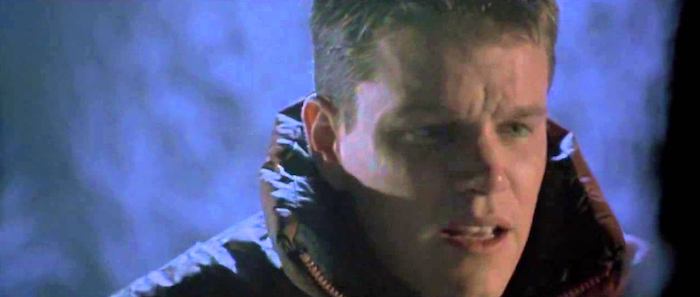
A scene from the 2002 movie The Bourne Identity, screenplay by Tony Gilroy and William Blake Herron, novel by Robert Ludlum.
IMDb plot summary: A man is picked up by a fishing boat, bullet-riddled and suffering from amnesia, before racing to elude assassins and regain his memory.
Here Bourne (Matt Damon) finds himself in Zurich with hardly any memory of who he is and where he’s been.
EXT. ZURICH PARK -- NIGHT THE MAN trying to get comfortable on a bench. It's
chilly but this will have to do until morning. Just settling in, when -- ZURICH COP #1 (O.S.)
(authority German)
Can't you read the signs? THE MAN turns. TWO ZURICH COPS coming toward him. ZURICH COP #2
On your feet. Let's go. Right now. THE MAN makes his feet. They're on top of him now. ZURICH COP #1
The park is closed. There's no
sleeping in the park. ZURICH COP #2
Let's see some identification. THE MAN not sure what to do. Eyes moving. Mouth shut. ZURICH COP #1
Come on. Your papers. Let's go. THE MAN
I've lost them. I've...
(German now)
My papers. They are lost. ZURICH COP #1
(not sympathetic)
Okay. Let's go. Put your hands up. ZURICH COP #2
(pulling his nightstick)
-- come on -- hands up -- up -- THE MAN raising his hand slowly -- ZURICH COP #1
reaching up to pat him down -- THE MAN
-- look, I'm just trying to sleep
okay? --
(German again)
-- I just need to sleep -- ZURICH COP #2 has heard enough -- giving a sharp poke
with the nightstick -- into THE MAN's back -- and
that's the last thing he'll remember because -- THE MAN is in motion. A single turn -- spinning -- catching COP #2
completely off guard -- the heel of his hand driving
up into the guy's throat and -- COP #1 -- behind him -- trying to reach for his
pistol, but THE MAN -- still turning -- all his
weight moving in a single fluid attack -- a
sweeping kick and -- COP #1 -- he's falling -- catching the bench --
trying to fight back but -- THE MAN -- like a machine
-- just unbelievably fast -- three jackhammer punches
-- down-down-down and -- COP #1 -- head slammed into
the bench -- blood spraying from his nose -- he's out
cold and -- COP #2 -- writhing on the ground -- gasping for air
-- struggling with his holster -- THE MAN -- his foot
-- down -- like a vise -- onto COP #2's arm --
shattering the bone -- COP #2 starting to scream, and
then silenced because -- THE MAN -- he's got the pistol -- so fucking fast --
he's got it right up against COP #2's forehead --
right on the edge of pulling the trigger -- he is,
he's gonna shoot him -- ZURICH COP #2
(gasping, pleading)
-- no -- please God no -- please
don't -- please no -- my Go -- stopping as -- THE MAN slams the gun against his temple and -- This fight is over. THE MAN standing there. In the silence. Two
unconscious cops at his feet. Blood on his pants.
What just happened? How did he do this? And there's
THE GUN in his hand. And God, it just feels so
natural -- checking it -- stripping it down --
holding it -- aiming it -- like this is something
he's done a million times before... This is something he definitely knows how to do. And then he stops cold. Throwing down the gun.
Running off into the darkness --
Here is the movie version of the scene:
Some intriguing differences, primarily in trimming the action. No blood. No pleading from the cop. No jamming the gun against the cop’s temple. Just wham, wham, wham, wham! Cops down. My guess is the director (Doug Liman) and perhaps Gilroy in production decided it was better to focus on the suddenness and brevity of Bourne’s actions to drive home to him — Bourne — the instantaneous shock of what he is capable of.
Beyond the action description, check out the moment after the altercation and how Gilroy describes it: The MAN standing there. In the silence. Two unconscious cops at his feet. Blood on his pants. What just happened? How did he do this? And there’s THE GUN in his hand. And God, it just feels so natural… like this is something he’s done a million times before.
Gilroy gets novelistic, describing Bourne’s inner thoughts. It’s effective writing at a key moment: To bring the script reader into the experience of the Protagonist and convey his feelings about what he just did.
What other thoughts do you have about this scene? Love to hear them.
One of the single best things you can do to learn the craft of screenwriting is to read the script while watching the movie. After all a screenplay is a blueprint to make a movie and it’s that magic of what happens between printed page and final print that can inform how you approach writing scenes. That is the purpose of Script to Screen, a Go Into The Story series where we analyze a memorable movie scene and the script pages that inspired it.
For more Script To Screen articles, go here.