Script To Screen: “The Birds”
A scene from the 1963 Alfred Hitchcock thriller The Birds, screenplay by Evan Hunter, short story by Daphne Du Maurier.
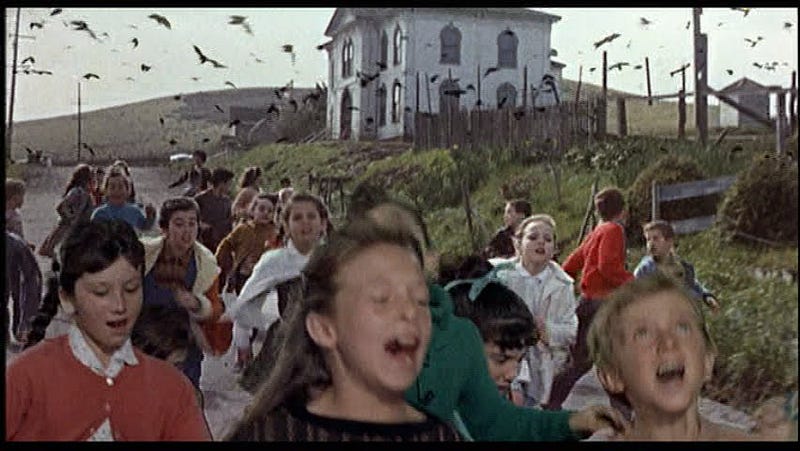
A scene from the 1963 Alfred Hitchcock thriller The Birds, screenplay by Evan Hunter, short story by Daphne Du Maurier.
IMDB Plot Summary: A wealthy San Francisco socialite pursues a potential boyfriend to a small Northern California town that slowly takes a turn for the bizarre when birds of all kinds suddenly begin to attack people there in increasing numbers and with increasing viciousness.
This is one of the more memorable scenes in the movie: school children attempting to escape an onslaught of attacking birds.
FULL SHOT - THE ROOM Through the windows, we can see the waiting crows. One moves
restlessly into flight, then settles on the equipment again. ANNIE
Quiet down, children! Quiet down! The children modulate into silence. ANNIE
Miss Daniels wants to see how we
conduct ourselves during a fire drill.
I'd like you to... CHILDREN
(grumbling in Unison)
A fire drill? This is our play period,
Miss Hayworth! Gee whiz! Etc. ANNIE
I'd like you to show her how quiet
and obedient you can be. The children again fall silent. ANNIE
We're going to go out of the school
now. Those of you who live nearby
can go directly home. I want the
rest of you to go down the hill, all
the way to the hotel. Do you
understand? CHILDREN
All the way down the hill? Gee, Miss
Hayworth, we never... Home? Why do
we...? ANNIE
(shushing them)
I want you to go as quietly as you
can, not a sound, until I tell you
to run. And then I want you to run
as fast as you can. Does everyone
understand?
(pause - silence)
All right. John, would you lead the
class, please? The children walk two-by-two to the corridor door. John
opens it, and they begin filing out. Melanie turns to look
at the play yard. CLOSE SHOT - A SINGLE CROW fluttering at the window, almost in exploration. He hangs
there for a moment, then wings back to the playground
equipment. CLOSE SHOT - MELANIE MELANIE
(whispering)
Hurry! EXT. PLAY YARD - FULL SHOT (6) straight on of all the crows. NEARER SHOT - PLAY YARD (8) but a different angle. CLOSER SHOT - PLAY YARD (10) but a different angle from the others CLOSE SHOT - (12) A low angle of five or six crows filling the screen. EXT. PLAY YARD The screen is filled with crows. About fifty or more. All of
a sudden we HEAR the distant PATTERING of children's feet as
they start running. Immediately the crows rise and the
CAMERA PANS UP with them into the sky. EXT. SCHOOL ROAD - LONG SHOT - (PLATE) (15) The FULL SHOT showing the children running toward the
CAMERA.
Annie herding them at the rear. The crows - about two
hundred - rising over the schoolhouse roof and descending
toward and reaching the running children. Shot as a moving
background with six or seven children in front on a
treadmill with the mechanical birds coming into top of
screen as though continuing on from the plate. The birds
swing around and among the foreground children. EXT. SCHOOL ROAD (4) (S) A side view of running children with Melanie in front urging
them forward. Birds fly between them, two or three others
wheel around, one live one sweeps by in foreground. EXT. SCHOOL ROAD (3) (P) Three or four children running. Birds overhead - one or two
children spread out as others come in from sides and take
their places. Birds swerve in and out. EXT. SCHOOL ROAD (2) (S) Profile of running child. Bird catches up and bites. EXT. SCHOOL ROAD (3) (S) A nearer side on view without Melanie. Birds wheeling in and
out - others overhead. EXT. SCHOOL ROAD (1) (P) Bird on top of girl's head (showing feet and wings). EXT. SCHOOL ROAD (2) (S) A three-quarter back of two children running - lots of birds
overhead and others wheeling. Screen almost full of birds. EXT. SCHOOL ROAD (1) (P) One-half child's face - a bird's head and beak on left,
dashing round to the child. EXT. SCHOOL ROAD - CLOSE UP (L) of feet running. EXT. SCHOOL ROAD - HIGH MOVING SHOT (6) (L) showing the crows among the running children. EXT. SCHOOL ROAD (1) (P) Big head of girl - bird lands on her right shoulder - wing
over her face. EXT. SCHOOL ROAD (1) (P) One SCREAMING child as bird swoops from top left down to
lower right. EXT. SCHOOL ROAD (2) (S) Head and shoulders of boy who ducks behind pole -- bird goes
by as another attacks him from right-hand side. EXT. SCHOOL ROAD (1) (FP) Back view of boy's head running. He looks back. EXT. SCHOOL ROAD (½) (P) Big head of bird coming at CAMERA. EXT. SCHOOL ROAD (1) (FP) Back view of little girl running. She looks over her
shoulder. EXT. SCHOOL ROAD (½) (P) Big head of bird coming into CAMERA. EXT. SCHOOL ROAD (3) (L) Straight back CLOSE SHOT of Annie dragging slow children. No
birds in back, but several wheeling around them. EXT. SCHOOL ROAD - HIGH MOVING SHOT (6) (L) showing the crows chasing the children down the street -
with the Bay in the distance. EXT. SCHOOL ROAD (3) (S) A bird dives to head of Michele and she falls OUT of
picture. EXT. SCHOOL ROAD - CLOSE UP (1) (L) of Michele as she hits ground. EXT. SCHOOL ROAD - CLOSE UP (½) (L) Her glasses smash. EXT. SCHOOL ROAD (2) (S) Flash Cathy - she sees and runs back. Birds swirling around. EXT. SCHOOL ROAD (1) (S) Six birds descend on fallen Michele - legs running by. EXT. SCHOOL ROAD (3) (S) Cathy RUSHES IN. She disperses birds and bends to pick up
Michele. EXT. SCHOOL ROAD (2) (S) Melanie stops, looks back and sees Cathy and Michele, heads
of other children rushing by in foreground. Birds swirling.
Melanie dashes out left. EXT. SCHOOL ROAD (3) (S) Melanie reaches Cathy and Michele -- Michele is now on her
feet. Birds swirling -- Melanie looks about -- sees. EXT. SCHOOL ROAD (2) (L) Station wagon across the street. Birds swirling about and
children running by. EXT. SCHOOL ROAD (5) (L) Melanie drags Cathy and Michele to the station wagon. We see
the Bay in the distance and children running on the bottom
of the street. INT. STATION WAGON - CLOSE SHOT (8) (S) Shooting inside the wagon across the front seat. The three
scramble in, Cathy first, then Michele and Melanie last -- the door SLAMS on crows swooping around. Cathy and Michele
are SCREAMING with fright. INT. STATION WAGON - P.O.V. (3) (FP) Through the windshield we see crows attacking. Bay and
running children in distance. INT. STATION WAGON (3) (P) The faces of the three - Birds are fluttering on the rear
window. INT. STATION WAGON - MELANIE (3) (P) wheel in foreground. She starts to slam hand on horn ring. INT. STATION WAGON (2) (S) Crows attacking side window. INT. STATION WAGON (2) (S) Hand on horn ring. INT. STATION WAGON (2) (P) Cathy and Michele's faces huddled together. INT. STATION WAGON (2) (P) Melanie's big head - she looks down. INT. STATION WAGON - CLOSE UP (1) (P) Knob of wiper -- her hand comes in and pulls it out. INT. STATION WAGON (3) (FP) Wipers starting. Crows retreat. INT. STATION WAGON (2) (P) The three faces staring out. INT. STATION WAGON - P.O.V. (3) (P) through windshield. The crows are starting to go away. INT. STATION WAGON (2) (P) Melanie looks out and sees: EXT. SCHOOL ROAD - P.O.V. (6) (FP) through windshield. Annie running back with stick. She beats
the last of the crows away. INT. STATION WAGON (6) (S) Melanie flops in exhaustion over the wheel as Annie comes
round to the side window and starts to open the door.
Now the movie version of the scene:
There are a few key differences between script and screen — most notably Melanie (Tippi Hedren) doesn’t turn on the windshield wipers because in the movie, she doesn’t have car keys — but for the most part, the script is a shot-by-shot blueprint for the movie. This is not surprising because that is how Hitchcock operated. Here is an excerpt from an interview with screenwriter Ernest Lehman who wrote North By Northwest:
Hitch and I acted out the entire crop-dusting sequence in his living room. Then I incorporated every move into the script, and that was the way he shot it.
Storyboarding is really an illustrator’s work for the director. A motion picture illustrator puts pictures on paper and puts them on boards. In story-boarding a script for a Hitchcock film, the illustrator is told what pictures to put on the boards by the script, which has benefited from my conferences with the director. Of course, I participate in what is going to appear on that storyboard, because even without the storyboard the script describes exactly what is going to be on the screen. Hitch would have it no other way. The script even describes the size of the shot, whether it’s a medium or a tight close-up, whether the camera pulls back and pans to the right as the character walks toward the door, whether it tilts slightly down and shoots through the open doorway, getting the helicopter as the lights go on outside. That’s why Hitch says it’s a bore for him to get the picture on the screen, because it has all been done already in his office [emphasis added].
What can contemporary screenwriters take away from this script to screen post? Here are a few things.
- The scene reminds us that movies are primarily a visual medium. Just look at those pages, one image after another in quick succession.
- The screenplay, over 50 years old, represents a style whereby the script was a blueprint to produce a movie, even down to individual camera shots. Screenplay style has moved away from directing jargon and production lingo, evolving into a more literary feel.
- While it is uncommon to use camera shots in contemporary scripts, we can indicate them through the use of individual paragraphs. For example, let’s take the action inside the car and strip away the camera direction:
INT. STATION WAGON
The faces of the three — Birds are fluttering on the rear
window.
Melanie starts to slam hand on horn ring.
Crows attacking side window.
Hand on horn ring.
Cathy and Michele’s faces huddled together.
Melanie’s big head — she looks down.
Knob of wiper — her hand comes in and pulls it out.
Wipers starting. Crows retreat.
The three faces staring out. Through windshield —
The crows are starting to go away.
Notice how each line suggest a camera shot without use camera lingo? This style allows writers to ‘direct’ the action in a more literary fashion than the production blueprint approach of yesteryear.
One of the single best things you can do to learn the craft of screenwriting is to read the script while watching the movie. After all a screenplay is a blueprint to make a movie and it’s that magic of what happens between printed page and final print that can inform how you approach writing scenes. That is the purpose of Script to Screen, a series on GITS where we analyze a memorable movie scene and the script pages that inspired it.
For more articles in the Script To Screen series, go here.