Script To Screen: “Midnight Cowboy”
The last scenes from the 1969 movie Midnight Cowboy, screenplay by Waldo Salt, novel by James Leo Herlihy.
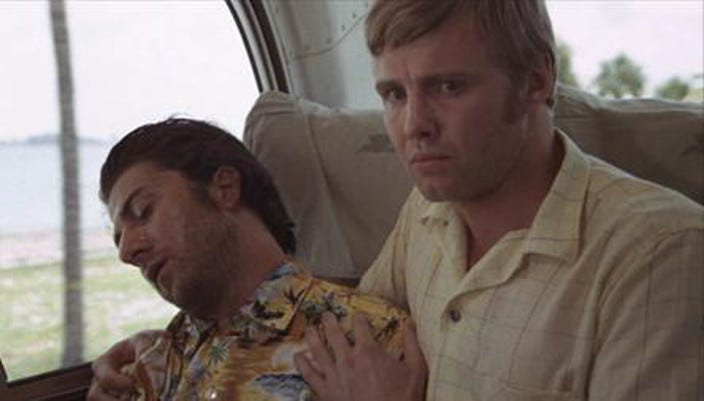
The last scenes from the 1969 movie Midnight Cowboy, screenplay by Waldo Salt, novel by James Leo Herlihy.
IMDb plot summary: A naive hustler goes to New York to seek personal fortune but in the process finds himself a new friend.
Ratso (Dustin Hoffman) and Joe (Jon Voight) are en route to Florida. However, Ratso’s health has been deteriorating…
INT. GREYHOUND BUS - DAYRatso's eyes squint in a dazed half-sleep. Joe leans across
to pull down the shade. He hesitates a moment, watching...... past his reflection, a group of young men on their way to
work, carrying lunch pails, dressed exactly as Joe is now
dressed...... then Joe lowers the blind and seats himself. Ratso nods
slightly, his voice practically inaudible. RATSO
Thanks, Joe. JOE
Shee-it, you know, I got this thing
all figured out, Ratso. I mean
Rico. When we get to Miami, what
I'll do, I'll go to work. I gotta
do that, 'cause see, I ain't no
kind of a hustler. I ain't even any
goddam good as a bum. I'm a
nothing, that's what I am. So
reckon I'd better go to work and
get me a goddam job. Okay?Joe glances at Ratso, but there is no response.
Surreptitiously, Joe takes out a cigarette, turns his face
away from Ratso and lights it, hiding it cupped in his hand
as he smokes. JOE (CONT'D)
Yeah, guess that's what I'm gonna
do.They ride for a moment in semi-darkness, Joe smoking, looking
at the other people on the bus, brighter without the shades
down. Joe turns, checking the blanket around Ratso, noticing
that Ratso is sitting in a peculiarly stiff, awkward
position. Joe leans over to straighten Ratso's head, blocking
our view for a moment. Then Joe leans back, frowning,
thoughtful. We still do not see Ratso's face. Joe rises
slowly, starting forward in the bus...... passing an older couple, a schoolgirl, two ladies with
straw hats, a young man trying to read, pausing when he
reaches...... the DRIVER, staring out at the Sunshine Parkway with the
Driver, leaning over so he won't have to speak too loudly. DRIVER
Yes, sir? JOE,
My friend's dead in the back seat. DRIVER
Your friend's what in the back
seat? JOE
Dead. Dead as a doornail. DRIVER
Is this some kind of...He glances at Joe, then pulls off the road and stands up. DRIVER (CONT'D)
Okay, folks, everything's fine.
Nothing to worry about.The passengers crane their necks as Joe follows the Driver to
the rear of the bus. The passengers at the rear are staring
ahead, trying not to see what is going on. The Driver touches
Ratso, straightens, touches his hat, but doesn't remove it. DRIVER (CONT'D)
Is he kin to you?Joe nods no. DRIVER (CONT'D)
Don't you want to close his eyes? JOE
Close them? DRIVER
Just reach over and close them.
That's all.Joe closes Ratso's eyes. DRIVER (CONT'D)
I guess we'll just drive on, right?
Nothing else to do. JOE
No, sir. Not till Miami. I'll see
to burying then.The Driver moves to the front and turns to the passengers. DRIVER
Just a little sickness, folks,
nothing serious. We'll be in
Miami...
(looks at watch)
... in forty minutes.INT. GREYHOUND BUS - DAYJoe sits stiffly, very frightened, as the bus starts on. Then
he glances at Ratso, frowning, reaches out an arm and puts it
around Ratso, settling back, staring straight ahead. THE END
Here is the movie version of the scene:
What strikes me the most is how Voight takes this scene direction — Joe sits stiffly, very frightened… reaches an arm and puts it around Ratso, settling back, staring straight ahead — and imbues the moment with such incredible emotion. You can just see the flood of confused feelings coursing through his body as he rides toward an uncertain future.
Of course, this reminds me of another ending scene in which Dustin Hoffman rides a bus:
One of the single best things you can do to learn the craft of screenwriting is to read the script while watching the movie. After all a screenplay is a blueprint to make a movie and it’s that magic of what happens between printed page and final print that can inform how you approach writing scenes. That is the purpose of Script to Screen, a weekly series on GITS where we analyze a memorable movie scene and the script pages that inspired it.
For more Script To Screen articles, go here.