Script To Screen: “Lost In Translation”
The ending scene from the 2003 movie Lost In Translation, written by Sofia Coppola.
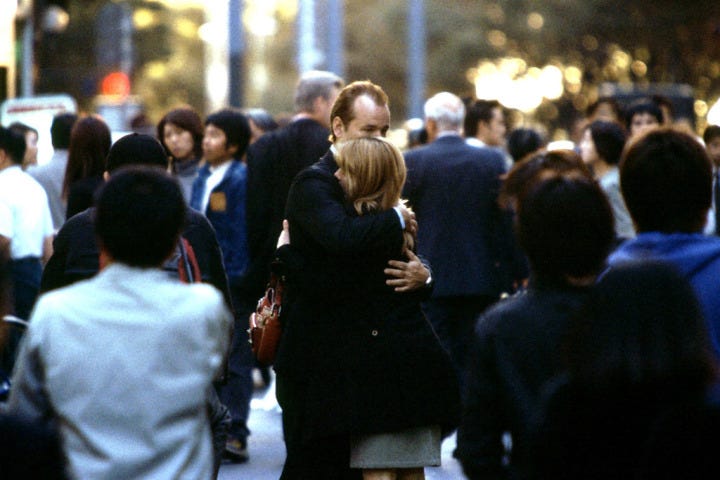
The ending scene from the 2003 movie Lost In Translation, written by Sofia Coppola.
Plot Summary: A faded movie star and a neglected young woman form an unlikely bond after crossing paths in Tokyo.
Here is the scene from the script:
INT. CAR - DAY In the backseat, Bob leans back on the little doily. The car pulls away. Around the corner, he looks down a crowded alley and
sees Charlotte's blonde hair. BOB
Can you pull over a second? The DRIVER, wearing white cloth gloves, pulls the car
over slowly. Bob tries to open the door'99 it won't
open, he has to wait for the automatic doors to open
for him (slowly). EXT. TOKYO STREETS - DAY Bob gets out and rushes down the street to where he
saw Charlotte. The street is crowded with JAPANESE
PEOPLE, and different colored umbrellas, (it's sunny
out with a light rain). Music blasts from speakers on the street, and there
is some promo going on with GIRLS handing out little
cologne samples. Bob looks around for her, but only
sees dark hair, umbrellas, and super tan JAPANESE
KIDS. In the distance an umbrella moves to reveal
Charlotte. BOB
CHARLOTTE! But she can't hear him over the loudspeaker. He
rushes to her. C.U. she turns and we see she is crying. The music swells. He embraces her, holding her close
to him in the crowd. BOB
Why are you crying? CHARLOTTE
(sincere)
I'll miss you. He kisses her, hugs her good-bye. BOB
I know, I'm going to miss you, too. He holds her close.CUT TO: Charlotte watches Bob as he reaches his car, he turns
and looks at her. She smiles at him, and is lost in the crowd. Bob gets into his car. CUT TO: Charlotte walks with the crowd as they go on their
way. CUT TO: INT. CAR - DAY Back in the Presidential, alone, Bob leans against
the little doily. They drive off. He looks out the window, Bob's happy he's going home,
he's happy he came to Tokyo. Bob's P.O.V.- Tokyo goes past his window. FADE TO BLACK: THE END
Here is the movie version of the scene:
There are some subtle, but important differences between the script and the movie, and I encourage you to compare the two and cite those changes. Let me focus on the biggie. Instead of this exchange:
BOB: Why are you crying?
CHARLOTTE: I’ll miss you.
BOB: I know, I’m going to miss you, too.
There is this: Bob whispering something to Charlotte. So we not only get a dialogue cut (three lines), we also have a mystery introduced into the story: What did Bob tell her?
There are all sorts of theories, many of which you can find here in this Vulture article.
As for me, I’d prefer not to know the answer. I like how Bob’s unknown comments frame the respective reactions of the characters as they leave each other. In the movie, Charlotte does seem to have a lighter mood, consonant with the line in the script “she smiles at him.” But I’m not so sure Bob’s mood in the movie reflects what is written in the script: “Bob’s happy he’s going home, he’s happy he came to Tokyo.” Check out the very ending of the scene as Bob is driven through the streets of Tokyo. Does he look “happy” to you?
One of the single best things you can do to learn the craft of screenwriting is to read the script while watching the movie. After all a screenplay is a blueprint to make a movie and it’s that magic of what happens between printed page and final print that can inform how you approach writing scenes. That is the purpose of Script to Screen, a weekly series on GITS where we analyze a memorable movie scene and the script pages that inspired it.
For more Script To Screen articles, go here.