Script To Screen: “Little Miss Sunshine”
The climax of the 2006 movie Little Miss Sunshine, written by Michael Arndt.

The climax of the 2006 movie Little Miss Sunshine, written by Michael Arndt.
Setup: A family determined to get their young daughter [Olive] into the finals of a beauty pageant take a cross-country trip in their VW bus. And now it’s her turn to perform…
Here is an extended version of the scene:
Here is a transcript of a 2007 Michael Arndt appearance at Cody’s Books in Berkeley, California talking about the dance scene:
This scene you’re about to see is the climax of the movie. And it’s really the thing I’m most proud of because as a writer, I’m a big believer in endings. I think that the ending of your story is when the meaning of your story is revealed. But I also think in setting up the story… a good story for me is for a character, right before the climax, taking a decisive action, making an important decision. And usually you’ve got to make that decision as difficult as possible.
So what I was trying to do here was push Olive into this corner where she has to decide if she’s going to go onstage or not. At that moment, she’s weighing two value systems. One is her dad who says there’s no sense in entering contest if you don’t think you’re going to win. She’s already overheard her dad go back and say, “There’s no way she’s going to win. I don’t want her going on.” Then on the other shoulder is her grandpa who’s said, “We’re gonna have fun tomorrow, we’re gonna tell them all to go to hell.” And also, “A real loser is someone who doesn’t win, it’s someone who doesn’t try.”
To be didactic about it, you’re trying to have your character make a meaningful decision and really push them into the corner. And I always thought when I started writing this, the external stakes of the story, which is whether Olive wins the contest or not, is about as low a set of stakes as you can possibly get: a child beauty pageant. But I wanted to try as a comic strategy to jack up the emotional stakes of the story and also the philosophical stakes of the story, so they were absolutely as high as possible. So that when she was sitting there trying to make this decision what she was going to do, you were like a hundred percent invested. What this little girl decided next was a really, really important decision, and that you wanted to see how it turned out.
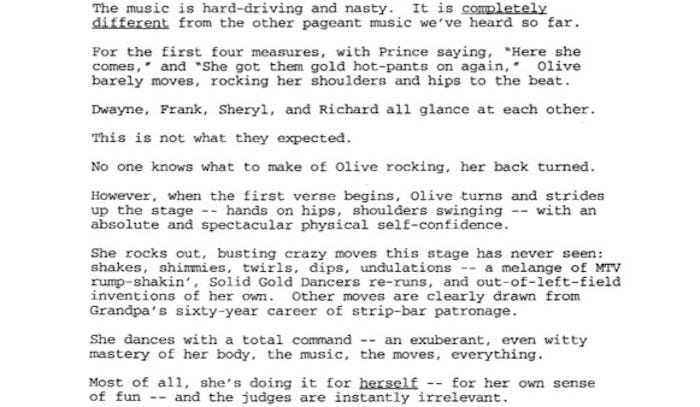
I love the scene description Arndt crafts. It doesn’t get bogged down in the specifics of the dance. Let the choreographers worry about that. The screenwriter’s job is convey mood, feel, action and entertainment. Arndt does that in spades here.
One of the single best things you can do to learn the craft of screenwriting is to read the script while watching the movie. After all a screenplay is a blueprint to make a movie and it’s that magic of what happens between printed page and final print that can inform how you approach writing scenes. That is the purpose of Script to Screen, a Go Into The Story series where we analyze a memorable movie scene and the script pages that inspired it.
For more Script To Screen articles, go here.