Script To Screen: “Get Shorty”
A scene from the 1995 movie Get Shorty, screenplay by Scott Frank, book by Elmore Leonard.
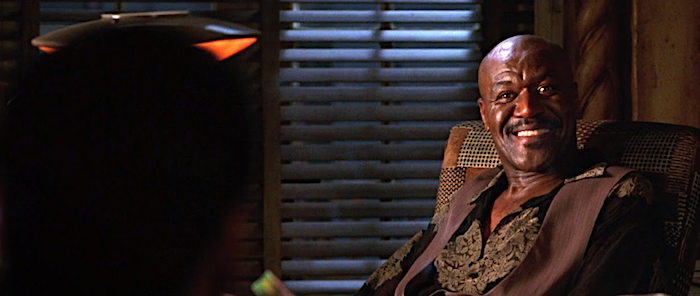
A scene from the 1995 movie Get Shorty, screenplay by Scott Frank, book by Elmore Leonard.
Plot Summary: A mobster travels to Hollywood to collect a debt and discovers that the movie business is much the same as his current job.
BO CATLETT: I’m just explaining to you what I’m doing here. Case you think I come to rob the place, rip off any of this dusty old shit the man has.
CHILI: I’d never make you as a burglar, not in that outfit.
Bo Catlett sits back in the chair a moment, watches Chili light a cigarette . . .
BO CATLETT: Harry called you his associate, but what does that mean? I never heard your name or read it in Variety or The Reporter or anyplace.
CHILI: It’s what he said, I’m his associate.
BO CATLETT: You must bring something heavy to the deal.
CHILI: That’s right, me.
Bo Catlett picks up a piece of paper off the desk . . .
BO CATLETT: Says here you’re getting Martin Weir for the part of Lovejoy.
CHILI: Yeah, we’re getting Martin.
BO CATLETT: No shit, come on. How you gonna do that?
CHILI: I put a gun right here… (touches the side of his head) …and I tell him, ‘Sign the paper Marty or your fuckin’ dead.’ Like that.
BO CATLETT: I wonder, would that work? (then) You know who I see for Al Roxy? Harvey Keitel. The man could do it in his sleep.
CHILI: Harvey Keitel. Yeah. Maybe. He was pretty good in the movie Fingers.
BO CATLETT: I missed that one. Or, hey, you know who else? Morgan Freeman. You know Morgan?
CHILI: Yeah, Morgan Freeman. But he’s a colored guy.
BO CATLETT: So what? Where’s it say in this script he’s white? Color is what the part needs, man, somebody to do it has some style. The way it is now, Ronnie could do it, play himself, some cracked out asshole. (then) So what do you think of the script?
Bo watches as Chili picks up a copy of the script, begins flipping through it.
CHILI: Title’s the first thing’s got to go. And the guy’s name. I mean, even this writer’s name, Murray Saffrin is better than Lovejoy.
BO CATLETT: I’m with you on that. And don’t you think it needs a good female part? Increase the romance angle.
Chili flips through the script, sees a name . . .
CHILI: There’s Ilona.
BO CATLETT: What about her?
CHILI: Get something going there.
BO CATLETT: With Ilona? You know how old Ilona is?
CHILI: She’s . . . young.
BO CATLETT: Young? She’s fuckin’ nine-years-old, same age as Lovejoy’s kid. Bernie. One she calls Bernard. Have you read the script?
CHILI: Yeah, I read it. I was just thinking you could make her older. We might even be able to get Karen Flores.
BO CATLETT: Who?
CHILI: She’s been out of movies a few years, but she’s good. Real good.
Bo Catlett studies Chili a moment, smiles . . .
BO CATLETT:You know what I’m thinkin’? (leans forward) You wanna make the girl older. I don’t like the ending. We could do that, you and me, sit down and write the script over where it needs it.
Chili flips through the script a moment . . .
CHILI: You know how to write one of these?
BO CATLETT: There’s nothin’ to know. You have an idea, you write down what you wanna say. Then you get somebody to add in the commas and shit where they belong, if you aren’t positive yourself. Maybe fix up the spelling where you have some tricky words . . . although I’ve seen scripts where I know words weren’t spelled right and there was hardly any commas in it at all. So I don’t think it’s too important. Anyway, you come to the last page you write in ‘Fade out’ and that’s the end, you’re done.
CHILI: That’s all there is to it, huh?
BO CATLETT: That’s all.
Chili sits forward, stabs out his cigarette, exhales into Bo Catlett’s face . . .
CHILI: Then what do I need you for?
Bo Catlett starts for the door.
BO CATLETT: I really think I can be of service on this one.
CHILI: Yeah, well, we need a ride somewhere, we’ll let you know.
Here is the scene from the movie:
Have to love that take on how easy screenwriting is. I suspect a lot of people think it’s like that.
One of the single best things you can do to learn the craft of screenwriting is to read the script while watching the movie. After all a screenplay is a blueprint to make a movie and it’s that magic of what happens between printed page and final print that can inform how you approach writing scenes. That is the purpose of Script to Screen, a weekly series on GITS where we analyze a memorable movie scene and the script pages that inspired it.
For more Script To Screen posts, go here.