Script To Screen: “Field of Dreams”
Ray meets his father… and they have a game of catch in the final scene from this 1989 movie, screenplay by Phil Alden Robinson, novel by…
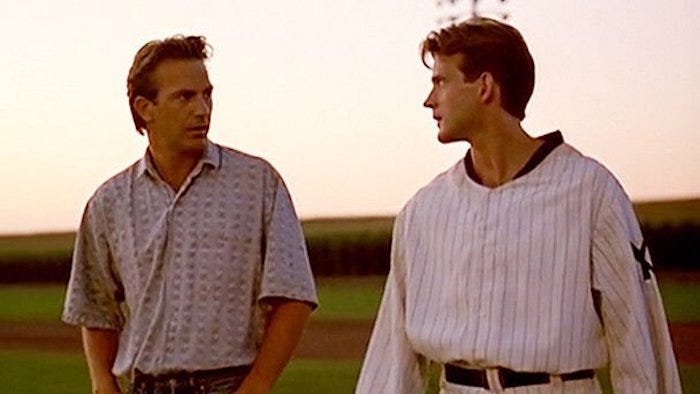
Ray meets his father… and they have a game of catch in the final scene from this 1989 movie, screenplay by Phil Alden Robinson, novel by W.P. Kinsella.
IMDb plot summary: An Iowa corn farmer, hearing voices, interprets them as a command to build a baseball diamond in his fields; he does, and the 1919 Chicago White Sox come.
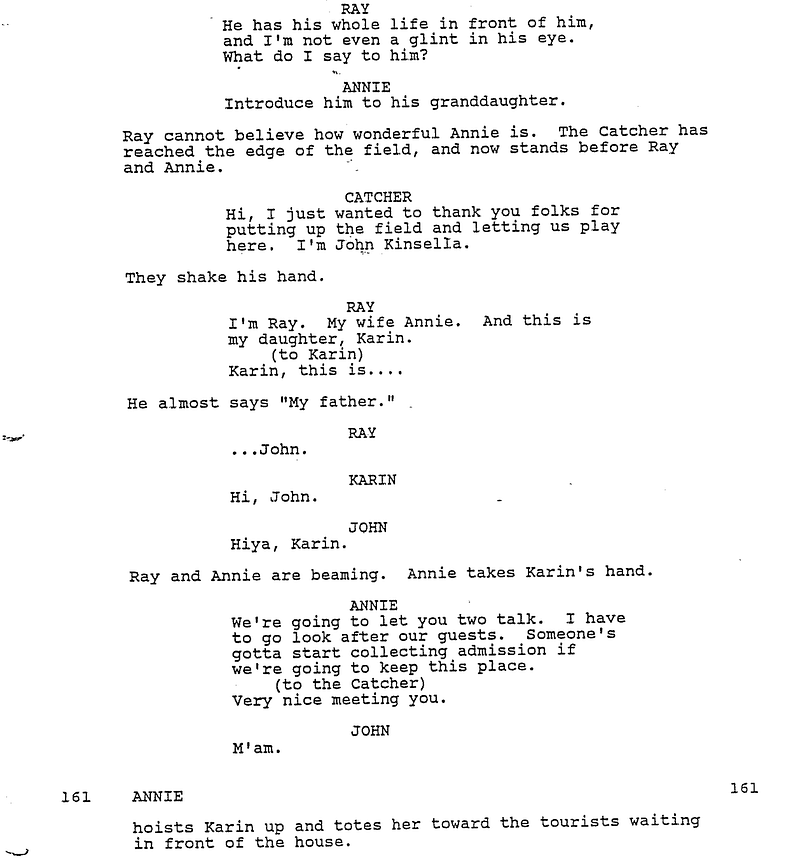
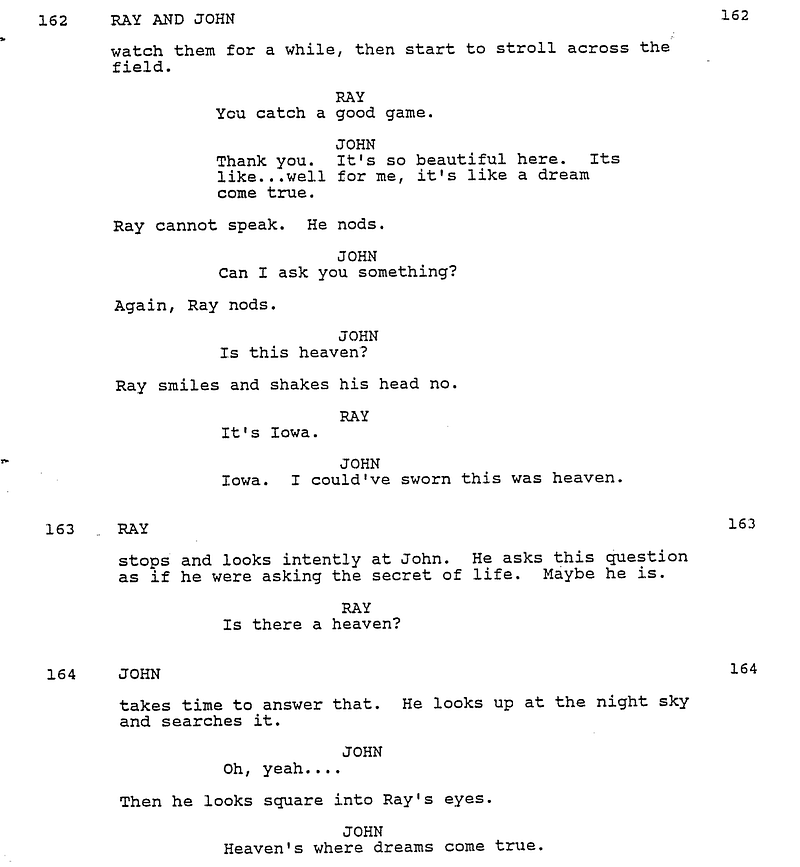
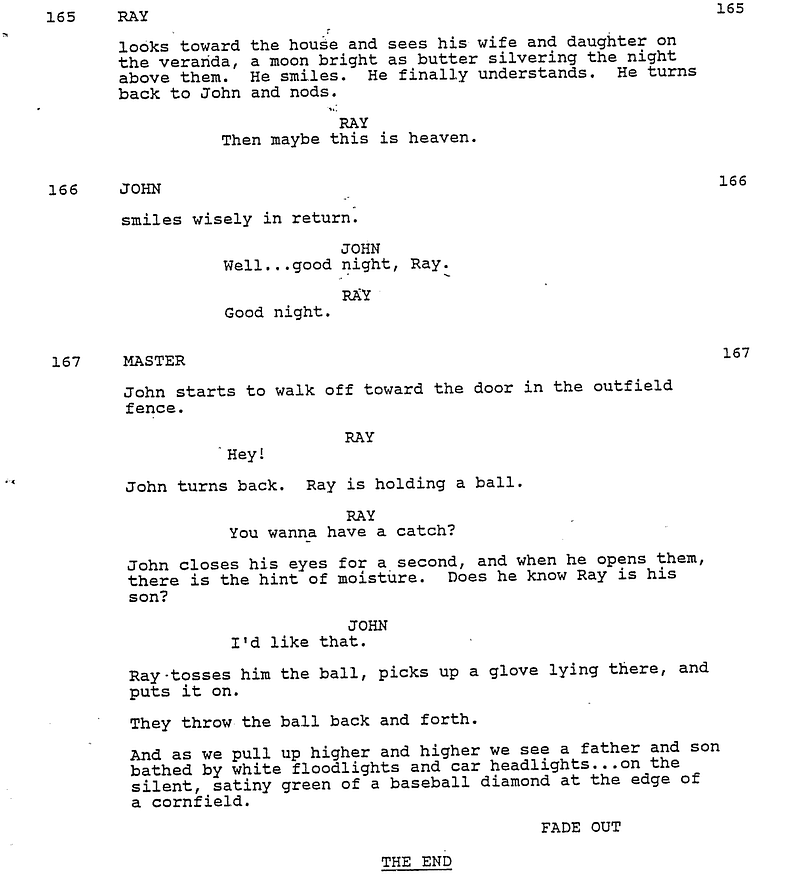
Here is the scripted version of the scene:

Here is the movie version of the scene:
The movie follows quite closely the script, however with two HUGE differences:
- In the movie, instead of saying, “Hey,” Ray says, “Hey, Dad.” Does John hear him? He doesn’t react as if he did. I’ll bet they shot it with Costner doing some takes with “Hey” and some with “Hey, Dad.” The latter tested better, that’s my take.
- In the script when Annie leaves to go to the house, there are already “tourists waiting.” In the movie, they save that reveal for the final shot: A helicopter shot of Ray and John having a catch with a stream of car headlights stretching out to the horizon. It’s in the script, but a case of addition through subtraction.
One more note: Here again is a so-called unfilmable: “John closes his eyes for a second, and when he opens them; there is the hint of moisture. Does he know Ray is his son?” That is a statement about John’s inner life, his thoughts. It is not action. It is not dialogue. It is what I call psychological writing. And we, as screenwriters, have the right to dip into our characters from time to time and do that, especially if the moment warrants it.
This moment absolutely demands it!
I saw Field of Dreams at the Writers Guild theater in Beverly Hills. At the end, I was surrounded by grown men breaking down in tears, actual sobbing. Evidently, baseball and father-son stuff is a big thing among screenwriters!
One of the single best things you can do to learn the craft of screenwriting is to read the script while watching the movie. After all a screenplay is a blueprint to make a movie and it’s that magic of what happens between printed page and final print that can inform how you approach writing scenes. That is the purpose of Script to Screen, a series at Go Into The Story where we analyze a memorable movie scene and the script pages that inspired it.
For more articles in the Script To Screen series, go here.