Script To Screen: “Dallas Buyers Club”
Ron ‘asks’ someone to shake Rayon’s hand in a scene from the 2013 movie written by Craig Borten and Melisa Wallack.

Ron ‘asks’ someone to shake Rayon’s hand in a scene from the 2013 movie written by Craig Borten and Melisa Wallack.
Setup: In 1985 Dallas, electrician and hustler Ron Woodroof works around the system to help AIDS patients get the medication they need after he is diagnosed with the disease. One patient is Rayon, a trans woman, who Ron befriends. They are out shopping together at a supermarket.
The scripted version of the scene:

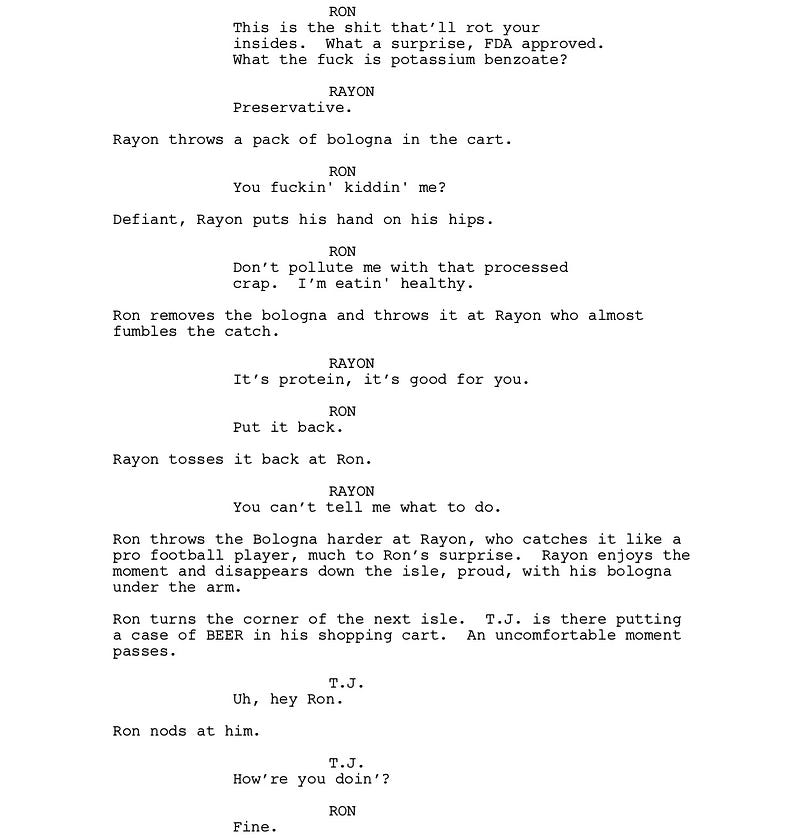
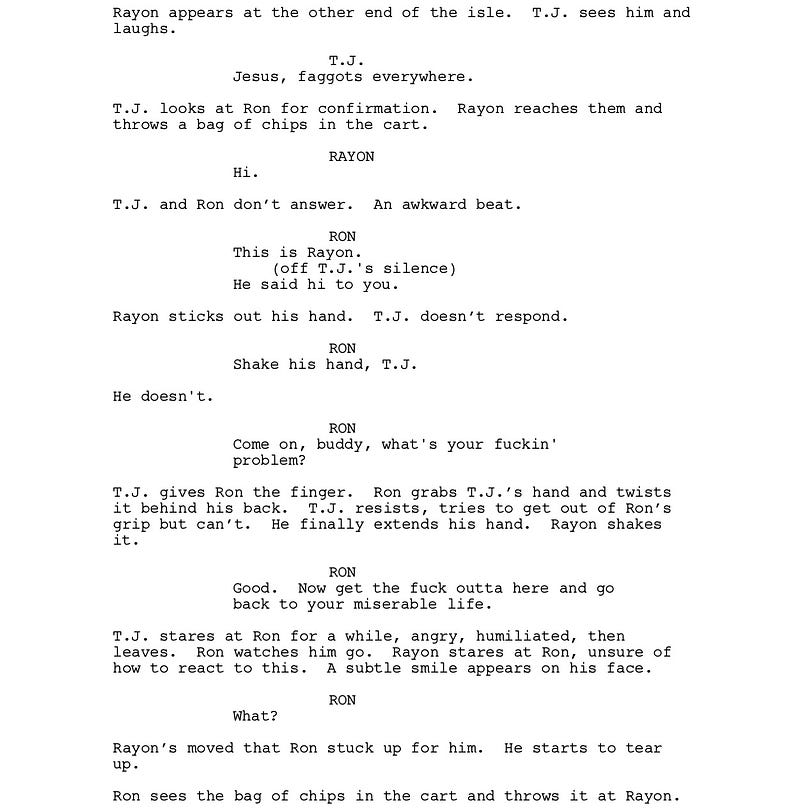
The movie version of the scene:
The movie is substantially the same as the script with this difference: When Ron has T.J. in a chokehold, he tells T.J., “ Shake his hand. Shake his hand, T.J., give him a good one.” Those lines were likely added to make clear to the audience what Ron’s goal is in the moment and not just punishing T.J. for not shaking Rayon’s hand.
I moderated a 2014 Austin Film Festival panel which included Craig Borten, screenwriter of Dallas Buyers Club and when it was time for the Q&A session, someone asked Craig why he chose to use “his / him” when referencing Rayon? Why not “hers / her” for a character — a fictional one in the movie — who identified as female? I suspect if the movie were made today, Craig may have done that.
This raises the issue of the singular they. It has been around since the 14th century, but in the 21st century has come to be used in reference to individuals who do not identify as male or female. This is something you must consider in your writing: what gender does a character identify with.
One of the single best things you can do to learn the craft of screenwriting is to read the script while watching the movie. After all a screenplay is a blueprint to make a movie and it’s that magic of what happens between printed page and final print that can inform how you approach writing scenes. That is the purpose of Script to Screen, where we analyze a memorable movie scene and the script pages that inspired it.
For more articles in the Script To Screen series, go here.