Script To Screen: “Blade Runner”
Batty and Deckard’s final struggle from the movie Blade Runner (1982), screenplay by Hampton Fancher and David Webb Peoples, based on a…

Batty and Deckard’s final struggle from the movie Blade Runner (1982), screenplay by Hampton Fancher and David Webb Peoples, based on a novel by Philip K. Dick.
Set-Up: All of his kin are dead and Batty goes after Deckard.
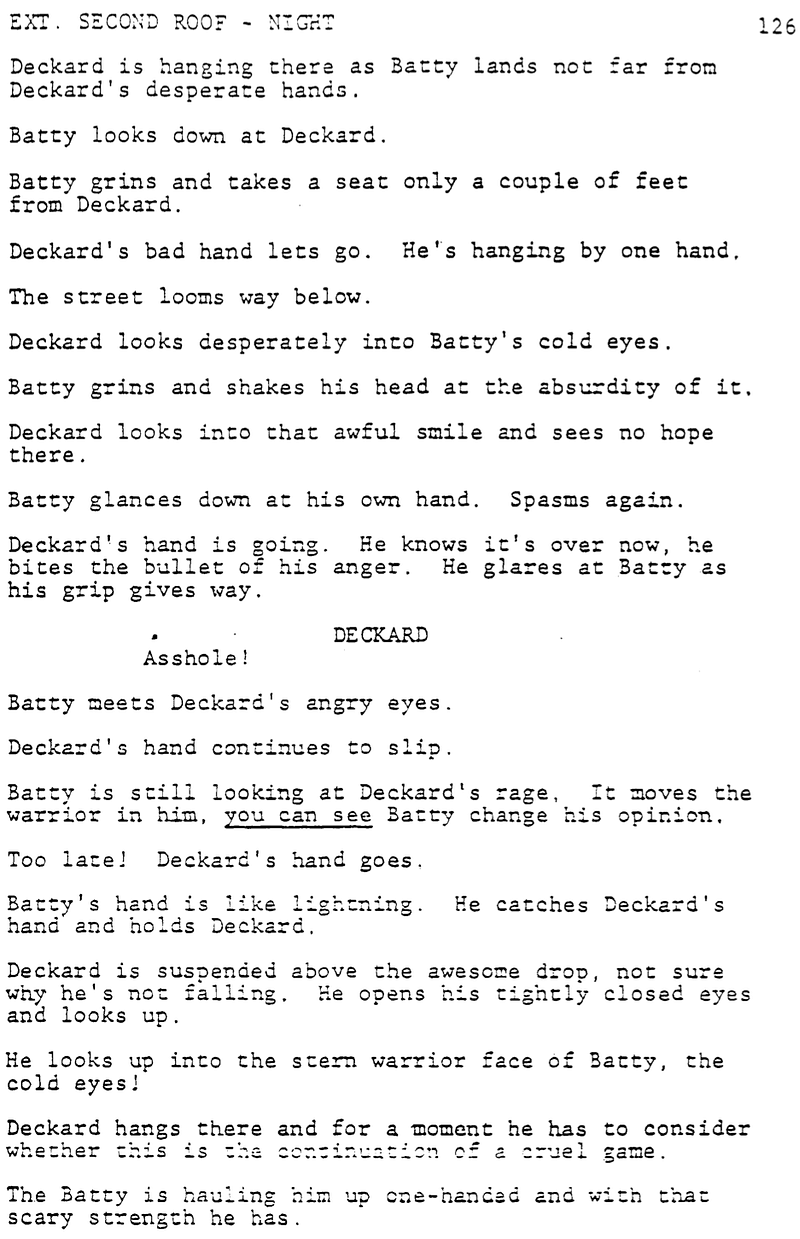
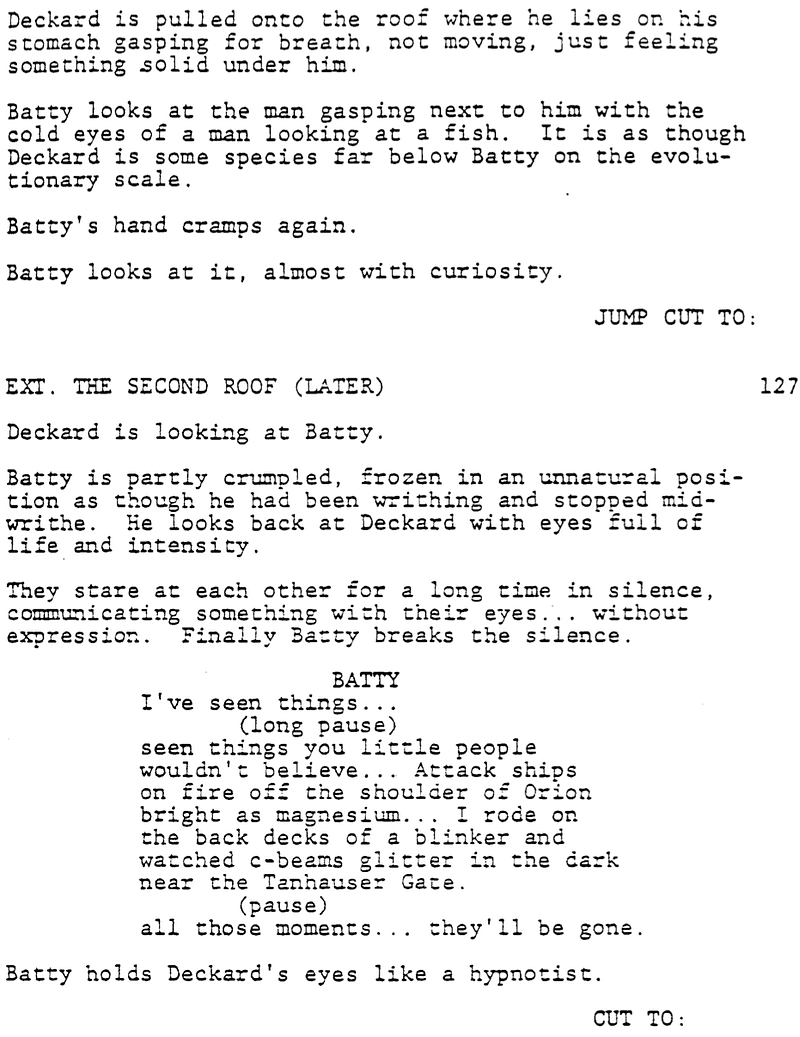
Here is the scene from the movie:
Check this out: An earlier version of the final struggle between Batty and Deckard:
INT. TENTH FLOOR APARTMENT #2 - NIGHT Provocation accomplished. Batty smiles and walks lei-
surely towards the door. Deckard's terrified scream
and the SOUND of GLASS CRASHING stop him. Batty speeds
up and moves into the room. The window pane is splattered, curtains sucked out,
bellowing in the wind. BATTY
Crap. He walks up to the window. Deckard comes away from the
wall, inching up behind him, laser in both hands, aimed
at the base of Batty's skull. Batty starts to lean
over, but even before his eyes see the pavement, he
knows. He spins... Deckard FIRES again. This one goes home. Batty falls
like he was poleaxed, hits the floor dead weight. Deckard starts to tremble. His arms go limp as his
head tilts back and he closes his eyes. He can breathe
again.
On the floor, Batty's hand is crawling toward Deckard's
ankle. With the unsuspected abruptness of a man slipping on a
banana peel, Deckard comes down. Face knotted in hor-
ror, he EMPTIES THE LASER in Batty's body -- but the
hand holds on. With a screech of frustration he drops
the laser and like an animal claws at Batty's dead
fingers -- but the fingers are welded shut. Deckard starts to crawl, pulling Batty behind him. He
struggled through the door and stumbles to his feet. INT. TENTH FLOOR HALL - NIGHT Deckard plunges down the corridor dragging Batty along.
He falls, gets to one foot, falls again and crawls the
last couple feet to the stairwell. INT. TENTH FLOOR STAIRWELL - NIGHT Groaning, he tugs and pulls, hauls and heaves Batty's
body to the edge of the landing. He pauses for breath,
then lays back, wedging his feet against Batty's shoul-
ders and pushes. Inch by inch the body goes over the
edge. Then all at once it drops. But the hand holds
and the weight of the body takes Deckard with it. As
Deckard slides over the edge, he grabs hold of the
railing. Deckard's hanging three hundred feet over the basement
floor, supporting himself and Batty's corpse -- almost
four hundred pounds of stress on his fingers.
With his free foot he chops away at Batty's hand, try-
ing to break it loose. But it's not working. Deckard's
fingers are starting to slip. His face is a mask of agony as he wedges his heel over
Batty's thumb. With the help of gravity and everything
he's got in his right leg to push with, he pushes. The
thumb breaks loose. Batty falls. The SOUND OF HIS BODY HITTING BELOW sounds good, but
Deckard doesn't notice. He's in an awkward position.
He must reverse the way he's facing to pull himself up.
He lets go with his right hand and crosses it over the
left. Then turns the left around so he's got an over-
hand grip. Like a man doing his last pull-up... the one that can't
be done, Deckard pulls himself up, throws a foot over
the edge and grapples and heaves and wiggled himself
onto the cold solid steel of the stairwell landing. And lies there, body jerking spasmodically, slowly
clenching and unclenching his cramped hand, but it's
his burning cheek against the cool metal he's most aware
of. Dizzy, hot, lungs on fire, he stands -- and putting one
foot in front of the other, Deckard descends the stairs.
A huge difference between the two endings.
I’ll see you in comments for a discussion of this scene from Blade Runner.
One of the single best things you can do to learn the craft of screenwriting is to read the script while watching the movie. After all a screenplay is a blueprint to make a movie and it’s that magic of what happens between printed page and final print that can inform how you approach writing scenes. That is the purpose of Script to Screen, a series on Go Into The Story where we analyze a memorable movie scene and the script pages that inspired it.
For more articles in the Script To Screen series, go here.