Script To Screen: “Barton Fink”
The opening scene from the 1991 movie Barton Fink, written by Joel Coen and Ethan Coen.
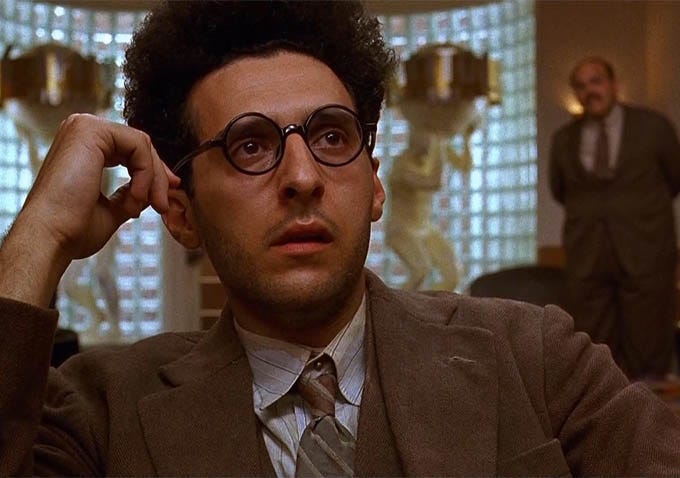
The opening scene from the 1991 movie Barton Fink, written by Joel Coen and Ethan Coen.
Plot Summary: A renowned New York playwright is enticed to California to write for the movies and discovers the hellish truth of Hollywood.
FADE IN: ON BARTON FINK He is a bespectacled man in his thirties, hale but somewhat
bookish. He stands, tuxedoed, in the wings of a theater,
looking out at the stage, listening intently to end of a
performance. In the shadows behind him an old stagehand leans against a
flat, expressionlessly smoking a cigarette, one hand on a
thick rope that hangs from the ceiling. The voices of the performing actors echo in from the
offscreen stage.
ACTOR
I'm blowin' out of here, blowin' for
good. I'm kissin' it all goodbye,
these four stinkin' walls, the six
flights up, the el that roars by at
three A.M. like a castiron wind.
Kiss 'em goodbye for me, Maury!
I'll miss 'em – like hell I will! ACTRESS
Dreaming again! ACTOR
Not this time, Lil! I'm awake now,
awake for the first time in years.
Uncle Dave said it: Daylight is a
dream if you've lived with your eyes
closed. Well my eyes are open now! I
see that choir, and I know they're
dressed in rags! But we're part of
that choir, both of us – yeah, and
you, Maury, and Uncle Dave too! MAURY
The sun's coming up, kid. They'll be
hawking the fish down on Fulton
Street. ACTOR
Let 'em hawk. Let 'em sing their
hearts out. MAURY
That's it, kid. Take that ruined
choir. Make it sing! ACTOR
So long, Maury. MAURY
So long. We hear a door open and close, then approaching footsteps. A
tall, dark actor in a used tweed suit and carrying a beat-up
valise passes in front of Barton: From offscreen stage: MAURY
We'll hear from that kid. And I don't
mean a postcard. The actor sets the valise down and then stands waiting int
he shadows behind Barton. An older man in work clothes – not wardrobe – passes in
front of Barton from the other direction, pauses at the edge
of the stage and cups his hands to his mouth. OLDER MAN
FISH! FRESH FISH! As the man walks back off the screen: LILY
Let's spit on our hands and get to
work. It's late, Maury. MAURY
Not any more Lil... Barton mouths the last line in sync with the offscreen
actor: MAURY
...It's early. With this the stagehand behind Barton furiously pulls the
rope hand-over-hand and we hear thunderous applause and
shouts of "Bravo!"
Here is the film version of the scene:
Some subtle changes. For example, the movie doesn’t start with Barton, but rather 36 seconds of backstage business before finally panning to a close up of the story’s Protagonist. What other changes can you note?
It’s an important scene as it establishes the pristine nature of a playwright and his high ideals, an important starting point to establish the contrast with Hollywood. Indeed note how everything in this scene is so dark. Now compare that with Barton’s introduction to the office of movie studio chief Jack Lipnick.
All bright and cheery… on the surface. A good reminder to think of visual contrasts when writing our scripts, a good way of reinforcing a change in mood and location.
Any fans of Barton Fink? I think it’s one of the Coen brothers’ best efforts. How about you?
One of the single best things you can do to learn the craft of screenwriting is to read the script while watching the movie. After all a screenplay is a blueprint to make a movie and it’s that magic of what happens between printed page and final print that can inform how you approach writing scenes. That is the purpose of Script to Screen, a series on GITS where we analyze a memorable movie scene and the script pages that inspired it.
For more articles in the Script To Screen series, go here.