Script To Screen: “American Beauty”
One of the most memorable scenes from the 1999 movie American Beauty, written by Alan Ball, a plastic bag dancing in the wind.
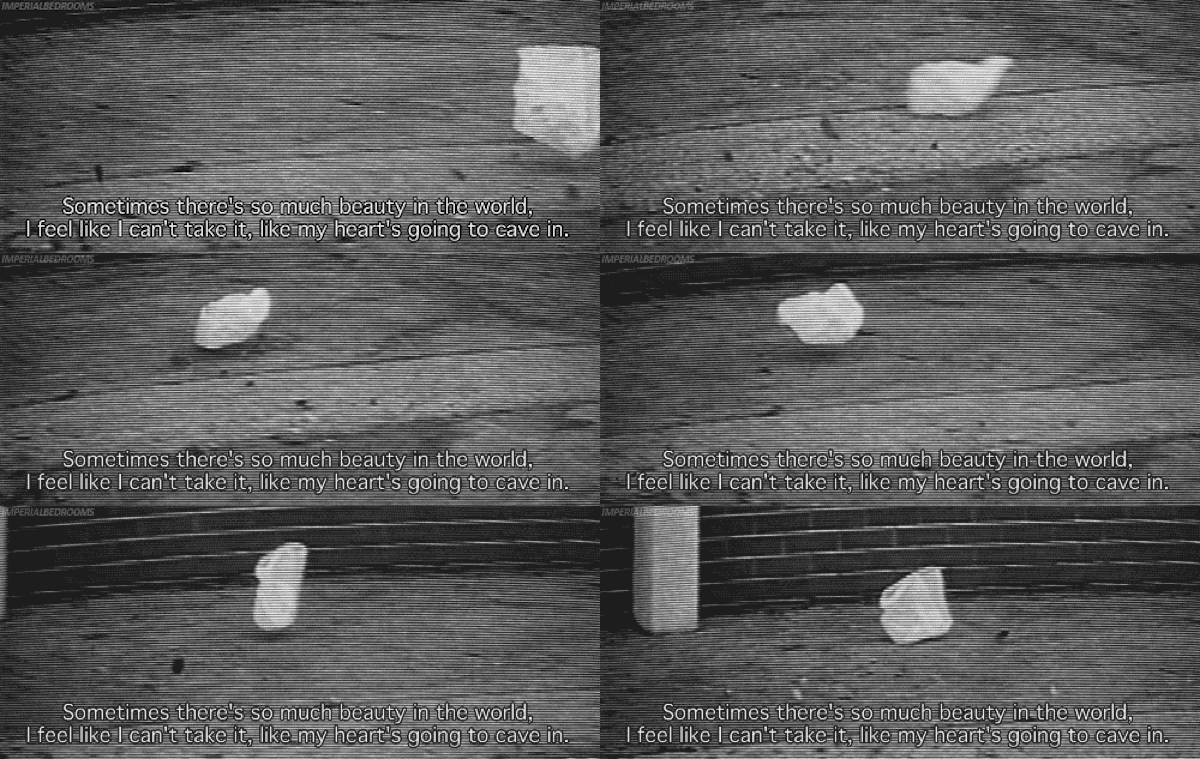
One of the most memorable scenes from the 1999 movie American Beauty, written by Alan Ball, a plastic bag dancing in the wind.
Logline: Lester Burnham, a depressed suburban father in a mid-life crisis, decides to turn his hectic life around after developing an infatuation for his daughter’s attractive friend.
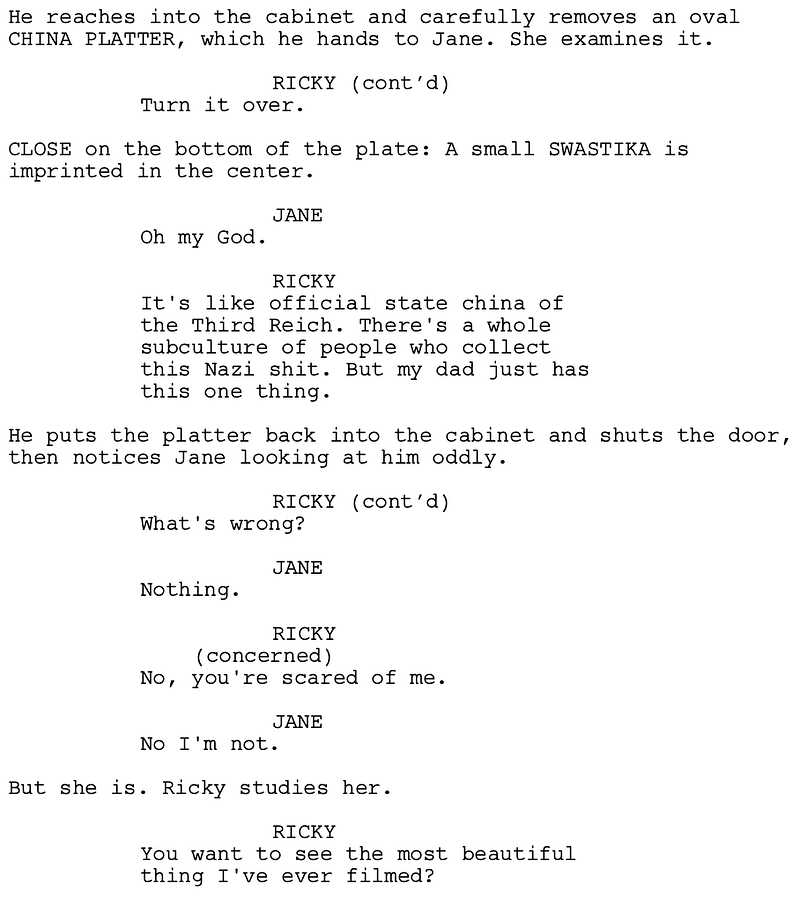
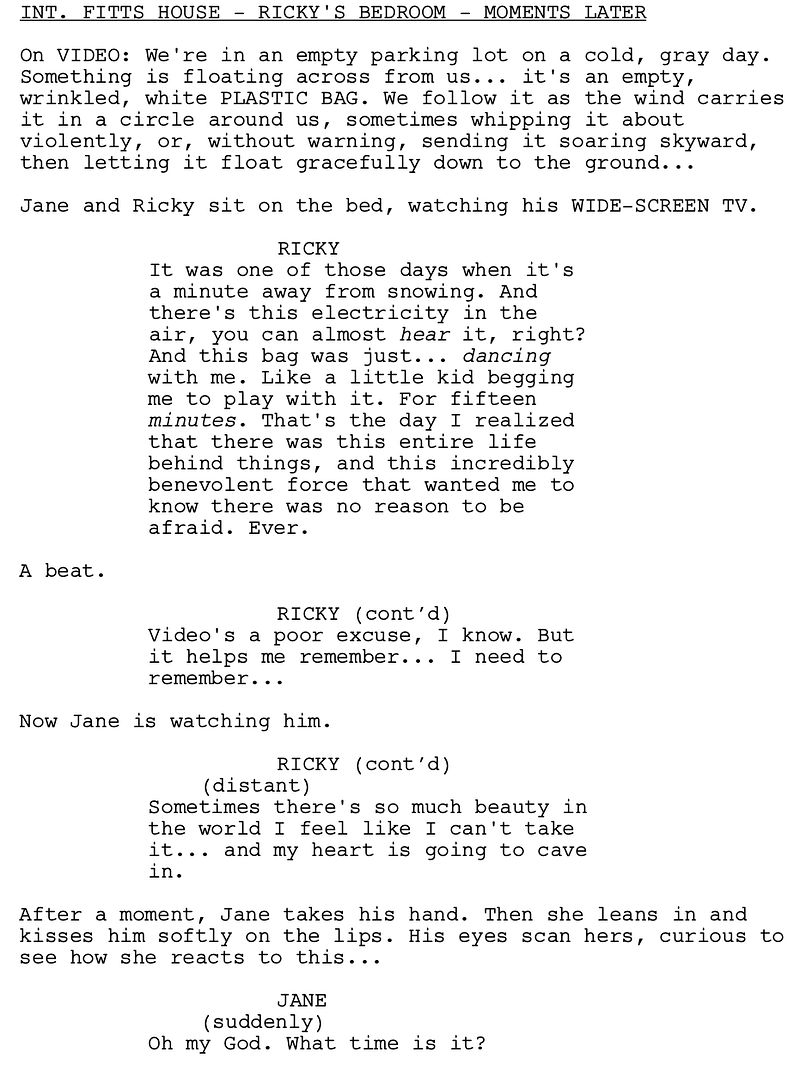
Here is the movie version of the scene:
In a 2000 Salon feature on Alan Ball, there is an interesting insight about this scene:
I went to a script-writing seminar a few weeks back that was attended by six of the year’s best screenwriters, three of them Oscar contenders — Charlie Kaufman, who wrote “Being John Malkovich,” Eric Roth, who co-wrote “The Insider” and Alan Ball, who wrote “American Beauty.” Much of the attention in the seminar, both from the audience and from the other members of the panel, focused on Ball, for obvious reasons. Not only is he the front-runner for the Oscar, and not only will “American Beauty” most likely win best picture, but there is a kind of newness to the tone of “American Beauty” that makes it almost seem like a landmark film, a kind of paradigm shift in the portrayal of the pain and despair of everyday life in ways that recognize both its comedic and tragic aspects and make it seem, ultimately, all worth it.
Ball was asked about the plastic bag scene, but not by one of the audience members. It was illuminating, actually, that the question came from another writer, David O. Russell, who wrote another of 1999’s most innovative films, “Three Kings.” Russell leaned forward into the mike, looked Ball right in the eye, and asked, as if he were asking a telepath how he had managed to bend a spoon, “How did you come up with the plastic bag scene?”
For those who have not seen the film, the scene is simple — a white plastic bag is caught in the wind in front of the kind of graffittied metal doors that come down at night in front of liquor stores in tough neighborhoods. The scene is shot in slow motion. The bag goes up and down and left and right and around and around. It could be a bird, or a butterfly, or a cloud. But it’s not. It’s a piece of litter on a dirty street. And as such it’s a metaphor that even in the toughest place, and perhaps most often in tough places, beauty happens.
Ball answered the question directly, with no emotion. He said that he wanted a scene of grace to balance out the heaviness of the other scenes, to provide a quiet moment. “I tried to think of the most beautiful thing I had ever seen,” he said. For him, it wasn’t some schmaltzy sunset in Hawaii. He remembered walking past the World Trade Center at a time in his life when he was working as the art director at a magazine, and writing plays at night for a theater company that was disintegrating. Most of the people in the theater company were hitting their mid-30s and moving on. He felt a little stuck. A plastic bag was caught on the wind and it seemed to float around him, as if it were a specter, as if it were alive and talking to him. There was something so profound in the simple beauty of the moment, he said, that it brought him to tears.
I called Ball after the script seminar to talk to him in more detail about the plastic bag moment. “It was in the early ’90s, towards the end of winter, the beginning of spring,” he said. “It was kind of cold and overcast but it wasn’t raining. It was a Sunday. So the whole financial district was deserted. But it was kind of one of those days that after months of it being freezing, it was warm enough to walk. And so I just decided to walk from midtown down to the World Trade Center to catch the train back to Brooklyn. I was in front of the World Trade Center, and I noticed this plastic bag in the wind, this white plastic bag. And it circled me, and it literally circled me, like, 10 or 15 times. And after about the third or fourth time I felt very, um, I started to feel weird. And then, I don’t know, there was something striking about the experience, and I really did feel like I was in the presence of something.”
Stories are ALL around us, even a plastic bag doing a circular dance in the wind. Takeaway: As writers, we need to open our eyes and ears to take in the world around us.
One of the single best things you can do to learn the craft of screenwriting is to read the script while watching the movie. After all a screenplay is a blueprint to make a movie and it’s that magic of what happens between printed page and final print that can inform how you approach writing scenes. That is the purpose of Script to Screen, an ongoing series on Go Into The Story where we analyze a memorable movie scene and the script pages that inspired it.
For more articles in the Script To Screen series, go here.