Script To Screen: “A Quiet Place”
The horrifying opening incident is a master class in demonstrating how to use individual paragraphs of scene description to individual…
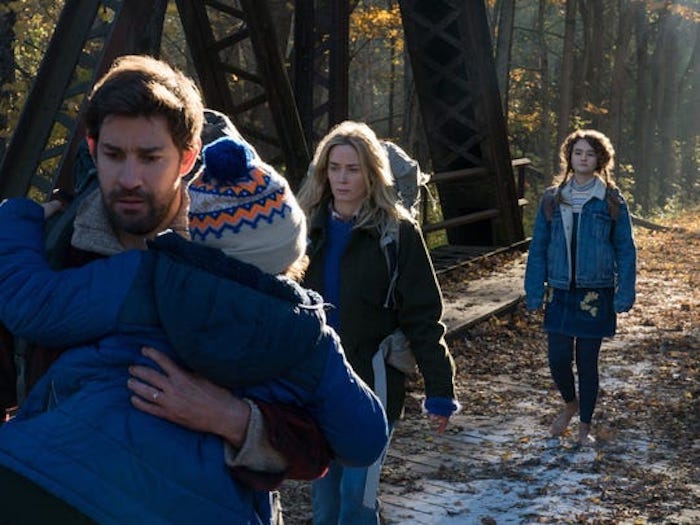
The horrifying opening incident is a master class in demonstrating how to use individual paragraphs of scene description to individual suggest camera shots.
From the 2018 hit movie A Quiet Place, screenplay by Bryan Woods & Scott Beck and John Krasinski, story by Bryan Woods & Scott Beck
Plot summary: In a post-apocalyptic world, a family is forced to live in silence while hiding from monsters with ultra-sensitive hearing.
Here is the scripted version of the movie’s opening incident:
EXT. BRIDGE - LATE AFTERNOON From the ground we look up at an old and rusted bridge
towering over us eerily... the sand path continues across it. WE TRACK WITH THE FAMILY as they walk across the bridge...
There are minor creaks underneath the sand. Suddenly we see... the four year old stops just before the
entrance of bridge. The family continues... not seeing him. WE FOLLOW THE BOY'S HANDS as he fishes around in his hood and
pulls out... THE TOY SHUTTLE. HEAD ON, we walk with the father, each member of his proud
brood can be seen walking behind him. We can hear his
strained breath... and the tiniest swish of the footsteps in
sand. HEAD ON, walking with the daughter... we now suddenly hear
nothing. As she looks to be in her own world... So we are in
hers. A smile breaks on her face as she walks and breathes in
total silence. We walk with her for a long moment, when
suddenly behind her... A FLICKERING RED AND BLUE LIGHT. The girl does not turn. She just keeps walking. Still
smiling. As she looks up to her mother, we go into: SLOW MOTION - FROM THE GIRLS'S POV, we see her mother and father spin
around with a frantic shock on their faces. - BACK ON THE GIRL. She looks confused at her parents
behavior... LIGHTS AGAIN FLASH EERILY BEHIND HER. - ON THE FATHER rushing to put the boy on the ground and
turning to run. - ON THE MOTHER, spinning around with terror in her eyes...
she looks to be holding in a SCREAM. - BACK ON THE GIRL slowly beginning to turn around at what
her parents could be looking at as we:
SPEED BACK UP TO NORMAL A loud playful beeping rushes in... from the blinking
shuttle. Then, from the woods we hear... THE MOST UNMISTAKEABLE
HORRIFYING.... SCREEEEEEEECH!!! - ON THE MOTHER as she slowly lowers the backpack to the
ground... and her legs begin to fail her. - ON THE FATHER running, violently shaking his head... It
looks like he's HOLDING IN A SCREAM. - THE TREES BEHIND THEM... RUSTLE AND SNAP as something
barrels through. - ON THE BOY... holding up his space ship proudly to his
incoming father... an enormous smile on his face. - ON THE FATHER... 20 feet away... his face is a still frame
of pure fear as he runs to camera. Then: THE MOST IMMEDIATE AND TERRIFYING COMBINATION OF SOUND ONE
COULD EVER IMAGINE. ... A SHRIEK?... A SCREAM? ... A CRUNCH? Then... ON THE FATHER as... a thin line of blood splatters on his
face. - Mid run, the father's body immediately goes limp... failing
him as he comes to a halt just in front of camera. - Then, as quickly as it came... THE SOUND IS GONE. - IN WIDE PROFILE, The father stands lifeless... The two
children stand frozen with fear... the MOTHER drops to her
knees and... a space shuttle blinks silently in the sand. The four year old... IS GONE.
Once again... only the wind can be heard.
BLACK. SILENCE.
FADE IN: TITLE
A QUIET PLACE
Here is the scene from the movie:
Notice how each paragraph of scene description ‘moves’ the action?
- ON THE MOTHER - ON THE FATHER- THE TREES BEHIND THEM - ON THE BOY - ON THE FATHER
This technique of using individual paragraphs of scene description to suggest camera shots is a common practice in contemporary screenplays. Directors don’t want to be told how to shoot their movie? Fine. In describing the action with separate paragraphs, the screenwriter infers camera shots without using directing lingo or camera jargon.
Side benefit of this approach: It causes us to keep paragraphs down to 2–3 lines making the script a much easier read than having big blocks of scene description.
One of the single best things you can do to learn the craft of screenwriting is to read the script while watching the movie. After all a screenplay is a blueprint to make a movie and it’s that magic of what happens between printed page and final print that can inform how you approach writing scenes. That is the purpose of Script to Screen, a series on Go Into The Story where we analyze a memorable movie scene and the script pages that inspired it.
For more Script To Screen articles, go here.