Script To Screen: “12 Years a Slave”
From the 2013 movie 12 Years a Slave, screenplay by John Ridley, based on a memoir by Solomon Northup.
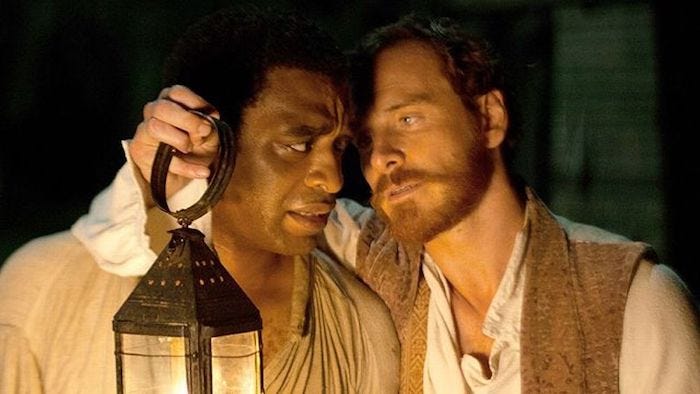
From the 2013 movie 12 Years a Slave, screenplay by John Ridley, based on a memoir by Solomon Northup.
Plot summary: In the antebellum United States, Solomon Northup, a free black man from upstate New York, is abducted and sold into slavery.
Setup: Some time later, slave owner Epps (Michael Fassbender) dispatches Solomon (Chiwetel Ejiofor) to a nearby plantation owned by Shaw. Shaw has married one of his slaves and elevated her status (at least on his plantation). Patsey (Lupita Nyong’o) is there for a visit, enjoying the finery, but apparently Epps is jealous that Shaw might attempt to bed her. After a brief refreshment, Solomon convinces Patsey to join him. As they return to Epps’ plantation, he is clearly drunk.
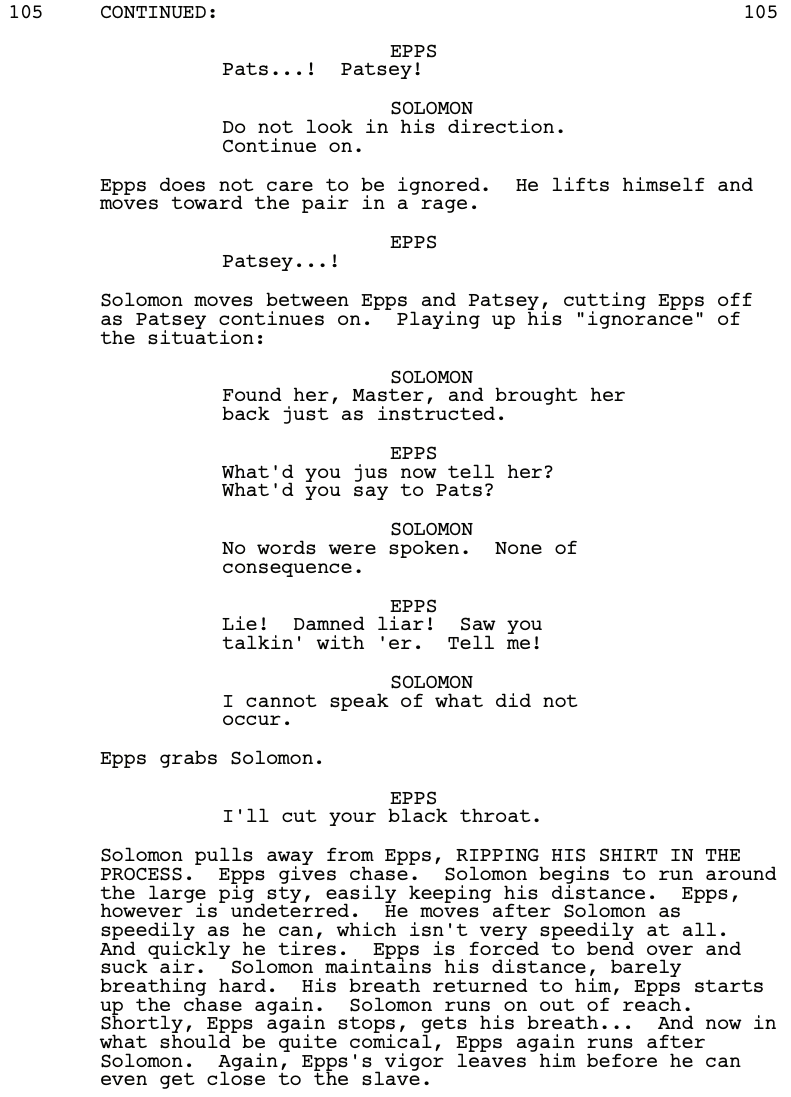
Here is the scene excerpt from the script:

Here is the scene from the movie:
A few things:
- During the “chase,” there is some additional dialogue: Solomon insisting, “I brought her back just as instructed” and Epps saying, “Stay away from Patsey, boy.”
- The scene continues on with Epps confessing his depraved drunken state (“liquor filled me… I’m all done in”) and screenwriter Ridley notes this in scene description: “ALL OF THE PRECEDING SHOULD BE MORE FUNNY THAN SHOCKING. A CHANGE OF PACE FROM THE OTHERWISE NECESSARY BLEAKNESS OF SLAVE LIFE.”
But the main thing I’d like to note is the Narrative Voice at work here. There is a kind of formality to the language used in the scene description. For example:
- “Epps does not care to be ignored”
- “Playing up his ‘ignorance’ of the situation”
- “Epps gives chase”
- “And quickly he tires”
- “Solomon maintains his distance”
I would take this to be the writer’s attempt to reflect the sensibilities of the time, perhaps even echo the way Northup wrote in his memoir. In any event, this serves as a reminder that we need to be conscious of and take an active role in figuring out how the style of our scene description matches up with the genre and tone of the story we’re writing. No two Narrative Voices will be the same. They vary from story to story.
Finally, there is the supposed screenwriting ‘rule’: Action Paragraphs — 3 Lines Max.
The script for 12 Years a Slave is filled with long blocks of scene description like the one featured here which is 13 lines long.
Is it wise to write a spec script with 13 line long paragraphs of scene description? Probably not. But 12 Years a Slave did win an Oscar for Best Adapted Screenplay.
So once again, “rule” broken.
One of the single best things you can do to learn the craft of screenwriting is to read the script while watching the movie. After all a screenplay is a blueprint to make a movie and it’s that magic of what happens between printed page and final print that can inform how you approach writing scenes. That is the purpose of Script to Screen, a Go Into The Story series where we analyze a memorable movie scene and the script pages that inspired it.
For other Script to Screen articles, go here.