Script Analysis: “Vice” — Scene By Scene Breakdown
Reading scripts. Absolutely critical to learn the craft of screenwriting. The focus of this weekly series is a deep structural and…
Reading scripts. Absolutely critical to learn the craft of screenwriting. The focus of this weekly series is a deep structural and thematic analysis of each script we read.
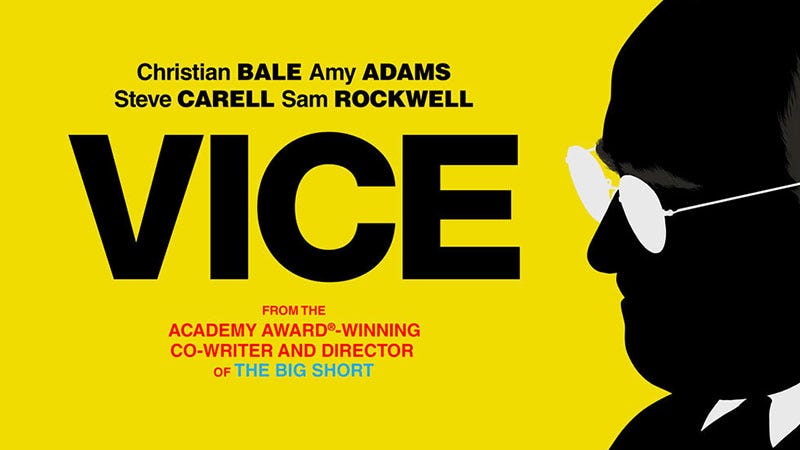
Today: A scene-by-scene breakdown of the script for the 2018 movie Vice, written by Adam McKay.
IMDb plot summary: The story of Dick Cheney, an unassuming bureaucratic Washington insider, who quietly wielded immense power as Vice President to George W. Bush, reshaping the country and the globe in ways that we still feel today.
Here is my take on this exercise from a previous series of posts — How To Read A Screenplay:
After a first pass, it’s time to crack open the script for a deeper analysis and you can do that by creating a scene-by-scene breakdown. It is precisely what it sounds like: A list of all the scenes in the script accompanied by a brief description of the events that transpire.
For purposes of this exercise, I have a slightly different take on scene. Here I am looking not just for individual scenes per se, but a scene or set of scenes that comprise one event or a continuous piece of action. Admittedly this is subjective and there is no right or wrong, the point is simply to break down the script into a series of parts which you then can use dig into the script’s structure and themes.
The value of this exercise:
- We pare down the story to its most constituent parts: Scenes.
- By doing this, we consciously explore the structure of the narrative.
- A scene-by-scene breakdown creates a foundation for even deeper analysis of the story.
You may download the script for Vice here.
Vice
Scene by Scene Breakdown
By David Joyner
GoIntoTheStory.com
Note: Adam McKay uses these abbreviations frequently:
VT = video tape (eg, archival footage)
SOT = sound on tape (often used instead of O.C., off camera)
p1. 1963 — Young Cheney drinking in a bar, driving home drunk, and getting pulled over by police
p2. 9/11/2002 — Older Cheney with Condoleezza Rice and others watching the twin towers attack on CNN. Secret Service swarm in rushing Cheney to a secure underground bunker.
pp2–3. Once safe, Cheney takes over, issuing orders to (SecDef) Rumsfeld to “shoot down any aircraft deemed a threat”. When Rumsfeld asks if he has presidential authority, Cheney says yes. But does he really?
p4. We meet the “Narrator”, who gives us historical, legal, and political background. (We learn his relationship to Cheney on page 97.) Here, Narrator introduces Cheney as a mysterious man who became the most powerful VP in US history.
pp5–6. The Narrator continues to speak over a montage of young Dick Cheney and (then fiance) young Lynne Cheney: fishing, getting drunk at Yale (which he’s expelled from), working as a line-man for a telephone company in Wyoming, around 1963
pp6–8. Young Dick Cheney, after work, gets drunk, gets into a fight, drives home drunk, and gets pulled over again by the police. The next day, young Lynne Cheney is irate and forces him to change his behavior.
p9. Montage of young Cheney graduating from college, getting married to Lynne, driving to DC.
pp10–11. In DC, a theater full of congressional fellows listen to congressmen, including young Donald Rumsfeld. Rumsfeld is introduced as a man who weilds power like a butterfly knife expert.
p12. Cheney becomes trusted Rumsfeld’s assistant.
p13. Montage of Cheney working for Rumsfeld:
flipping cue cards,
interfacing with consultants,
at dinner with Lynne, Rumsfeld and wife.
p14. Narrator: Cheney found his calling as a servant to power.
p15, Cheney gets a closet-sized office in the White House. He calls Lynne to share the joy, she’s proud of him. It’s a big deal to them.
We meet the Narrator in person, Kurt. He’s a married young man with a small boy. He’s still mysterious as to his connection with Cheney, but promises more later.
pp16–18. Rumsfeld and Cheney, walking in the White House, stop in front of Kissinger’s door. Nixon is inside. Why? So they can have a conversation that isn’t recorded on the planned bombing of Cambodia. Cut to: a peaceful Cambodian village is bombed.
p19. 1973 Cheney takes a job as a political consultant (a rise in power). Rumsfeld’s sent to NATO as an ambassador by Nixon (a demotion of sorts).
pp20–21. Lynne’s mother dies of drowning under mysterious circumstances. At the funeral, Cheney tells Lynne’s alchoholic father to never contact wife or kids again.
pp22–23. 2003 (as VP). Cheney directs CIA operations kidnapping suspected terrorists.
pp24–25. 1974. Nixon resigns. Rumsfeld, untarnished by Watergate, comes back to DC as Ford’s chief of staff.
pp26–27. Halloween massacre, where Rumsfeld replaced Slessinger as SecDef and Cheney moves into Chief of Staff.
pp28–29. Cheney is happy to learn from Scalia (at the time a DoJ lawyer) that there is a legal “unitary executive” theory where the US President has absolute executive authority. Later Scalia would make it to the Supreme Court.
p30. 1976. Jimmy Carter is elected. A disaster for the GOP.
p31. Cheney, back in Wyoming, gives a political pitch at a local VFW while he’s running for Congress.
pp32–33. As he steps off the stage, Cheney has a heart attack. The doctor tells him to take a 2 week rest. Lynne successfully campaigns for him.
p34. Cheney is back in DC as a congressman from Wyoming. He works to deregulate industry.
p35. 1980. Reagan gives a speech at the RNC convention. Cheney’s influence increases.
p36. 1984. Cheney has another heart attack.
pp36–37. 1986. The Cheney’s at a large Christmas party hosted by the Reagans. Bush Sr asks the Cheney’s for their support of son Jeb when he runs for office. The Narrator also discusses Cheney’s role in repealing the “fairness doctrine”, leading to the rise of opinion news (eg, Roger Ailes’ Fox News).
p38. At the same party, George W Bush (the son) is drunk and breaks some champagne glasses. Cheney knows he will compete with George W in the next RNC nomination for the president.
p39. They learn that their daughter Mary is gay. Cheney comforts Mary.
p40. 1992. Cheney is interested in running for president. Since his poll numbers are low and they worry about Mary being attacked for being gay, Cheney returns to private industry.
p41. Breaking the 4th wall, credits roll and TEXT ON SCREEN explains to us the happy public service life of Cheney is over as he goes into private industry, Lynne writes books, … A phone rings VERY LOUD.
p42. Cheney gets a call from George W to be his VP. Lynne advises against it, as it is a “nothing job.”
pp43–46. George W and Cheney have a meeting. George W wants Cheney as his VP. Cheney says no but agrees to run his search for a suitable VP.
pp47–49. Cheney discusses the VP idea with Lynne, who eventually accepts the idea of him considering the VP position.
pp50–51. Cheney meets with David Addington, a lawyer who (like young Scalia) also holds belief in the unitary executive theory, but for the VP.
pp51–53. George W and Cheney meet again. This time Cheney accepts the VP. While all the other VP candidates filled out background forms (medical records, tax returns, corporate filings, etc), Cheney did not.
pp54–55. 2000. Gore asks for a recount in Florida. Cheney proceeds as though George W won and took over the transition team.
p56. Cheney has another heart attack. Scalia stops Florida from completing the recount. George W beats Gore by a margin of 536 votes.
p57. Flahback to the day young Cheney first got an office in the WH.
pp58–60. Cheney chooses for his circle an A team of advisors and for George W the B team (illustrated in the script by chess-like game pieces). Cheney asks all emails to and from George W, as well as TS briefings, pass through his office. Cheney insures that there are planty of Bush/Cheney loyalists posted strategically in DC positions.
pp61–62. To increase his influence in the House of Reps, Cheney got an office there using his friendship with Dennis Hastert. Cheney also got two offices in the Senate, thanks to Trent Lott, and one at the Petagon, thanks to Donald Rumsfeld.
pp63–64. The Americans for Tax Reform lobbying group worked with Cheney on reregulating taxes on the rich. The estate tax, on estates worth over $2,000,000, was renamed the “death tax” to make it easier to repeal. Cheney and the right-winged media
machine helped squash regulations on climate control, regulations for large corporations, and taxes on the super rich.
p65. To get around oversight rules on policians and lobbyists, Cheney schemed to plan inexperienced subordinates at the DoE to sit in on his meetings with energy CEOs, allowing them undue influence on writing laws that control the energy industry.
p66. The details of his meetings with energy CEOs were not made available. A FOI request resulted in a map of Iraq’s oil fields and a list of oil companies interested in acquiring them, if they became available.
p67. 2001. 9/11. We rerun the opening scene: Cheney with Condoleezza Rice and others watching the twin towers attack on CNN. Secret Service swarm in rushing Cheney to a secure underground bunker. Once safe, Cheney takes over, issuing orders to Rumsfeld to “shoot down any aircraft deemed a threat”. When Rumsfeld asks if he has presidential
authority, Cheney says yes.
pp68–69. Cheney has asks his lawyer David Addington if the rules of engagement are fluid. Addington says yes. They have a longer (unrecorded) conversation. The Narrator asks what Cheney was discussing with his lawyer at this fateful day in US hstory.
pp70–71. George Tenet mentions the Al Qaeda “chatter” they’ve picked up. Rumsfeld tries to push Iraq as the culprit. Richard Clarke agrees with Tenet, Al Qaeda is to blame. Rumsfeld argues. Colin Powell agrees with Tenet and Clarke and says they should look at Afganistan. Bush and Cheney go with Tenet “for now.”
pp72–73. Cheney insists on unfiltered (unverified) intel. He hears about sarin gas attacks and beheadings.
p74. Cheney meets John Yoo who agrees with David Addington regarding the unitary executive theory of powers held by the POTUS.
pp75–76. Yoo’s first legal opinion allowed the US govt to monitor every citizen’s phone without warrant. The torture memo allowed the US to torture POWs, in violation of the Geneva Convention. When this issue is raised, Cheney and Rumsfeld re-defined torture
as “enhanced interrogation.” Cheney says: “… if the US does it then by definition, it can’t be torture.” A montage of:
a naked man being water-boarded,
a cleric screaming as he is shocked on his genitals,
a man, with his wife and children, being threatened by a CIA agent who yells at the man: “We will rape and kill your wife and children…”
p77. A fantasy scene of a waiter at an expensive restaurant reading off choce menu items, such as
extreme renditio, where the suspect is arrested without record,
Guantanamo Bay prison (“Delicious” says Rumsfeld),
War Powers Act allowing the executive branch powers to attack a country deemed a threat.
pp78–79. 2002. A marketing person runs a focus group to study the best ways to market a war against Iraq, overseen by the DoD. Cheney forms the “Office of Special Plans” to make it clear to the public that Saddam Hussein is a serious threat.
pp80–81. In spite of political rhetoric by Cheney and his team, the American public are not convinced Saddam Hussien is connected to Al Qaeda.
pp82–83. Oval Office meeting with George W, Cheney, Tenet, Rumsfeld, Colin Powell, and Karl Rove. Powell says there is no evidence Iraq has anything to do with the 9/11 attack. George W wants to attack Iraq only if the American public supports it. Rove says Powell has the highest trustworthy ratings, so he could give a report to the UN providing the American public with evidence Iraq is a threat. Powell says he is unaware of such intelligence. George W says to give the UN talk anyway.
pp84–86. Powell was give the speech to read. His CoS Col. Wilkerson read the speech and informs Powell it contained at least 5 pieces of disproved intel. In spite of objections, Powell reads the speech at the UN. It tries to draw a line from Al Qaeda to Iraq using Zarqawi as the common bond. (Since Zarqawi swore to kill all Shia Muslims, but Osama bin Laden’s mom is Shia, so many doubted these two terrorists have a working relationship.) Later, Colin Powell would call that speech the most shameful moment in his life.
pp87–88. 2003. While Cheney’s family has an enjoyable dinner, laughing and drinking, George W starts a war in Iraq.
p89. George W in a flight suit on an aircraft carrier announces that the US and allies have prevailed in Iraq.
p90. A general meets with Cheney, Rumsfeld, Wolfowitz. The general is concerned about the large no-bin contracts being awarded to Halliburton (in violation of rules). Rumsfeld simply says “we’re not concerned”. Cheney adds, “not at all.” Wolfowitz moves the discussion to other topics.
2006. Cheney accidentally shoots Whittington in the face with his shotgun. It is not Cheney but Whittington who apologizes.
p91. 2003. Cheney is upset about Joe Wilson’s critique of Cheney’s Iraq “intel”. He tells Scooter Libby to leak the name of Wilson’s wife (Valarie Plame, CIA undercover agent).
pp92–93. Rumsfeld intercepts a CIA report that states that Zarqawi credibilty (among terrorists) was increased by Powell’s UN speech (written by Cheney’s team). The Narrator tells us that this increase in Zarqawi’s influence coincided with the founding of a terrorist group that eventually became ISIS.
p94. Valerie Plame sues Cheney for leaking her identity. Senator Leahy investigates the no-bid contracts DoD contracts to Halliburton. Some nations accuse Cheney and Bush of war crimes.
pp95–96. On behalf of George W, Cheney asks Rumsfeld to resign. 2009. Barach Obama is elected.
pp97–98. A few years later. Cheney has more heart problems. This time, without a donor, he’s expected to die. While jogging down a suburban neighborhood street, the Narrator tells us that Cheney told his family he was ready to die and has zero regrets for the chouces he made. Then the Narrator is hit by a car and dies. Quick cut to surgery room in local hospital where Narrator’s heart is removed and transported in a cooler by helicopter to Cheney’s hospital. Thus, we learn the connection between Cheney and our omnipresent Narrator.
pp99–100. Daughter Liz Cheney runs for Senate in Wyoming. She comes out against gay rights. Other daughter Mary calls up Cheney and wife Lynne in tears. Mary says Liz would not take such a stance without their approval. Lynne basically won’t discuss it.
p101. Quick cuts between Mary’s home, a lake in Wyoming with an old tree having a heart surrounding Dick+Lynne carved into it, Alex Jones from infowars, in 2016 Liz is elected to the Senate, Liz being asked if she and Mary have mended their relationship. Liz answers “I don’t have to answer that.”
pp102–103. Cheney is interviewed on TV. He’s questioned about the Iraq war and its consequences. He faces the camera (breaking the 4th wall) and gives a monologue. He has no apologies for his actions and he says it has been an honor to be a public servent.
pp104–105. The end credits roll over a verbal and physical fight between a liberal and a conservative in the focus group.
Writing Exercise: I encourage you to read the script, but short of that, if you’ve seen the movie, go through this scene-by-scene breakdown. What stands out to you about it from a structural standpoint?
If you’d like a PDF of the Vice scene-by-scene breakdown, go here.
Major kudos to David Joyner for doing today’s breakdown.
To see dozens more screenplay scene-by-scene breakdowns, go here.
To read dozens of Go Into The Story Script Reading & Analysis Series, go here.
Reading scripts is hugely important. Analyzing them even more so. If you want to work in Hollywood as a writer, you need to develop your critical analytical skills. This is one way to do that.
So seize this opportunity and join in the conversation!
I hope to see you in comments about today’s script: Vice.