Script Analysis: “Us” — Scene-By-Scene Breakdown
Here is my take on this exercise from a previous series of posts — How To Read A Screenplay:
Here is my take on this exercise from a previous series of posts — How To Read A Screenplay:
After a first pass, it’s time to crack open the script for a deeper analysis and you can do that by creating a scene-by-scene breakdown. It is precisely what it sounds like: A list of all the scenes in the script accompanied by a brief description of the events that transpire.
For purposes of this exercise, I have a slightly different take on scene. Here I am looking not just for individual scenes per se, but a scene or set of scenes that comprise one event or a continuous piece of action. Admittedly this is subjective and there is no right or wrong, the point is simply to break down the script into a series of parts which you then can use dig into the script’s structure and themes.
The value of this exercise:
- We pare down the story to its most constituent parts: Scenes.
- By doing this, we consciously explore the structure of the narrative.
- A scene-by-scene breakdown creates a foundation for even deeper analysis of the story.
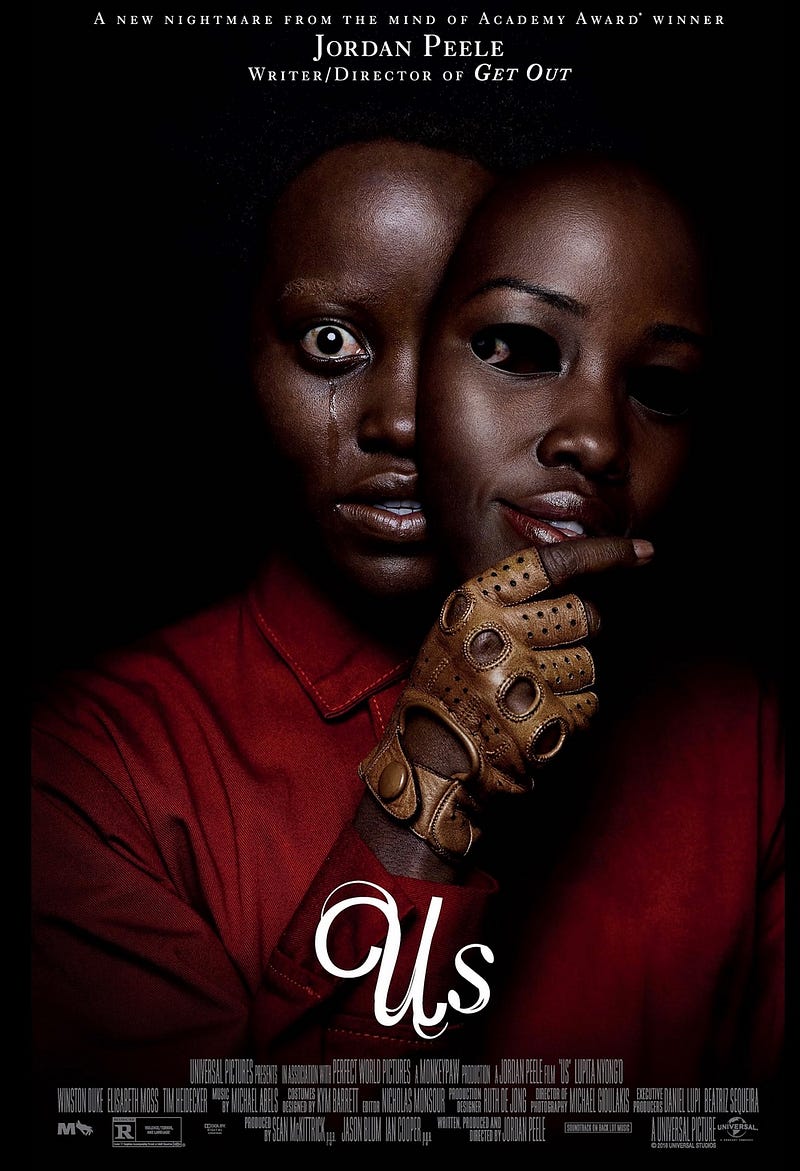
Today: Us (2019). You can download the script here.
Written by Jordan Peele.
Plot Summary: A family’s serene beach vacation turns to chaos when their doppelgängers appear and begin to terrorize them.
Us
Scene-By-Scene Breakdown
By Rose Banks
GoIntoTheStory.com
pp. 1–3: Intro. On-screen text tells of miles of tunnels beneath America, of which “many have no known purpose at all.” This is followed by 1980s stock footage of “Hands Across America: a four thousand mile long chain of good people…” holding hands “…to fight hunger in the United States.”
pp. 3–7: 1986. The boardwalk at the Santa Cruz beach. Nine year old Young Adelaide, in the Thriller teeshirt her father has won for her at the bottle-toss booth, drifts away from her squabbling parents, Russell and Rayne, heading for the beach. En route, a homeless young man with a cardboard sign proclaiming Jeremiah 11:11; a young couple playing “Rock Paper Scissors,” “Scissors” coming up again and again. The beach, when Adelaide reaches it, is near-empty; in the distance, an ominous lightning storm. She turns toward a beachside attraction promising an opportunity to Find Yourself. She feels compelled to go inside.
pp. 7–8: The funhouse, with its fake-forest path, pop-out owl, and panels of distorting mirrors, turns from cheesy to scary when the lights go out and Adelaide’s nervous whistling of “Itsy Bitsy Spider” is echoed by that of a stranger. And then she turns toward a mirror, to see not her own face, reflected, but the back of another, identical girl’s head.
pp. 8–9: Credits, followed by a gradual reveal of one, two, many rabbits; an entire wall filled with small, wire-fronted cages, each containing a large, plump bunny.
pp. 9–14: Present day. Adelaide Wilson, now 34, arrives with her husband Gabe and children Zora and Jason at the bayside house that had belonged to Adelaide’s parents. Thirteen year old Zora complains about the lack of wi-fi while eleven year old Jason tries to wander off into the woods. Photos in the house show Adelaide at fourteen, practising ballet. Later, a breakfast-table dispute erupts over Zora’s abandonment of her athletic ambitions. She’d rather learn to drive. Her father suggests she practice her running on the beach. Adelaide flinches at the beach, but there’s worse: Gabe and the kids want to go to the boardwalk.
pp.14–15: 1986. Young Adelaide, who has been unable to tell anyone what happened to her in the funhouse, listens secretly to a psychiatrist advising her parents to give her time, to encourage her to “draw, write… dance…,” whatever will help Adelaide tell her story.
pp. 15–17: Present day. Adelaide watches a real spider crawl over one of Jason’s rubber spider toys. An odd coincidence. Gabe arranges for the family to meet up on the beach with their friends Josh and Kitty Tyler; Adelaide is resistant, maybe not only because of the location.
pp. 17–19: Searching for Jason (missing, again) Adelaide finds herself among memories in the house’s basement: the mirror in front of which she practiced ballet, pictures of her in a tutu, an old stuffed bunny. Her memories manifest as fourteen year old ballerina Teen Adelaide, interspersed with scenes of Jason, wearing the werewolf mask he carries about with him, getting locked in a closet while re-attempting his so-far-failed “spark starter” magic trick.
pp. 19–21: Gabe turns up in a newly-acquired motor boat. Josh now also has a boat; Jason says it’s probably a better one. Gabe retorts “It’s not a contest.”
pp. 21–24: On their way to the beach, the Wilsons banter in the car; Jason makes further unsuccessful attempts at his finger-snapping magic trick. Santa Cruz’s beach and amusement park loom closer and Adelaide tries to hide her fear. Zora argues again about driving. Adelaide flashes back to her parents’ car, returning that night from the boardwalk; her father drunk, her parents arguing, herself in shock. She snaps back to the present to see an unconscious, bleeding homeless man being loaded into an ambulance: Santa Cruz.
pp. 25–35: As the Wilsons carry down their beach gear Adelaide dares a quick glance toward the funhouse: it’s still there, renamed but not much altered. They set up alongside the Tylers: Josh and Kitty, slightly drunk, and fourteen year old gymnast twins Lindsey and Becca. Josh is combative, Gabe defensive over his new boat; Kitty snips at Adelaide, admits to a facelift. Zora and the Tyler twins dislike each other. Jason, least affected by the prickly atmosphere, plays on the beach, then later heads for the Port-O-Potties. Adelaide and Kitty are confessing their abandoned ambitions (to become a ballet dancer, a movie star) when a frisbee falls onto their beach towel, fitting perfectly over one of its giant polka dots. Another coincidence. Adelaide suddenly notices her son is missing. Flash to Jason, exiting the toilet to see a man seemingly doing yoga, but with dried blood on his hands. Jason turns up safe, but Adelaide is by this time freaking out, angry and emotional. The families part awkwardly.
p. 35: Driving home, the Wilsons hear a radio report of possibly linked stabbings that occurred earlier that day. Adelaide turns off the radio.
pp. 35–38: The family arrive home, prepare for bed. Gabe gripes about Josh’s new car, how he got the car only to rile up Gabe. Adelaide teases him. Later, she notices 11:11 on Jason’s clock. Yet another coincidence, more elevens. She talks to Jason about how his going missing made her feel, and promises to keep him safe, but then sees his drawing of two stick figures, one faced away from the other — what is it? Jason shrugs. Adelaide is scared all over again.
pp. 38–41: In their bedroom, Adelaide tells Gabe she needs to go home, that she can’t bear being so close to the beach and the hall of mirrors. For the first time, she tries to tell him what happened to her that night. Her story is interspersed with flashbacks in which we see the identical girl turn and face Young Adelaide — hating, screaming, trying to choke her. All her life since, Adelaide has feared the other girl would come after her; now, with the odd coincidences she’s been noticing, she thinks the girl is getting closer. Gabe is disbelieving. Tries to reason with Adelaide. Joke with her. Nothing works. And then the lights go out and Jason turns up at the door, saying “There’s a family in our driveway.”
pp. 41–45: The family — a man, woman, boy, and girl — in silhouette look like the Wilsons… and yet, not. Gabe makes light of their presence, but Adelaide calls the police. Gabe goes out to confront the intruders while Adelaide discovers the police will take 14 minutes — too long — to reach them. Outside, Gabe’s nerve is rattled by the intruders’ strange manner and stillness. He goes back inside to pick up a baseball bat, but this falls to intimidate the silent strangers, who suddenly split up and attack, the man (later, Abraham) heading straight for Gabe.
pp. 45–47: The Wilsons are besieged in their house by the intruders. Abraham beats against the front door while the others go around the back of the house. The two kids are fast: the daughter (Zora’s double, Umbrae) runs and climbs like a super-athlete, while the boy (Jason’s double, Pluto) scurries on all fours like an animal. Adelaide’s double, Red, the evident leader, moves slowly, deliberately, whistling “Itsy Bitsy Spider,” as in the funhouse, long ago.
pp. 47–51: The intruders invade with ease, Abraham (Gabe’s double) smashing Gabe’s knee with the bat. Red shepherds the Wilsons into their living room. Abraham is out of it, confused; Umbrae smirks cruelly; fire-loving Pluto wears a rubber burn mask, and behaves — and is treated by his mother — like a dog. All four wear identical red, baggy jumpsuits. Red, voice rasping from disuse, launches into her life story, how she grew up with nothing, ate raw rabbits, and was later trapped into leading an unhappy shadow version of Adelaide’s happy family life. But it was all of it a test, Red claims; she was being tested by God. And who are they, these invaders? “We’re Americans,” Red says, before handcuffing Adelaide to a table. Red invites Zora to run.
pp. 51–54: Zora runs, while Jason is forced to play with Pluto. “Show him one of your tricks,” Adelaide hints. Abraham tortures the injured Gabe by kicking him down the back porch stairs. Jason takes Pluto to the closet he knows it’s so easy to get locked into. Zora runs, further; Umbrae prepares to chase. Red tells Adelaide her vision of her people emerging, severing their connections to their upper-world equivalents, and tracing a “line of blood.”
pp. 54–60: In the closet with Jason, Pluto takes off his mask: his lower face is covered with burn scars; Jason is terrified. Zora is caught by Umbrae, who has moved impossibly fast. Gabe comes back to consciousness in a garbage bag: he is on his boat, with Abraham, but manages to knock Abraham overboard, where he is at first tangled in a rope and dragged away, later slashed across the chest by the boat’s propellers. In the closet, Jason finally gets his “spark starter” trick to work, startling Pluto and locking him temporarily inside. Adelaide tries to call the police but the line is busy. She works on the table she’s handcuffed to with a fire poker and gets free. Umbrae has been distracted by the chance to stab a guy with her scissors, and Zora returns, gasping. Adelaide, Zora, and Jason run to the dock where they escape with Gabe in the boat, while Red, Umbrae, and Pluto, who have discovered Abraham’s body, watch.
pp. 60–63: The Tylers are besieged in their split-level, glass-walled showhouse. Josh, Kitty, and the twins are no match for their doubles and Tex, Dahlia, and twins Nix and Io despatch them quickly and bloodily to the tune of the Beach Boys’ “Good Vibrations.”
pp. 63–67: Adelaide bangs on the Tylers’ door — only to be confronted and seized by Tex. His family drag her into the house. Gabe tells Zora and Jason to run, while he deals with Tex, but they instead go into the Tyler house to help their mother, tied down by Dahlia, who’s considering how she wants to cut up Adelaide’s face. Undecided, Dahlia cuts into her own cheek, in a parody of Kitty’s plastic surgery, while Zora and Jason fight the scissor-wielding Nix and Io. Zora throws Nix over a mezzanine balcony and clubs Io to death with the fire poker, while Jason later stabs Dahlia with one of the twins’ scissors. Now on Josh’s boat, Gabe shoots a flare gun at Tex, startling him sufficiently that Gabe can club him down. “I’m done with boats,” he says.
pp. 67–72: In the wreckage of the Tylers’ house, alongside their corpses, the Wilsons speculate as to the reason for the attacks. “There’s no reason,” Adelaide says. “It’s all just craziness.” Gabe tries to contact the police but the line’s still down. They turn on the TV and find similar incidents are happening everywhere. Plus, a hand-in-hand chain of people dressed in red… the family argue about whether to leave — Adelaide wants to go to Mexico — or stay. Adelaide wins.
pp. 72–73: The Wilsons decide to take the Tylers’ car, Josh’s former pride, but first Adelaide has to dip back inside for the keys. Where she finds that Nix, whom Zora threw over the balcony, isn’t dead after all. Nix attacks; Adelaide stabs her in the head with scissors.
pp. 73–77: Zora argues that she should drive, due to her father’s damaged leg and her mother’s still being in handcuffs. The family debate who killed the most of the doubles. Umbrae turns up, standing in front of the car. Zora slams the car back and forth, sending Umbrae crashing into a tree. Before the family set off again there’s an oddly tender moment when Adelaide leaves the car, looking for Umbrae, and watches her daughter’s duplicate die.
pp. 77–80: Santa Cruz. The town hit by an apocalyse. Empty streets, corpses. In the backseat, Jason discover his spark-starting trick is now easy. It feels like a sign, as when they turn a corner they find their old car in flames, Pluto between them and it. Adelaide gets out and tries to talk to him, but Jason meets Pluto’s eye and intuits a trap. He gets out. As he walks forward, Pluto walks backward, into the flaming wreckage of the car. He is engulfed in flames. Red emerges from hiding and snatches Jason. Gabe can’t run, Zora breaks down; only Adelaide can follow.
pp. 80–81: Adelaide runs toward the amusement park, past a line of people holding hands, one of them Jason’s bloody-handed “yoga man,” identical to the homeless man stabbed and carried away in an ambulance. Adelaide enters the funhouse and its maze of mirrors. Finds the place she saw Young Red. Opens a secret door. A white rabbit hops out. She steps over it into the dark space beyond, into a maintenance room, then onto a downward escalator that leads to an endless-looking tunnel, now occupied only by hopping rabbits. She passes an empty cafeteria with empty rabbit cages. Passes a workroom with sewing machines and rabbit pelts.
pp. 81–83: Up top, Gabe and Zora talk about the end of the world. They hide in an abandoned ambulance and watch the growing chain of bloody-handed people.
pp. 83–84: Down below, Adelaide finds Red in an abandoned schoolroom, cutting out a paper chain of red people. “It was humans who built this place,” Red claims. It was an experiment, to create soulless duplicates, the Tethered, who could be used like puppets. Only the experiment failed, and the Tethered were abandoned to go mad. Until “there was us.”
pp. 84–88: Flashback to 1986: Adelaide’s father throws the ball at the bottle toss booth. Then back and forth between Adelaide and Red, explaining to Adelaide in the classroom, and the tunnel world as it had once looked, everyone from up top duplicated, including Adelaide’s parents Russell (as Weyland) and Rayne (as Eartha). The actions of the Tethered are similar those being taken above, but twisted. In the cafeteria the Tethered happily eat raw rabbits. “God brought us together that night,” Red says. Now we see Young Adelaide’s approach, Young Red’s ascent to meet her, and afterward “the miracle”: two teenage girls dancing, one on a stage, under a spotlight, one in a darkened underpass, shambling watchers half-entranced, half-bemused. Teen Red becomes their leader, the one with a plan, the one who will deliver them.
pp. 88–91: Back and forth again, the present intercut with scenes from the past, of the two dancing girls, but now Adelaide and Red fight. Red attacks with her scissors; Adelaide defends with the fire poker and her handcuff chain. The fight spills out of the classroom into the underpass. Adelaide is pursued, stabbed outside of the Tethered’s underground barracks, into which Red escapes. In the past, both girls’ dances reach a grand finale; Teen Adelaide leaps and lands perfectly; Teen Red stumbles. In the present, Adelaide runs Red through with the fire poker. But she’s not dead, and when she begins again to whistle “Itsy Bitsy Spider” Adelaide chokes her to death with the handcuff chain. Adelaide finds Jason hiding in a locker; he has seen everything and is now afraid of her. She tries to reassure him. She leads him away.
pp. 91–92: The ambulance drives off. Jason watches his mother. Flashback reprise of Young Adelaide hiding outside the psychiatrist’s office, her confused and anxious parents; the psychiatrist’s advises again to let Adelaide draw, write, dance to tell her story, as we watch Young Adelaide practise diligently in her mini ballet studio in the basement.
pp. 92–93: 1986. Reprise of the scene in which Young Adelaide is drawn toward the hall of mirrors, but now from Young Red’s POV. She watches Young Adelaide cross the beach, then hides behind a mirrored wall to snare her. She drags her into the underpass world, where Young Adelaide wakes, handcuffed to a bed in the barracks.”Mom! Dad!” Eartha and Weyland look down at her, puzzled. Young Adelaide realises these are not her parents.
p. 93: 1986. Young Adelaide’s parents, Russell and Rayne, drive away from the boardwalk, unaware the girl in the back of their car is not their daughter. It is Young Red.
p. 93: Present day. The camera follows the ambulance carrying the Wilsons inland, away from Santa Cruz, the bird’s-eye view opening up to show a row of people standing hand in hand, the chain going on and on, into the distance.
Writing Exercise: I encourage you to read the script, but short of that, if you’ve seen the movie, go through this scene-by-scene breakdown. What stands out to you about it from a structural standpoint?
To download a PDF of the breakdown for Us, click here.
Kudos to Rose Banks for doing the scene-by-scene breakdown.
For more movie scene-by-scene breakdowns, go here.