Script Analysis: ‘The Trial of the Chicago 7’ — Scene-By-Scene Breakdown
Here is my take on this exercise from a previous series of posts — How To Read A Screenplay:
Here is my take on this exercise from a previous series of posts — How To Read A Screenplay:
After a first pass, it’s time to crack open the script for a deeper analysis and you can do that by creating a scene-by-scene breakdown. It is precisely what it sounds like: A list of all the scenes in the script accompanied by a brief description of the events that transpire.
For purposes of this exercise, I have a slightly different take on scene. Here I am looking not just for individual scenes per se, but a scene or set of scenes that comprise one event or a continuous piece of action. Admittedly this is subjective and there is no right or wrong, the point is simply to break down the script into a series of parts which you then can use dig into the script’s structure and themes.
The value of this exercise:
- We pare down the story to its most constituent parts: Scenes.
- By doing this, we consciously explore the structure of the narrative.
- A scene-by-scene breakdown creates a foundation for even deeper analysis of the story.
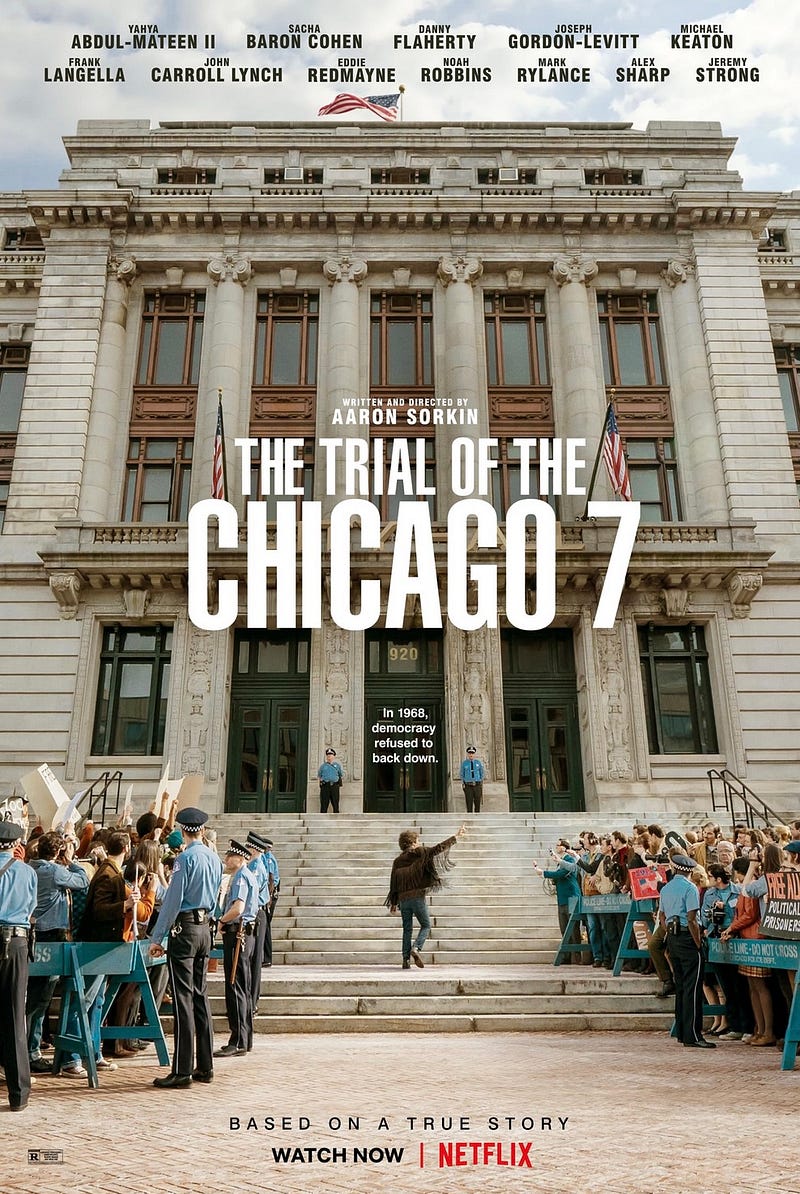
This week: The Trial of the Chicago 7 (2020). You may download the screenplay here.
Written and directed by Aaron Sorkin.
Plot summary: The story of seven people on trial stemming from various charges surrounding the uprising at the 1968 Democratic National Convention in Chicago, Illinois.
The Trial of the Chicago 7
Scene by Scene Breakdown
By Andrew Lightfoot
GoIntoTheStory.com
Page 1–3: The turbulent times of the late 60’s. President Johnson announces the increase to monthly drafts to 35,000, which quickly over time increases to 51,000. The infamous speeches of both John F. Kennedy and Martin Luther King Jr, and their eventual assassinations.
Page 3–4: TOM HAYDEN and REGGIE DAVIS, leaders of the Students for a Democratic Society (SDS), talk to a crowd of students inside a campus auditorium. They announce that they will be going to Chicago. They also have a video of the horrific use of napalm on civilians playing on a movie screen.
Page 4: We snap to a seedy underground club where ABBIE HOFFMAN and JERRY RUBIN speak to a large crowd. They are also going to Chicago, but their view of the mass protest has more partying involved. They warn the crowd that things will be tense and if they are met with violence that they will meet it with violence. They are the leaders of the Youth International Party (Yippies).
Page 4–6: Another jump, this time to a suburban driveway where DAVID DELLINGER loads up his station wagon for the trip to Chicago. His wife and son are there to see him off. David assures his wife that it will be non-violent and that he has done many protests before. She expresses concern over the others being at the helm of this also. He leads a group called Mobilization to End the War in Vietnam (The Mobe).
Page 6–8: Inside the Black Panther headquarters. the chairman of the Black Panther Party, BOBBY, gets himself ready to head to Chicago. His girlfriend, SANDRA, argues with him about attending. She suggests letting another make the speech as he is already in trouble with the law in Connecticut and is going to a place where violence is likely to happen, but he refuses. Chicago is the place he needs to be in. She offers him a handgun. He rejects that too, saying if he knew how to use it, he wouldn’t need to make speeches.
Page 8–9: A mix of shots of a typewriter and Jerry teaching a small group of students how to make a Molotov cocktail. The typewriter user punches out a confidential FBI memo to all offices instructing them to submit detailed analysis of potential counter-intelligence action against New Left organizations and Key Activists.
After the students have all made a molotov, they throw them at a building which turns out to be a U.S. Army recruitment center.
Page 9–12: Both sides prepare for the protest in Chicago.
- The protestors make leaflets and announce they will be going to Chicago whether they have permits or not. Tom warns Abbie not to mess around.
-The National Guard arrives in Chicago. The Mayor of Chicago RICHARD DAILY announces that he issued an order for any arsonist or anyone with a molotov is to be shot.
-In a city hall press conference, government officials call the protestors revolutionaries who are bent of the destruction of the U.S.
WALTER CRONKITE, at the Democratic Convention, speaks into the camera saying the event is about to start, but in a police state.
Page 12–14: Two federal prosecutors, RICHARD SHCULTZ and THOMAS FORAN, arrive at office of the newly appointed Attorney General JOHN MITCHELL. Outside his office they meet HOWARD, a special advisor to the Attorney General who brings them in.
Page 14–21: Inside they meet Mitchell and Schultz soon finds out why he is there. Mitchell wants him to be the lead prosecutor of the upcoming trial involving the Chicago protestors. Mitchell has great dislike of these individual and seeks an indictment for violation the Rap Brown Law. This law was created by southern whites in Congress to limit the free speech of black activists, and no one has ever been charged with It.
Schultz questions who started the riots. Mitchell tells him it wasn’t the police and tells Schultz to dismantle any witnesses they bring in that say the police started it, and win the trial because that is what’s expected of him.
Page 21: Outside Mitchell’s office both Schultz and Foran talk. Foran questions Schultz’s lack of gratitude, but Schultz tells him that they ae giving the protestors exactly what they want … a stage and an audience.
Page 21–24: A mass of people gather outside the courthouse, both supporting and against the protestors. Two officers escort Jerry and Abbie in through the front doors of the building and into the rotunda. One crowd member yells “We love you, Abbie”. Abbie turns and sees a guy throwing an egg at him. Jerry catches the egg, without breaking it, much to Abbies surprise. Abbie asks how he did that, but Jerry chalks it down to experience. Now, standing there with an egg, Jerry doesn’t know what to do with it.
Page: 23–24 — The two defense lawyers (WILLIAM KUNSTLER and LEONARD WEINGLASS) enter the courtroom for the first time. They chat with the press. Kunstler makes it clear that they will not be acting as Bobby Seale’s attorney. Seale’s actual attorney is in the hospital and unable to attend.
Page 24–29: The gallery of the courtroom is packed with all sorts of supporters for the protestors. There is also a high security presence too. Two men who were also a part of the protest FROINES and WEINER. Froines understands why they are trying to charge the others, but don’t know why they are there with them. Weiner tells him this is the Golden Globes of protests and it’s an honor to get nominated.
Further down the table are Rennie and Tom. Rennie has been keeping a list of all the American’s killed in the war since the day they’ve been arrested. He says with the trial now getting started it’ll be easy to forget who this is all about. Kunstler and Rennie take their seats at the table and say their good mornings. Just then, a side door opens up, and two marshals escort a handcuffed Bobby Seale into the courtroom. Kunstler speaks with Bobby once they seat him.
He tells Bobby that he is here if he needs him and suggests that the group of African-Americans seated together in the front row spread out. The jury wouldn’t like the look of it. Kunstler also asks for them to remove their berets. FRED HAMPTON, the head of the chapter of the Black Panther Party in Chicago, is seated in the front row also. He denies the help from Kunstler but tells the other to spread out and remove the berets.
Page 29–36: JUDGE HOFFMAN enters the courtroom. The trail begins. He notes that the gallery us full of people and reminds everyone that this is a trial not a sporting event. He calls for opening statements, but Bobby rises and points out that his lawyer isn’t present. Judge Hoffman tells him to sit. Schultz continues on with his opening statement, but is soon cut off by the judge. Awkwardly, Judge Hoffman wants the court to know that there are two Hoffman’s there and doesn’t want any confusion. This causes Abbie to pip up a bit, which lands him at risk of contempt of court.
Schultz continues on. His goes through all the names of the defendants and the groups they are associated with. He mentions Bobby’s name and this causes Bobby to speak up again about his lawyer not being present. Judge Hoffman tries to get Kunstler to act as his lawyer, but Kunstler refuses as it doesn’t satisfy the requirements of due process. Despite this, Bobby continues on refusing to be put in the same group as the others. He says all he was there to do is give a speech and fly home. He claims the reason he is there is so they can make the protestors look scarier by having a black man with them.
Page 36–43: In a defendant’s conference room the group chat about the disastrous opening of the trial. Tom asks them what the plan was with this trial. Are they there defend themselves from a possible 10-year sentence or are they there just to give a “fuck you” to the establishment? He then calls out Abbie and Jerry for making them look exactly the way Schultz wants them to look. They bicker back and forth until Fred, shows up. Fred talks directly to Kunstler asking him why he spoke for Bobby and why the white guys are in a room while Bobby is in a holding cell. Kunstler replies he only made it clear that he wasn’t Bobby’s lawyer and the reason for him being in a holding cell was because he is under arrest for a murder in Connecticut.
A marshal enters the room and tells everyone to return to the courtroom. Kunstler tells Abbie and Jerry to keep their mouths shut unless asked a direct question. Abbie tells him that this is a political trial and ignoring reality is weird to him. Kunstler tells him there is no such thing as a political trial, only civil and criminal trials.
Page 43–47: Day 3 of the trial. The mayor’s administrative officer, DAVID STAHL, is on stand being questioned by Schultz about the meeting he had with Jerry and Abbie. They tried to get permits to have a festival in Grand Park during the Democratic Convention. Stahl denied them the permits as he was told there would be rock music playing and public fornication. After being denied, Abbie lets Stahl know that this is going to happen regardless and insist the next president stops sending thier friends overseas to get murdered. Abbie gives a final offer; he gets paid one hundred grand and he’ll call the whole thing off.
After Schultz is finished, Weinglass questions Stahl and asks if he has any other meetings with any of the defendants.
Page 47–54: Stahl has his meetings with the other defendants separately. They ask for permits and like Jerry and Abbie, are denied. At the end of Tom’s and Rennie’s meeting Tom tells Stahl that it is pretty reckless of him to not have a contingency plan for the thousands of people who are coming to Chicago.
After Weinglass is finished Judge Hoffman allows Kunstler to continue with the cross-examination, but he is interrupted before he can ask the first question. Judge Hoffman notices that Fred is speaking with Bobby and demands to know who Fred is. Bobby eventually tells him and Judge Hoffman puts in the trial record that Bobby is being represented by the head of the Chicago chapter of The Black Panther Party, Fred Hampton. Kunstler tries to tell the judge that Fred could’ve been giving Bobby the score of the White Sox game for all anyone knew, but to no avail.
Kunstler continues on with Stahl and asks about Abbie’s attempted extortion. He soon finds out that Stahl hasn’t contacted any law enforcement agency about this, which prompts Kunstler to ask if Stahl took this threat seriously or not. Stahl admits he had no reason to believe that Abbie was being serious. Kunstler then asks him if he knows what perjury is. This causes Schultz to object. Judge Hoffman sustains Schultz’s objection, strikes the entirety of Stahl’s testimony under cross-examination, and orders the jury to disregard it.
Kunstler asks Stahl if any of the defendants threatened violence to Chicago if they didn’t get any permits. Stahl says not directly, but they did say the permits should be issued to reduce destruction in the city. Kunstler asks if the defendants said who would be doing the destruction. All Stahl says is the destruction didn’t come from the Chicago Police Department. Bobby tries to question Stahl, but Judge Hoffman denies him.
Page 55: Abbie and Jerry are in a make-shift press room giving a press conference. One reporter asks why Bobby won’t let anyone represent him. Jerry tells the reporter that he posed that question with a lie. We see Kunstler pulling up to an apartment building via taxi. Reporters wait outside and bombard him taking pictures as soon as he leaves the taxi. Jerry continues on over this explaining that Bobby’s lawyer, Charles Garry, is currently in hospital and that a motion was made for postponement, but was denied by a judge who appears to be suspending due process for a while, according to Jerry.
Page 56–58: College students have taken over a second floor, three-bedroom apartment. They call it the “Conspiracy Office”. Kunstler enters and asks BERNADINE if he has received any messages. She gives him a stack of them and he brings them into the dining room where Tom and Weinglass are. He tells Tom no more press conferences. Tom warns him of getting in between Abbie and a camera. The lawyers tell Tom that jurors six and eleven are on their side.
Back in the other room, Jerry and Abbie’s earlier press conference is on the TV. A reporter asks Abbie if he would’ve accepted the hundred-grand and called the protest off. Abbie responds that he would’ve accepted the money, but to call off the revolution would cost his own life.
Page 59–62: Day 23 of the trial. Something’s off, Judge Hoffman is handed a note and adjourns the court for the day. He asks to see counsel in his chambers. Later on, all lawyers are in Judge Hoffman’s chambers, and he informs them that two jurors have received threatening notes. The jurors, six and eleven, are brought in one at a time and are convinced by the judge to be removed from the jury for their own safety and the safety of their families. After the meeting Kunstler speaks with Foran and Schults. He tells them that the Panthers don’t write letters any more than the mafia does and warns them that if their office had anything to do with this then they’ll see the justice system closer than they ever wanted to.
Page 62–66: Back in the conspiracy office the lawyers and defendants discuss what other options they have to choose from after losing the two jurors. Their only choices are a 27-year-old dental hygienist or a Korea vet who has kicked his son out of the house for protesting the Vietnam war. All this doesn’t matter as a message is brought in by an assistant saying that Judge Hoffman has sequestered the jury. Kunstler tells Weinglass that he wants an expert in geriatric psychiatry sitting in the gallery for a few days for a mental check of the judge. Their talk is broken up by the television. The news scrolls through a list of the soldiers who were killed that day.
Page 66–68: Back in the courtroom, Kunstler tries to strike the order of sequestering the jury. Judge Hoffman cuts him off asking Jerry and Abbie what they are wearing. It turns out they both are wearing judge’s robes. Judge Hoffman orders them to take it off, they do, only to reveal police uniforms underneath. The people in the gallery laugh. Kunstler continues on with trying to overturn the judge’s decision about the jury, but only gets charged with one count of contempt of court. Nonetheless, he is allowed to continue and he asks for the jury to be taken care of by the marshals. As this goes on, Tom is looking at the marshals in the courtroom. One of them adjusts a nametag on his uniform. This causes Tom to remember something. At the end of the protest Tom, Abbie, and a bunch of other protestors are cornered by a line of riot police with their clubs out. They have nowhere to go. One by one the riot police remove their nametags and badges and put them in thier pockets.
Page 68–77: Frank Deluca, a detective of the Chicago Police department, takes the stand. Schultz questions him about his job to keep Rennie under surveillance. We go to through night in question where Rennie is with Tom and Jerry, who is doing his molotov demonstration. Rennie spots a car that was following him all day. Him and Tom approach it. Rennie tells Tom about his girlfriend Sarah Beth and how this isn’t her world. He’s concerned about going to her place with the officers following.
They notice the car is empty and Tom devises a plan. Rennie is to go back into the crowd and make sure to be seen by the officers before he leaves. Tom will take air out of the tire of a car so they can’t follow Rennie. Unfortunately, Tom is caught and placed under arrest. Seeing this, the crowd start approaching and things get heated. Tom tells the crowd no to worry, but in court, Deluca tells Schultz that Tom was egging them on. A cameraman intervenes and forces the officers not to arrest Tom that night incase things got violent. Instead, Tom is picked up the next morning by police and brought to jail.
Page 77–78: Judge Hoffman calls a recess, but Bobby has a motion. He wants to represent himself. Kunstler speaks up saying that the other defendants would like to join in. Judge Hoffman asks Kunstler if he is now representing Bobby, to which Kunstler reminds the judge again that Bobby isn’t represented by council. Judge Hoffman overrules Bobby’s motion causing Bobby to keep talking saying it’s his constitutional right. This annoys Judge Hoffman and he orders Bobby to be quiet because he has lawyers to speak for him. Kunstler yet again reminds the judge that Bobby has no lawyers, this earns him his second contempt of court.
Page 79: Abbie is at in a college auditorium giving a speech about the events the night Tom was caught deflating the tire. He then mentions that in ten days the government called thirty-seven witnesses, all of which are government employees. He calls this portion of the trial “With Friends Like These…”.
Page 79–81: SAM, STAN, and SCOTT, three seemingly normal people infiltrate the protest and get introduced to Abbie, Rennie, and Tom. After each introduction we flip to the trial where at the stand they announce that they are all officers.
Page 81–82: Jerry is at a bar having a drink. The bartenders give him another drink and says it’s from a woman, DAPHNE, at the end of the bar. Jerry walks over to her and they flirt.
Page 82–91: Daphnie, now on the stand, informs the court that she is actually an FBI special agent in counter intelligence. She explains to the court the events of the day where over eight hundred protestors marched to the police department to bail Tom out. She also tells them that her job was to use Jerry to try and infiltrate the leaders of the group. During the march, some frat boys harass a young woman involved with the protest. This irritates Jerry.
Once the group gets close to the police headquarters a bunch of police in riot gear pour out of it blocking their way. Rennie, Dave, and Abbie all agree this is too much and command the marshals of the protest to turn the group around and head back to the park. Back in the courtroom, WOJOHOWSKI, is now on the stand and tells the court the protestors were looking for a fight. Kunstler tries to object to this as no one can know the minds of hundreds of people, but Judge Hoffman overrules it.
Page 92–94: More divisions of police show up. The frat boys who have gone away have returned again to continue harassing the young woman. Things heat up as the protestors now face off with the police and yell at them. Rennie and Daphnie ask Jerry to help
calm the crowd down, but it too late. Someone in the crowd shouts to take the hill, and all chaos erupts. In the courtroom, Scott, on the stand, tries to say that Jerry was the one that yelled it. Kunstler objects, and Judge Hoffman sustains it. Back in the warzone, Jerry and Rennie yell for people to stop running. An officer can be heard on a bullhorn telling people to leave the park as there was no permits for their demonstration. The crowd doesn’t stop. They meet the police line and receive tear gas and riot clubs.
Jerry and Rennie see the bloodied protesters retreating. They try and pull as many people away as possible. Jerry spots the young woman making her way up the hill, but she doesn’t make it. The frat boys find her and tackle her to the ground. She gets roughed up before Jerry can get there, but when he does, he makes short work of the two. The third runs away after tear gas is fired in their area. Jerry helps the young woman, but soon three officers show up and arrest him at gunpoint.
Page 94–98: Tom, now bailed out of jail, stands with Jerry, Rennie, Abbie, and Dave. All of them survey the aftermath of the violence. Tom admits he’s worried about getting everyone out of Chicago alive. Rennie asks Jerry how he go out so quick. Jerry tells him they couldn’t think of what to charge him with. He was detained not arrested. Tom tells Abbie to cool his people down, but Abbie tells him they have to risk injury and protest in front of the convention. Tom points to the hill, which still has tear gas floating around it. Saying that is what will happen if they try.
In court, Kunstler begins his cross-examination of Daphne. She defends Rennie and Jerry telling the court they tried to turn everyone around. She admits that demonstrators attacked the police first, but no one sitting at the defense’s table were the ones doing the attacking. Bobby attempts to cross-examine her but is denied. Fred stands up and tells the court that Bobby was only in Chicago for four hours. The defendants applaud and bang the table in approval. Judge Hoffman calls for a recess. Tom sits quietly. He does not like this one bit.
Page 94–102: It’s the Christmas season. Jerry and Abbie sit on a bench outside the Natural History Museum. They spot Schultz with his two daughters. They approach him for a friendly chat. Abbie tells Schultz’s daughters that their father is a good man. Schultz warns the guys that the window for them to plead out is quickly closing. Jerry tells Schultz that sending Daphne to him only to break his heart was way out of line. Schultz tells him he doesn’t work for the FBI and that many agents were sent to gather information on all of them. Abbie tells Schultz there’s no hard feelings between them and asks him if he thinks they are responsible. Schultz replies “I think you got the result you were looking for”.
Page 102: Everyone in the conspiracy office is asleep. The phone rings, waking up Tom. Bernadine answers it and tells Tom that something has happened.
Page 102–104: Tom and Kunstler are in Cook County jail waiting in the visiting room. A guard brings in Bobby. Kunstler tells Bobby that Fred Hampton is was killed in a shootout during a police raid. Bobby tells him he already knows and that Fred wasn’t killed. He was executed.
Page 104–111: Day 90 of the trial. Detective FRAPOLY takes the stand and gives his account on a rally in which Jerry and Bobby gave speeches at. Schultz asks about the speech that Bobby gave. Bobby continuously interrupts Frapoly’s testimony. This irritates Judge Hoffman, who warns Bobby to keep quiet. Once it comes time for the defense to cross-examine, Bobby speaks up.
He ignores the Judge’s order to sit, he stands and addresses the gallery, and informs them that Fred Hampton was assassinated. Fed up with Bobby, the judge orders marshal to deal with him. They take Bobby into a room, bind in ankle and wrist restraints, gag him with a balled-up rag, and bring him back out to the horror of everyone. Despite this, Bobby still refuses to listen to Judge Hoffman.
Schultz also refuses Judge Hoffman and doesn’t call up his next witness. He asks to approach the bench. All the lawyers walk up to Jude Hoffman’s bench. Schultz points out that a defendant is bound and gagged in an American courtroom. Kunstler and Weinglass agree and even liken it to medieval torture. Schultz puts forth a motion for Bobby’s case to be declared a mistrial. Kunstler and Weinglass weigh in saying that the judge discriminated against Bobby. Judge Hoffman orders the lawyers to return to their seats.
He then announces that Boby’s case has been declared a mistrial, but reminds Bobby he still has sixteen counts of contempt and a homicide charge in Connecticut to deal with. Judge Hoffman adjourns the court and the bailiff calls for all to rise. The defendants all remain seated except for Tom, who stands, but immediately regrets it.
Page 111–116: Back at the Conspiracy Office, the lawyers and defendants sit in the living room. They immediately attack Tom for standing up for the judge. Tom explains that’s he sees no point in insulting the very man who will sentence them at the end of the trial. This brings Abbie in. He tells Tom this is a political trial and they weren’t arrested, they were chosen. Dave speaks up saying he can take the stand claiming the jury can easily like him. Kunstler shuts that down saying that Dave sat out world War Two and even he wants to punch him.
Rennie shares his point of view with the group. He thinks it’ll be ironic if this was just a way for John Mitchell to get back a Ramsey Clark for Clark not resigning normally like outgoing cabinet members usually do, and instead, left it until the last hour. Kunstler and Weinglass take this in and their minds are blown. Kunstler immediately calls out to Bernadine to find Ramsey Clark.
Page 116–118: Kunstler and Weinglass show up outside Clark’s place via taxi. They notice a dark colored sedan with government plates on it. Clark’s maid invites them in.
Page 118–122: They meet with Clark inside his study but are not alone. Two senior deputies of the Justice Department, COLLEY and HOWARD, are in the room as well. This worries Kunstler saying that they will tell Schultz and Foran about this meeting. Clarks tells him they have already done so and will even inform John Mitchell, too. Kunstler’s asks Clarks if, during his time as Attorney General, there was any discussion about seeking indictments against his clients. The agents try to stop this saying it’s illegal for him to answer and that he is protected by law. Kunstler tells Clark he can be subpoena him. Clarks reveals the true reason why the agents are there. It’s so that they are present when he agrees to take the stand.
Page 122–130: Day 124 of the trial. Kunstler calls Ramsey Clark to the stand, but Schultz calls to disallow the witness due to the code of Federal Regulations. Judge Hoffman removes the jury. Weinglass tries to get the jury back in to hear Clark’s testimony. Judge Hoffman refuses saying if he hears anything of relevance, he’ll call the jury back in. Clarks get sworn in and is questioned by Kunstler about his time as General Attorney in the summer of 1968.
Clark tells him that he received a phone call from President Johnson. Schultz objects saying that Clark shouldn’t have to tell everyone the contents of a phone call between him and the president. Judge Hoffman agrees, but Clark says he’s willing to give his testimony. Clarks goes on explaining that the president asked him if he was seeking any indictments for the Chicago protestors. He told the president no as his own criminal division came to the conclusion that the Chicago police started the riots and that his counter-intelligence division came to the conclusion that the defendants did not conspire to incite violence during the convention.
Despite all this, Judge Hoffman denies the jury hearing Clark’s testimony. Kunstler gives up on the judge and asks the Court Reporter if she’s any good and then tells her to keep. Kunstler fires off questions, “Is this prosecution politically motivated” and “ Did President Nixon inherit an unpopular war” to which Clark happily answers “Yes”. Clark then steps down as he’s likely to get a charge of contempt of court. Kunstler asks the judge if the jury will be told that the defense called former General Attorney but the court rules he couldn’t testify. Judge Hoffman informs him that the jury won’t be told anything.
Kunstler walks back to his seat, picks up a heavy law book, and slams it down on the table. This gets him his third charge of contempt. This sets Dave off. He stands up and calls the judge a thug. Judge Hoffman calls the marshals on Dave, who fights them all the while demanding why they weren’t given a trial if they are as guilty as the judge thinks they are. Dave ends up punching one of the marshals. He apologizes as he is being handcuffed. Dave’s young son is in the crowd watching this too.
Page 130–137: The defendants are a mess. Jerry suggests they all get arrested in solidarity with Dave. Tom and Abbie have a go at one-another. Tom thinks Abbie wasn’t there to end the war, but to make the most of his close-up. He also believes that thanks to Abbie and his group people would view progressive politics pushed forward by stoned, lost, foul-mouthed losers. Abbie tells him that he has no money, so he stages stunts to bring in the cameras.
He then asks Tom if Kennedy got the nomination, would Chicago turn out differently. Tom says yes and Abbie agrees too. He then asks if Tom felt even a little bit happy when Kennedy was assassinated. Being one of Kennedy’s pallbearers Tom loses it and attacks Abbie. They get separated before Kunstler and Weinglass walk in. They bring bad news. A recording of what appears to be Tom starting the riot was just given to them. In the recording Tom says “ If blood is going to flow, let it flow all over the streets”.
Tom tries to defend himself by explaining back on that night he had just seen the police club Rennie in the head. Kunstler tells Tom he can’t take the stand or else they’ll make him answer for it and they will lose. Tom is determined to take the stand, so Kunstler offers him a mock examination.
Page 137–152: Tom goes through his mock examination as the events of that night play out. Dave is on stage introducing the next speaker. A kid in the crowd decides to climb up on a flagpole to get a better view. Some officers see this and move to get the kid down. Rennie notices the commotion and intervenes. Tom, from the stage, is watching all this unfold. The officers rough up the kid. Rennie tries to get the officers off the kid and resolve this peacefully, but one officer clubs him in the head causing blood to splatter all over.
Tom witnesses all this and snaps. Dave tries to stop him, but Tom takes over the microphone and announces what just happened to Rennie. He calls for everyone to move to the streets. They are going to the convention. Riot police get to the top of the hill once again as an army of angry protestors approach them. Tear gas is fired off first then the battle between protester and police ensues.
Tom calls for everyone to move to the bridges. One by one groups of protesters reach the end of the bridges only to be confronted by the national guard and armored vehicles. Tom’s, Abbie’s, and Jerry’s group find a bridge protected only by a basic police barricade. They dismantle that easily and head towards the convention.
They appear to be in the clear until a few riot police come around a corner ahead. The group turn another way only to find more riot police approaching. Soon they are cornered up against the front windows of Haymarket Tavern, which is packed with upper-class patrons. Tom watches as the riot officers start to remove thier badges and nametags, then, the protestors are shoved through the window and placed under arrest. Kunstler then asks Tom who started the riots? Tom replies with “Our … our blood”.
Abbie puts it all together and tells Kunstler that Tom meant to say it will be their blood that will flow all over the streets and tells him that Tom should be put on the stand. Abbie then tells Tom that he has read everything that Tom has published and believes he’s a talented guy except for his use of possessive pronouns and vague noun modifiers. Tom tells Kunstler to put Abbie on the stand instead.
Page 152–156: Abbie is on the stand. After a few questions from Kunstler, Schultz does his cross-examination. He tries to use Tom’s words against them, but Abbie brings up verses from the Bible to show words can be taken wrong if out of context. Schultz goes after Abbie asking if he has contempt for his government. Abbie denies this saying he thinks the institutions are wonderful things that are populated by terrible people and goes on to say that the contempt his government has for him is far worse.
Schultz brings the testimonies from the 27 witnesses throughout this trial that all say Abbie’s ultimate plan was a confrontation with the police. Schultz notices Abbie is taken a while to answer and tells Abbie he’s concerned it’s taking this long for an answer. Abbie responds with “Gimme me a moment, would you friend? I’ve never been on trial for my thoughts before.”
Page 156–160: Day 113 of the trial. This is the day Judge Hoffman gives his sentencing, but by law, allows the defendants to make a statement. They have chosen Tom to give the statement to the court. Judge Hoffman shows his approval of their choice and tells Tom that is he keeps is short, respectful, and free of anything political then he will look favorably on him with sentencing. Tom agrees and grabs papers from Rennie. He tells the judge that since the trial has begun there were 4,752 U.S. troops that have been killed in the Vietnam war. Tom proceeds to read out all the names. Judge Hoffman slams his gavel for order, but everyone ignores him. The courtroom is full of cheers and clapping. Even Schultz stands to respect the fallen.
POST TRIAL
“Abbie Hoffman, Tom Hayden, David Dellinger, Jerry Rubin and Rennie Davis were found Guilty of Incitement to Riot and sentenced to 5 years each in federal prison. The verdict was reversed by the Seventh Circuit Court of Appeals and a new trial was ordered. The U.S. Attorney declined to re-try the case.”
“In 1974, in a bi-annual survey, 78% of Chicago trial lawyers gave Judge Julius Hoffman a rating of “Unqualified”.”
“William Kunstler served 10 days in prison for Contempt of Court.”
“Attorney General John Mitchell served 18 months in Federal prison for his role in the Watergate break-in.”
“Bobby Seale was found Not Guilty of murder by a Connecticut jury. He lives in Northern California and has published several books on barbecuing.”
“Jerry Rubin became a stockbroker. In 1994 he was struck and killed by a car while jaywalking near the campus of UCLA.”
“Tom Hayden was elected to the California State Assembly in 1989. He lost his bid for the U.S. Senate by 2 percentage points.”
“Abbie Hoffman wrote a best-selling book, though the number of copies in circulation is unknown as the title was Steal This Book. He killed himself in 1989.”
Writing Exercise: I encourage you to read the script, but short of that, if you’ve seen the movie, go through this scene-by-scene breakdown. What stands out to you about it from a structural standpoint?
To download a PDF of the breakdown for The Trial of the Chicago 7, go here.
Major kudos to Andrew Lightfoot for doing this week’s scene-by-scene breakdown.
For more movie scene-by-scene breakdowns, go here.