Script Analysis: ‘The Trial of the Chicago 7’ — Part 2: Plot
Read the script written by Aaron Sorkin which won the Golden Globe and is nominated for the WGA and Academy Awards for Best Original…
Read the script written by Aaron Sorkin which won the Golden Globe and is nominated for the WGA and Academy Awards for Best Original Screenplay.
Reading scripts. Absolutely critical to learn the craft of screenwriting. The focus of this bi-weekly series is a deep structural and thematic analysis of each script we read. Our daily schedule:
Monday: Scene-By-Scene Breakdown
Tuesday: Plot
Wednesday: Characters
Thursday: Themes
Friday: Dialogue
Saturday: Takeaways
Today: Plot.
In every scene, something happens. A plot point is a scene or group of scenes in which something major happens, an event that impacts the narrative causing it to turn in a new direction.
A relevant anecdote. Years ago, I was on the phone with a writer discussing a script project. My son Will, who was about four years old at the time, must have been listening to me talking about “plot points” during the conversation because after I hung up, he asked, “Daddy, what’s a plop point?”
That’s in effect what a plot point is. It’s an event that ‘plops’ into the narrative and changes its course. So when you think Plot Point, think Plop Point!
The value of this exercise:
- To identify the backbone of the story structure.
- To examine each major plot point and see how it is effective as an individual event.
- To analyze the major plot points in aggregate to determine why they work together as the central plot.
This week: The Trial of the Chicago 7. You may download the screenplay here.
Written and directed by Aaron Sorkin.
Plot summary: The story of seven people on trial stemming from various charges surrounding the uprising at the 1968 Democratic National Convention in Chicago, Illinois.
The Trial of the Chicago 7
Scene by Scene Breakdown
By Karen Liu
GoIntoTheStory.com
1–3: File footage of President LYNDON JOHNSON addressing the nation, announcing that he is increasing the monthly draft for the Vietnam War. A well scrubbed YOUNG MAN from the Youth Draft Advisory Committee pulls out a capsule, and announces those whose birthday falls on June 3rd will be drafted. We see a montage of different kinds of mailboxes in different kinds of neighborhoods being opened, to the sounds of REPORTERS escalating the numbers of the monthly draft totals. The intensity ramps up with images of a YOUNG BLACK MAN, 18, slumped down on the ground, his induction notice shaking in his hands, file footage of MARTIN LUTHER KING denouncing the war, and the sound of the rifle shot that killed him over the file photograph of the balcony of the Lorraine Motel. We continue with file footage of ROBERT KENNEDY calling for prayers for the King family, followed by the sound of another gunshot. The montage ends on the Youth Draft Advisory Committee member who announces the next birthday drawn for the draft.
3–5: RENNIE DAVIS, mid-20’s, addresses a packed campus auditorium full of conservatively dressed students, speaking of his experience in Vietnam. It was not soldiers he faced but population centers, watching American napalm burn women and children alive. TOM HAYDEN, 30, steps out and announces they are going to Chicago to show their disgust of Hubert Humphrey’s nomination for the Democratic party, as a chyron ID’s these two men as Leaders of the Students for a Democratic Society (SDS). As Tom continues to rally the students, ABBIE HOFFMAN and JERRY RUBIN, Leaders of the Youth International Party (Yippies) rally patrons in an Underground Club.
5–6: In a suburban driveway, DAVID DELLINGER, 55, a Boy Scout Troop Leader and Leader of the Mobilization to End the War in Vietnam (The Mobe) speaks to his WIFE and YOUNG SON as he packs his old station wagon, assuring them that the protest at the Democratic National
Convention, is not going to be any different than the hundreds of others he’s organized. He promises his son that he will calmly, politely…
6–8: “Fuck the motherfuckers up” declares BOBBY SEALE, 32, National Chairman of the Black Panther Party, to his girlfriend SONDRA. She doesn’t want him to speak in Chicago, and is worried about him clashing with the police there while he’s still in trouble in Connecticut. He reminds her that as head of the Black Panthers, he’ll always be in trouble. Sondra references Martin Luther King, but Bobby cuts her off. “Martin’s dead. Malcolm’s dead. Medgar’s dead. Bobby’s dead. Jesus is dead. They tried it peaceful. We’re gonna try something else.” Sondra hands him a pistol, but Bobby refuses. “If I knew how to use that I wouldn’t need to make speeches.”
8–9: A typewriter bangs out an FBI confidential memo in respect to potential counter-intelligence action against New Left organizations and Key Activists, saying they are getting stronger and more brazen in their attempts to destroy American society. The writing of the memo is juxtaposed with Jerry demonstrating to STUDENTS how to make a Molotov Cocktail. As the students prep and throw them against what looks like a campus building, the explosions light up to reveal their target is the U.S. ARMED FORCES RECRUITMENT CENTER.
9–10: As Tom and Rennie prepare for their journey to Chicago, they call Abbie and Jerry, who are getting high. Tom is concerned about the chaos Abbie is capable of.
10–12: We return to the same rally at the Underground Club, with Abbie telling the crowd that people ask him if he is concerned about an overreaction from the police. We see file footage of MAYOR RICHARD DALEY announcing, “I have issued by an order to shoot to kill any arsonist or anyone with a Molotov cocktail in his hand.” While REPORTERS announce the numbers of the members of the NATIONAL GUARD and POLICE OFFICERS, we see a montage of our players preparing for their descent on Chicago. Abbie assures the crowd, “We’re not concerned about it. We’re counting on it.” Tom speaks from his podium “We want to underscore again that we’re coming to Chicago peacefully, but whether we’re given permits or not, we’re coming.” Dave announces from his podium, “We are not going to storm the Convention with tanks or mace, but we are going to storm the hearts and minds of the American people.” We end on file footage of a GOVERNMENT OFFICIAL, stating “These people are revolutionaries bent on the destruction of the United States of America.”
12: File footage of the Convention Center, as WALTER CRONKITE speaks. “A Democratic Convention is about to begin…in a police state. There just doesn’t seem to be any other way to say it.”
12: Title: The Trial of the Chicago 7
12–21: A title card informs us that we are in the U.S. Department of Justice, Office of the Newly Appointed Attorney General, John Mitchell. The bright RICHARD SCHULTZ, 33, and his boss, THOMAS FORAN are waiting on the couch. They look like they have been called to the Principal’s office. The chyron ID’s these two men as Federal Prosecutors. The SECRETARY remarks that they’ve “arrived at a moment in history.” As Schultz reacts in confusion, he sees a workman swapping out a large framed photo on the wall of Lyndon Johnson with one of Richard
Nixon. HOWARD ACKERMAN, Special Advisor to the Attorney General, enters and greets the men. Howard leads them into JOHN MITCHELL’s office. John makes comments about how his predecessor, RAMSEY CLARKE made a show of insulting him by not tendering his resignation to the new President until one hour before his appointment. John then offers Johnny Walker to the group, before making clear how he felt the situation in Chicago was handled. Mitchell asks Schultz if he believes that Chicago was what cost Hubert Humphrys the election. Schultz responds by saying the Republicans won because they ran a better candidate, before launching into the investigations that he and Foran conducted to determine they didn’t believe any federal laws were broken beyond trespassing and destruction of public property. Mitchell and Howard start laughing. It becomes clear to Schultz and Foran why they have been summoned when Howard explains they wish to seek an indictment under Section 2101 of Title 18, the Rap Brown law. “Conspiracy to Cross State Lines in Order to Incite Violence. It comes with a ten-year maximum and we want all ten.” As Schultz inquires who they wish to charge, Howard tosses him another file and states, “The all-star team.” The list Schultz reads out loud are Abbie Hoffman, Jerry Rubin, Tom Hayden, Rennie Davis, Dave Dellinger, Lee Weiner, John Froines and Bobby Seale. Foran explains that because Schultz is going to be lead prosecutor, he was not able to inform him of the reason for this meeting. Schultz is not sure they can get a good indictment on conspiracy, and awkwardly explains that the Rap Brown law was created by southern whites in Congress to limit the free speech of black activists, and that they’re not sure what it can do because no one’s ever been charged with it. Foran sides with Mitchell and Howard. “That makes it exciting, it’s virgin land. Undeveloped real estate.” Mitchell is adamant. “It’s a law and they broke it.” It’s evident that Schultz does not share their enthusiasm and Mitchell demands an explanation. “There will be people who’ll see this as the Justice Department restraining free speech and there will [be] people who’ll see these men as martyrs.” Mitchell lays the stakes down. “You’re 33 and you’re about to be named lead prosecutor in the most important trial in your lifetime after having been hand-picked by the Attorney General, I’m about to do it right now.” Though Schultz tries to raise the reasons he sees why it would be very difficult to get the indictment, Mitchell ends the meeting. “And you’ll dismantle them. And you’ll win. Because, Mr. Schultz, that’s what’s expected of you.”
21: As the Federal Prosecutors exit Mitchell’s office, Foran quietly reprimands Schultz. “You didn’t show a lot of gratitude in there.” Schultz is unrepentant. “On top of everything else, we’re
giving them exactly what they want — a stage and an audience.” As Foran questions whether Schultz really believes there will be a big audience, we hear a crowd start to chant — faint at first but then growing in volume: “The whole world is watching! The whole world is watching! The whole world is watching!…” Schultz confirms to his boss that he does.
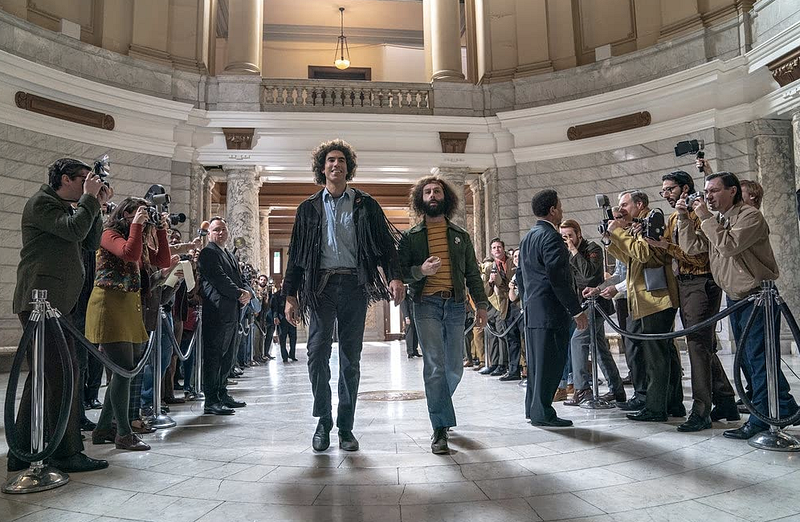
21–22: We now see the source of the “The whole world is watching!” chant — a massive crowd outside a courthouse held back by rope lines and police officers. The crowd is divided — one half in support of the defendants, while the other half making it clear they find the defendants’ hair too long and politics too left and are urging them to go live someplace else. We whip pan to see different signs: “Free the Chicago 7”; “Out of Vietnam Now!”; “What About White Civil Rights?”; “Love It Or Leave It!”, etc. A couple of POLICE OFFICERS escort Abbie and Jerry through
the front doors and through the rotunda. Press and photographers are being held back by a velvet rope as flashbulbs spray. Abbie asks Jerry if he is alright, but Jerry is honest that he was until he saw the crowd. A GUY from the crowd shouts out “We love you, Abbie!” As Abbie turns to flash a peace sign, the Guy throws an egg at him. Incredibly, Jerry grabs the egg out of the air without breaking it as the POLICE OFFICERS head into the crowd to find the guy who threw it. Abbie is incredulous and demands an explanation. Jerry answers, “Experience.” Abbie states, “You don’t know what to do with the egg now, do you.” Jerry confirms this. “No.”
23–24: Inside the courthouse rotunda, an elevator dings in a packed corridor lined with PRESS. A rumpled man, WILLIAM KUNSTLER, 40s, and the sharp LEONARD WEINGLASS step out. They are greeted by a bombardment of questions from the reporters. Kunstler tells them to quiet down, and introduces Weinglass as, “the new addition to the defense team,” “one of this country’s most talented First Amendment litigators.” Kunstler announces that Bobby Seale’s lawyer, CHARLES GARRY is still in hospital and confirms that he is not acting as his attorney. JACK, one of the reporters, lobs the rumor that it was Tom Hayden who wanted to bring in Weinglass due to his concerns about Kunstler’s seriousness. Weinglass ends the impromptu press conference. “This is William Kunstler. You want to find out how serious he is, meet him at a witness stand.”
24–28: The gallery is packed with diehard supporters of the defendants as well as a full press section in the back. There’s more than the usual amount of security. We see a half-dozen MARSHALS wearing blue blazers and badges. Dave Dellinger is talking to his wife and son.
Schultz, Foran, and an ASSISTANT are talking at the prosecutor’s table. We move down and find JOHN FROINES and LEE WEINER already at the defense table. John says to Lee, “I get why they’re trying to smoke Abbie and Jerry and Hayden, even Rennie and Dellinger, but for the life of me I can’t figure out what the two of us are doing here.” Weiner agrees. “I feel exactly the same way. But this is the Academy Awards of protest and as far as I’m concerned it’s an honor just to be nominated.” Down the defense table is Tom Hayden, seated beside Rennie, who has a piece of paper before him. “I’ve been keeping a list every day. Americans who’ve been killed since the day we were arrested.” Tom is curious. Rennie answers him, “With the trial starting it might get easy to forget who this is about.” Kunstler and Weinglass take their seats beside Tom and Rennie, and bid them good morning. Kunstler quietly admonishes Tom. “I just got a question about my seriousness. Whatever’s going on between you and Abbie, keep it out of this building.” While Tom struggles to explain, they are interrupted by the entrance of Bobby, who is handcuffed and in prison coveralls, and brought in by two MARSHALS. We see a group of 8 or so African-Americans sitting together in front, along with FRED HAMPTON — 21, handsome and a steady leader. Kunstler moves to speak to Fred and Bobby quietly. Fred greets him politely, while Kunstler asks Bobby if he has had breakfast. Fred is incredulous, but Kunstler explains that he is asking because that is the only thing he is allowed to discuss with Bobby. Fred confirms this, saying they have instructions from their lawyer. Kunstler offers his help, they need only to ask. Fred firmly tells him, “We don’t need you.” Kunstler comments to Bobby about the group of African Americans sitting together. “They shouldn’t sit together. The jury’s not gonna like that look.” Bobby starts to retort, but Fred smoothly agrees with Kunstler and asks the group to spread out in pairs. Kunstler then gestures to Fred to indicate they should remove their berets. Bobby responds with, “No, they’re dressed just fine.” Fred, however, tells the group it’s alright. “Take your very scary hats off.” He turns to Kunstler. “Don’t mess us up.” Kunstler returns to his seat as Abbie and Jerry are sitting down. It’s clear that Abbie is stoned and high. Kunstler turns to Tom. “You remember what I said.” Tom reminds him, “Okay, and you remember to keep us out of prison.”
28–36: The heavy wooden door behind the bench opens. The BAILIFF announces, “All rise!” JUDGE HOFFMAN takes his place at the bench. It’s not entirely clear whether Judge Hoffman is a bad judge, in the tank for the prosecution, experiencing early senility or a combination of all three. The Bailiff commences the proceedings. “Hear yea, hear yea. September 26, 1969, 10 o’clock A.M. All persons having business before the United States District Court of Northern
Illinois, Southern District, Eastern Division draw near and they shall be heard. Judge Julius Hoffman presiding. God save the United States of America and this Honorable Court.” While the JURY is led in, Judge Hoffman remarks, “As I look out into the gallery I see we have a full house. Some of you started forming a line early this morning. I’ll caution you that this isn’t a sporting event. Let the record show that we’ve been joined by our twelve jurors and four alternates.” He asks MRS. WINTERS to call the case. She announces, “69 CR 180, United States of America vs. David Dellinger, Rennard C. Davis, Thomas Hayden, Abbott Hoffman, Jerry C. Rubin, Lee Weiner, John R. Froines and Bobby G. Seale for trial.” Schultz confirms The People are ready to make opening arguments. We see a title card: Trial Day 1. Bobby stands. “I don’t have my lawyer here.” Judge Hoffman rebuffs him. “It’s not your turn to speak.” Bobby stands firm. “My trial’s begun without my lawyer.” Hoffman defers to Schultz. Schultz awkwardly begins his opening statement, introducing himself as an Assistant U.S. Attorney for the Southern District of Illinois, and his boss, U.S. Attorney Thomas Foran. He explains for the benefit of the jury that “At the defense table are the eight defendants represented by their lawyers, William Kunstler and Leonard Weinglass. The defendants would tell you they represent three different groups.” He is interrupted by Judge Hoffman, who would like to clarify for the jurors that, “There are two Hoffmans in this courtroom. The defendant, Abbie Hoffman, and myself, Judge Julius Hoffman.” Abbie is quick to respond. “Man, I don’t think there’s much chance they’re going to mix us up.” As the GALLERY laughs a little, Judge Hoffman is not amused. “You will address this Court as Judge or Your Honor and you will not address this Court until — you will not address this Court.” Tom struggles to stay cool. Schultz tries again. “The defendants would tell you they represent three different groups.” Judge Hoffman reiterates again. “And the record should reflect that defendant Hoffman and I aren’t related.” Abbie, unable to resist, cries out “Father no!” Judge Hoffman asks Abbie if he is familiar with contempt of court. Abbie answers, “It’s practically a religion for me, sir.” Tom is clearly uncomfortable with the exchange. Schultz continues on, naming the defendants. When he gets to Bobby, Bobby stands again and asks to speak. Judge Hoffman refuses. Bobby is demanding. “I have a right to counsel and His Honor knows that.” Judge Hoffman is immovable. “Don’t tell the Court what it does and doesn’t know. Be seated.” Bobby sits as Schultz awkwardly continues the prosecution, outlining the reason they are in federal court is because the defendants crossed state lines to execute their plan, which was to incite a riot, for which they were successful. As Judge Hoffman seeks clarity to identify all of the defendants, he mispronounces Lee Weiner and Dave Dellinger’s names, leading both to correct the confused Judge. Schultz and Kunstler try to be of assistance to get the record straight, but Abbie again is unable to resist. “Dillinger was a bank robber, Derringer is a gun, he’s David Dellinger and the judge and I aren’t related.” While Foran, Judge Hoffman, and Kunstler struggle to get back on track, Bobby stands again. “I object to being characterized as a member of this group.” Judge Hoffman asks the identity of his lawyer, to which Bobby explains, “My lawyer, Charles Garry, is in a hospital in Oakland having undergone gallbladder surgery.” Judge Hoffman demands that Kunstler defend Bobby, because it is all the same case, but Kunstler argues back, “The fact that there’s a lawyer near Mr. Seale doesn’t satisfy the requirements of due process.” Bobby struggles to speak for himself but Kunstler hushes him. “A motion was made for postponement due to Mr. Garry’s medical condition. I was there. Your Honor denied that motion and therefore Mr. Seale is here without legal representation.” Judge Hoffman reprimands Kunstler’s tone, but Kunstler responds with “I meant no disrespect to the Court, sir. I’m trying to be clear that I can’t muddy Mr. Seale’s grounds for appeal by appearing to speak as his lawyer.” Judge Hoffman appears to not accept the fact that Kunstler is not Bobby’s legal counsel, when Jerry interrupts, “Jesus Christ, for the fourth time, he’s not Bobby’s lawyer!” Bobby tries again to explain that he has never had contact with any of the 7 in the group represented by Kunstler, pointing out that “There are eight of us and there are signs out there that say ‘Free the Chicago 7’ — I’m not with them.” As Bobby continues to protest, Judge Hoffman demands a Marshal to seat him. A WHITE MARSHAL gives the order to a BLACK MARSHAL, who takes hold of Bobby as Bobby demands he take his hands off him. Judge Hoffman decrees that Bobby is charged with one count of Contempt of Court. The whole nightmare was precisely what Tom wished to avoid.
37–42: The Defendants and their lawyers congregate in the Defence Conference room for lunch. Tom’s the last one in and he slams the door behind himself, which gets everyone’s attention. Tom gets to the point. “Are we using this trial to defend ourselves against very serious charges that could land us in prison for 10 years or are we using it to say a pointless fuck you to the establishment?” Jerry and Abbie argue with Tom about the entire purpose of why they went to Chicago. Tom tries to reason with the group. “If the jury finds us guilty we’re not gonna be leaving here at all. And the only thing we need to say about why we came is that it wasn’t to incite violence.” Dave Dellinger, the Boy Scout Leader, announces he’s with Jerry. “The trial shouldn’t be about us.” Lee Weiner opines that he thinks the judge is crazy. Abbie stirs Tom up even further, mocking him for apparently trying to dress to appeal to the judge. While Abbie waxes on about real cultural revolution, Tom blasts Abbie. “I don’t have time for cultural revolution. It distracts from actual revolution.” Kunstler tries to end the fighting, “Alright, did everybody get everything off their chests?” when Fred Hampton enters the room to blast Kunstler, “What in the name of hell was that?!” He admonishes the group. “Bobby’s life is at stake and you guys are playin’ to the crowd?” He’s further appalled. “The white guys are in a furnished room while Bobby’s in a holding cell.” Kunstler tries to explain. “The white guys are free on bail. Bobby’s locked up ’cause he’s under arrest in Connecticut for killing a cop.” Weinglass pleads with Fred to convince Bobby to let them represent him. Fred pauses, then announces that Bobby is “innocent in Connecticut. He’s never killed anyone. It’s important you all know that.” Fred then admits that he has tried to persuade Bobby to allow Kunstler and Weinglass to represent him, but explains that Bobby “needs to do it his way.” Fred agrees to keep trying, but is interrupted by the Marshal calling the group back. Kunstler directs Abbie and Jerry to keep their mouths shut in the courtroom. Abbie reluctantly agrees. As the group leaves the room, Weinglass stops Tom. “Abbie’s smarter than you think he is.” Tom disagrees.
43–46: DAVID STAHL is on the stand. We see a title card: Trial Day 3. Stahl identifies himself to Schultz as the mayor’s administrative officer. Schultz asks him who did he have a meeting with on March 26th, 1968. Intercut with flashbacks of Abbie and Jerry meeting Stahl in his office as Schultz asks what was discussed at the meeting. Stahl explains, “I was told that the Youth International Party would be holding a Festival of Life in Grant Park during the Democratic National Convention, that there would be thousands of young people attending and that there would be rock bands playing in the park.” Stahl confirms to Schultz that he did not issue the permits by clarifying that beyond the musical performances, he was told there would be public fornication. Schultz asks for what Abbie said when he was told their request would be denied. We flashback to Abbie saying, “Mr. Stahl, you need to understand something. There’s going to be a Festival of Life in Grant Park and it will be held during the convention. Bands will play rock music. There will be public fornication, likely some of it with the wives and mistresses of delegates. Psychedelic long-haired leftists will consort with dope users. And we’re going to insist that the next President of the United States stop sending our friends to be slaughtered. These things are going to happen whether you give us the permit or not.” Schultz presses Stahl further. “Did Abbie Hoffman add something at the end of that meeting?” Stahl confirms. We flashback to Abbie: “Or you could gimme a hundred grand and I could call the whole thing off.”
47–55: Weinglass steps in for his turn. “Mr. Stahl, the meeting you just described with Mr. Hoffman and Mr. Rubin, was that the only meeting you had with any of the defendants?” We see a Title Card: Trial Day 4. Stahl confirms that it was not. Weinglass sets it up. “On August 2nd you had a meeting with Tom Hayden and Rennie Davis.” We flashback to this meeting, with Tom and Rennie dressed in coat and ties. Weinglass points out “And on August 12th you had a meeting with David Dellinger.” This flashback simply shows Stahl saying to Dave, “I’ll tell you the same thing I told the others.” Weinglass reminds Stahl that he held several more meetings with Tom, Rennie, and Dave, saying, “And at each meeting, a request was made for a permit to demonstrate in Grant Park during the convention.” We flashback to Dave, making his request. “Mr. Stahl, we intend a peaceful demonstration. We’re not interested in violence or disturbing the delegates.” Weinglass confirms, “And at each meeting the request for permits was denied.” In Tom’s meeting with Stahl, he explains. “We’re cautioning you. Thousands of people are coming to Chicago and if they’re not given a place to demonstrate they’re gonna demonstrate wherever they’re standing. It’s reckless, irresponsible and foolishly dangerous of the city not to develop a contingency plan. We’re gonna need police security and first aid, traffic control, water, sanitation — ” Weinglass gets to his point that Stahl had been asked five times for a permit, was advised of the dangers of not providing a location to demonstrate, and clarifies that that this was at the instruction of Mayor Daley, who has the power to appoint and remove him. Kunstler’s cross-examination of Stahl is interrupted by Judge Hoffman, who asks Bobby to identify the man who is seated behind him. Bobby refuses, saying that the man is not on trial here. Judge Hoffman is direct. “Mr. Seale, identify the man sitting behind you.” Fred whispers to Bobby, who relents. “His name is Fred Hampton.” Judge Hoffman speaks. “Let the record indicate that Mr. Hampton is the head of the Chicago chapter of the Black Panther Party.” Kunstler argues, “Your Honor, Mr. Hampton isn’t at the bar, why is the record identifying him at all?” Judge Hoffman announces, “Mr. Hampton is clearly giving Mr. Seale legal advice.” Kunstler counters, “Excuse me, sir, but for all you know Mr. Hampton is giving Mr. Seale the score of the White Sox game.” Judge Hoffman remains firm. “I will assume that he’s not.” As Kunstler seeks an explanation, Judge Hoffman maintains, “Because that’s what happens when you don’t have a lawyer. The Court assumes that you’re being represented by the Black Panther sitting behind you.” He motions for Kunstler to continue his cross examination. Kunstler presses Stahl further on why he did not alert any of the authorities about Abbie’s offer to call the entire protest off, when Judge Hoffman orders the jury to disregard the entirety of Stahl’s testimony under cross-examination. Kunstler’s on thin ice. Kunstler and Stahl discuss the source of the destruction, which Kunstler implies that Stahl is the one suggesting it is the Chicago Police Department. As Kunstler finishes, Bobby asks to cross-examine the witness. Judge Hoffman refuses. Bobby asks Stahl, “Have you ever met me?” But Judge Hoffman tells him to sit.
55: In a make-shift press room, Abbie and Jerry sit at a table in front of a dozen microphones. TV cameras line the back of the room. REPORTER #7 goes for the jugular. “Why won’t Bobby Seale let anyone represent him?” Jerry rebuffs him. “You’ve posed that question in the form of a lie.” The press conference continues in voiceover as we see Kunstler exit a taxi. He’s sprayed by flashbulbs as he makes his way into his house. Back at the press room, Jerry is adamant. “Bobby Seale’s lawyer is Charles Garry who’s in the hospital right now. A motion was made for postponement and it was denied by a judge who just for the heck of it is suspending due process for a while.”
55–58: A group of YOUNG WOMEN work at either answering phones or opening bags of mail in a three-bedroom apartment standing in for a make-shift “Conspiracy Office.” Court documents are in piles on tables and on the floor. A big board shows the schedule of witnesses and the walls are adorned with posters including ones that read “FREE THE CHICAGO 7”. BERNADINE answers the phone, “Conspiracy office, can you hold on?” Kunstler tells her, “Maybe you don’t want to call it the conspiracy office.” Bernadine is confident that the callers are smart and will “understand irony and appreciate the humor” but Kunstler tells her not to count on it. She passes him a stack of messages as she juggles the onslaught of callers. Kunstler moves into the dining room, where Tom and Weinglass sit at a table piled with documents, and informs Tom they had a good day. “Jurors 6 and 11” are with them. Weinglass elaborates. “6 made sure I saw a copy of a James Baldwin novel under her arm and 11’s been nodding during the Stahl cross.” We see Abbie and Jerry’s press conference on TV. While REPORTER #8 goads Abbie into whether he would have taken one hundred thousand dollars to call the whole thing off, with Abbie saying that though he would happily take the money, he cannot confirm he would cancel anything. REPORTER #9 asks pointedly, “How much is it worth to you? What’s your price?” Abbie clarifies the question. “To call off the revolution?” Abbie drops the comedy, and states simply, “My life.”
58–62: Everyone’s in their places but the BAILIFF and a MARSHAL are at the bench. They’ve given a note to Judge Hoffman and he’s looking it over. As everyone waits, we see a title card: Trial Day 23. Judge Hoffman moves to adjourn the court for the day and asks to see counsel in his chambers. As the lawyers walk into Judge Hoffman’s chambers, and a MARSHAL closes the door, Judge Hoffman announces that “It’s been brought to my attention that two of the jurors have received threatening notes from a member or members of the Black Panther Party.” Judge Hoffman then reveals that they are Juror number 6 and Juror number 11, and establishes that they will not be able to render a fair and impartial verdict and should therefore be dismissed. As the lawyers exit Judge Hoffman’s chambers, Foran comments, “I thought the Panthers were smarter than that.” Kunstler responds, “The Panthers don’t write letters any more than the mob does, and the moment I find out it was your office that did, you’re gonna see the criminal justice system up closer than you ever wanted to.” As Kunstler exits with Weinglass, Schultz looks at Foran…”Did we do this?”… but Foran says nothing.
62–66: Kunstler, Weinglass, and the Defendants process this new development at their Conspiracy Office. While Tom asks who are the alternatives, Jerry wants to make this public. The room is tense. Weinglass identifies that one of the alternatives is “Kay Richards. She’s a 27-year old dental hygienist” but Kunstler reveals the caveat, “We think she’s dating a guy named Tom Bannercheck who works for Daley.” As the room erupts in an uproar, Kunstler makes clear she is the preferable candidate as the other option was a Korean War vet who kicked his son out of the house for protesting the Vietnam War. Jerry speaks the question on everyone’s mind. “Did they manipulate the jury pool? How come there’s nobody who looks like me?” They are interrupted by the arrival of a message, announcing that Judge Hoffman is sequestering the jury. Kunstler’s reaction is telling as he instructs Weinglass, “I want an expert in geriatric psychiatry sitting in the gallery for a few days. I want a medical evaluation of this judge.” The group moves to the living room, and they are quiet as they watch the nightly news. Rennie and Bernadine write down the names of that day’s fallen soldiers being scrolled.
66–68: In the courtroom, the jury box is empty. Kunstler addresses Judge Hoffman. “We move to strike the order of sequestration of the jury which was made by Your Honor’s sua sponte motion.” Judge Hoffman is distracted by Abbie and Jerry. They’re wearing judge’s robes. Abbie answers. “It’s an homage to you, sir.” Judge Hoffman orders them to remove the robes. Abbie and Jerry take off the robes to reveal police uniforms underneath. There’s a big laugh from the GALLERY. Judge Hoffman motions to Kunstler to continue. Kunstler continues to respectfully challenge the judge’s order, but Judge Hoffman orders the BAILIFF to charge Kunstler with one count of Contempt. Kunstler continues to argue that the sequestration of the jury will manipulate the jury to be more sympathetic towards the law enforcement officers and therefore the side of the prosecution. As a MARSHAL adjusts his name tag in the courtroom, we flashback to Tom’s memory of the night of the riot outside the Hilton Hotel. A line of about fifty DEMONSTRATORS, including Tom and Abbie who have their backs up against the hotel and convention center. Facing them down are a line of RIOT POLICE with their clubs drawn. Tom sees a RIOT POLICEMAN take off his name tag and then his badge and puts them in a pocket. Then another does the same and then another…
68–77: FRANK DELUCA, a detective with the Police Department, City of Chicago, is being cross-examined by Schultz. Deluca gives his explanation of his duty during the convention. “I was to keep Rennie Davis under surveillance with my partner, Detective Bell.” Schultz questions him. “And while surveilling Rennie Davis on Sunday evening, August 25th, the night before the convention began, did you observe Tom Hayden committing a crime?” Deluca confirms this. “Yes. Mr. Hayden was letting the air out of the tire of a police vehicle.” We flashback to that night in Grant Park. It’s a sweltering hot night as we get introduced to the park and its occupants for the first time. Thousands of people that can only be made out in silhouette with flickers of lanterns, flashlights and fires. We can hear a pick-up band singing Simon and Garfunkel’s “America.” A sea of tents is being erected, a GROUP makes protest signs, while a fire burns in a garbage can beside a sign that reads “Burn Your Draft Cards.” YOUNG MEN come up, rip up their draft cards and throw them in the fire. We move to another fire burning in another garbage can. A sign reads, “Free Yourself from Patriarchy — Burn Your Bras”, with WOMEN walking by and dropping their bars in the fire. A police vehicle is driving slowly and repeating on a loudspeaker, “The park closes at 11pm by order of the Chicago P.D. You must be out of the park by 11pm. Violators will be prosecuted for trespassing…” as Abbie addresses a group of PROTESTORS, “It’s a strategy of throwin’ banana peels all over Chicago and then let the machine stumble. And when it stumbles, it gets into a policy of overkill and starts to devour itself. We’ll convince ’em. They’ll be convinced. Of what? That we’re crazy enough to do anything.” We then see Jerry addressing another group, “We think it’s important for confrontational tactical knowledge to be understood. Confrontational tactics make us safer. Why? Because the police become afraid. And that’s fighting fire with — ” with the crowd responding by shouting “FIRE!” Jerry begins his Molotov cocktail demonstration, as Tom and Rennie observe. Tom’s not in alignment with Abbie and Jerry. “You don’t fight fire with fire, you fight it with water, ya jackass.” While Rennie tries to dismiss their rhetoric as only metaphors, Tom’s very concerned. “Between the cops, the state police and the Guard, Daley’s got 15,000 soldiers on the street whose guns are loaded with bullets that are literal.”
He continues, “The atmosphere’s starting to get dangerous and someone’s gonna throw a rock. I want to get the word out that we’re protesting the war and not the cops.” Rennie points out to Tom the cars of the UNDERCOVER POLICE OFFICERS that have been tailing him. He’s staying with his girlfriend SARA BETH and her family, and not only does he wish to keep them in the dark about his activities, he does not want to bring those officers into their driveway to preserve his relationship with them. Tom hatches a plan to let the air out of the officers’ tires as a non-violent way for Rennie to get away. Frank Deluca continues with his testimony, describing how they had spotted Rennie Davis with his partner, BELL, and returned to their car. We flashback to the moment where we see Frank catching a kneeling Tom letting the air out of the car tire. Deluca grabs Tom and slams him on to the hood of the car, ordering him to assume the position, when a DEMONSTRATOR shouts, “Hey, they’re hassling Tom Hayden!” Two dozen silhouettes descend on Bell and Deluca. As Bell shouts and flashes his badge, identifying him as a police officer, Tom calls to the crowd to stay cool. Deluca directs Tom to tell the crowd to get back. We cut briefly back to the courtroom, as Schultz asks, “And did he tell the crowd to get back?” We see the flashback of Tom calling out, “Everybody get back! I’m alright, stay cool!” but back in the courtroom, Deluca claims “He was egging them on.” Schultz questions Deluca if they took Tom under arrest in that moment, but Deluca admits they did not. As Schultz questions why, we flashback to a bright light shining in Deluca’s face in Grant Park, as Bell quietly tells him that it’s from a TV camera. In the courtroom, Deluca states “We wanted to diffuse the situation so we arranged to take Mr. Hayden in the next morning.” We flashback to the next day, when OFFICER QUINN pulls up to Tom along with some other OFFICERS, flashing lights but no sirens, and arrest him in broad daylight. Tom was expecting them and is cooperative, as he bids farewell to Rennie.
77–78: As Judge Hoffman orders a recess, Bobby presents his motion. Judge Hoffman allows it. We see a YOUNG BLACK woman hand a legal pad to a BLACK MAN who walks the pad down to Fred Hampton who hands it to Bobby. As Bobby explains he has a motion pro se to defend himself and would like to invoke the precedent of Adams vs. U.S. ex rel. McCann, Judge Hoffman interrupts him. He’s clearly more interested in Fred than in hearing what Bobby has to say. Kunstler and Judge Hoffman again engage in the old argument over the situation of Bobby’s legal representation. As Bobby again tries to claim that he is being denied his Constitutional right, Judge Hoffman again silences him. “Will you be quiet? Will you? Will you be quiet? That’s all. You have lawyers to speak for you.” Kunstler is furious. “No he doesn’t!” which leads Judge Hoffman to cite Kunstler with his second count of Contempt.
79: It’s night time, and the College Auditorium is packed and smoke-filled. Everyone is there to see and hear Abbie, who’s up on stage at the microphone, in a style not unlike Lenny Bruce. He recounts, “So Hayden’s in a holding cell on a tire-pressure related charge and suddenly every freak in Chicago is mobilized. ‘They got Hayden, they got Hayden.’ We’re gonna march down to the police station, overcome the police and the Illinois National Guard and free Tom Hayden.” He pauses, then continues. “We couldn’t find our way out of the park.” A big laugh erupts from the crowd. “Over the course of 10 days, the government called 37 witnesses, each and every one of them an employee of the government. I call this portion of the trial, ‘With Friends Like These…’”
79–88: STANLEY R. WOJOHOWSKI is on the stand. We flashback to him, looking like a biker, being introduced to Abbie in Grant Park by another biker, EDDIE, as a bodyguard. As Schultz continues to cross-examine him, Wojohowski identifies himself as a Chicago Police Officer. We flashback to Rennie being introduced to SAM, a man to be trusted. Back in the courtroom, Sam identifies himself as Detective Sam McGiven, Chicago Police Department. Flashback to Tom meeting SCOTT, who promises Tom to get him anyone or anything he needs, but in the courtroom he identifies himself as “Staff Sergeant Scott Scibelli, Illinois State Police.” We flashback to Jerry meeting DAPHNE, who buys him a drink and flirts with him in a bar. In the courtroom, she identifies herself as “Special Agent Daphne O’Conner, FBI. Counter Intelligence.” She explains her assignment was “To use Jerry Rubin to try to infiltrate the leaders of the protest.” She further claims that when she was with Jerry, Abbie, Rennie, and Dave on the afternoon of the 27th, they were leading approximately 800 protestors to Police Headquarters at 11th and State in Chicago. As Schultz asks why, Daphne answers, “Tom Hayden was being held there on charges of tampering with a police vehicle. Jerry Rubin said it was time to confront the pigs.” Daphne clarifies that Jerry meant “It was time to confront the police.” We flashback and see Abbie, Jerry, Rennie, as well as Daphne, and the other undercovers lead DEMONSTRATORS who are pouring out onto the street from the park. We hear a call and response chant of “Free Tom Hayden! “Free Tom Hayden!” as the crowd makes its way up Michigan Avenue. A POLICEMAN standing on the street reaches for his radio and calls ahead. We see a rack of riot gear — helmets, nightsticks, etc., being grabbed off racks. We cut back to Sam’s testimony in the courtroom, who says that at the front of the group was the poet ALLEN GINSBURG who was chanting a kind of war chant. We flashback and see Allen has his hands raised and is chanting “ohmmmmm” as Abbie explains to Jerry that “He’s calming the energy, settling things down.” We intercut between Abbie’s retelling in the auditorium with the undercover officers’ testimony in the courtroom of the demonstrators’ march to the police station. We see them confronted by the sight of RIOT POLICE pouring out of the station and forming a line in the middle of the street. Jerry is ready for action, but Abbie tells him “We’re not rushing the police.” Rennie reminds them that Tom did not want anyone to get hurt, while Dave says, “We’ve gotta turn this crowd around. There’s too much momentum, we’ve gotta turn ’em around and calm ’em down.” Daphne tells Jerry, “He’s right. This isn’t safe, I know something about this.” Dave gives the order in his walkie-talkie “All marshals — slow ’em down and turn ’em around. It’s the Alamo up here. Turn ’em around and get ’em safely back in the park.” While Jerry protests that they should be marching right up to the police, Abbie stays rational. “I don’t think they’re gonna surrender man. Keep ’em moving. Dave and I are gonna stay and make Tom’s bail.” In the auditorium, Abbie says to the crowd, “The marshals are spreading the word that we’re gonna keep moving, go left on Roosevelt and back in the park, right?”
88–94: Daphne continues her testimony in court. “When they got to the park they saw that three divisions of police officers had moved in from the south.” But as Jerry, Rennie, and the Demonstrators return to Grant Park, they are faced with lines and lines of police officers that have formed at the top of the hill in the park.” In the auditorium, Abbie then says, “I don’t know what tactical genius came up with that, but you know when shit happens? When you don’t give protestors a place to go.” In the courtroom, Kunstler moves to object to Wojohowski’s testimony that “The crowd was looking for a fight.” We intercut with flashbacks of the demonstrators’ confrontation of the police, zeroing in on some FRAT BOYS who taunt a YOUNG WOMAN who is part of the march, with the officers’ testimony in the courtroom. Daphne’s testimony confirms that Jerry was trying to defuse the situation, and that it was an unidentified SOMEONE in the crowd that shouts “Take the hill!” In the flashback we see the CROWD charging up a hundred-yard hill to a statue that sits atop, and heading right for the Riot Police, as Rennie and Jerry try to stop them in vain. Tear gas canisters get fired into the crowd as the POLICE strap on gas masks. The POLICE move into the CROWD and start swinging their clubs full force. The unlucky ones near the gas emerge from the thick, grey dust blinded and gasping for air. Others have blood spray from their foreheads and down their mouths as they get struck in the face with clubs. Jerry and Rennie are trying to pull people away and send them back down the hill. The Young Woman who was taunted by the Frat Boys is tackled from behind by them as they continue their lewd remarks, hitting her in the face and tearing her shirt off. Jerry sees this, and runs towards the woman, pulling one of the Frat Boys off and punching another in the face, while the third Frat Boy runs off to avoid the tear gas. Jerry tends to the girl and takes his own shirt off to cover her, but is interrupted by the sound of a gun locking behind his head. Jerry tells the THREE POLICEMEN in gas masks to pursue the Frat Boys that attacked the Woman, but they arrest him instead.
94–98: Daphne is on the stand as Kunstler begins his cross-examination. He asks her to confirm that “After bailing Tom Hayden out, Abbie, Dave and Tom returned to the park, is that correct?” as we flashback and see the named parties surveying the scene. There’s still tear gas, people are being treated by EMTs and put into ambulances, etc. It’s not pretty. Things clearly had not gone according to Tom’s plan, and he pins the blame on Abbie. We see Daphne try to diffuse the tension between the men, as they take in the enormity of what’s happening. Tom wants Abbie to get his followers to cool off, reminding him of his responsibility for their well-being, but Abbie thinks differently. “We have to protest in front of the convention, Tommy, plain and simple. ’Cause that’s where the cameras are. We have to get to the convention. And that means we have to leave the park. And that’s when people’ll get hurt. As long as every person following me knows that, I sleep fine at night.” Tom points to the hill, where tear gas still hovers and people are being bandaged or handcuffed. “That’s what happened when we tried to go up a hill. We’re not getting anywhere near the convention.” In the courtroom, Kunstler clarifies with Daphne that though Jerry made remarks about forming an army and getting guns, he confirms with her that no one acted on this, nor did Jerry instruct the crowd to run into the park. He also clarifies that neither Rennie, Abbie, Dave, John, or Lee committed these actions or in some cases, were not even present. When Kunstler tries to get Daphne to admit on the stand that “They were trying to turn people around and send them back down the hill. Just like you told them to.” Daphne changes her tune. “Mr. Kunstler, the demonstrators attacked the police and the police responded.” Kunstler tries one more time. “Are any of the demonstrators you saw attacking the police sitting at the defense table?” Daphne concedes. “No sir.” Bobby then interjects. “I wasn’t there either.” Judge Hoffman tries to call a recess and refuse Bobby’s request to cross-examine Daphne, when Fred Hampton stands up, and states that Bobby was in Chicago for only four hours. As the Defendants, with the exception of Tom, applaud and bang the table, Judge Hoffman calls to recess for the weekend.
98–102: Saturday afternoon during the Christmas season at the Natural History Museum. We hear a brass performance of “O Holy Night.” Jerry and Abbie, sitting on a bench, discuss the exhibits in the museum, when they spot Schultz and his TWO YOUNG DAUGHTERS, aged 6 and 4. They greet him, and as Schultz introduces his daughters to the two men, Abbie surprisingly compliments their father. Schultz tells the two men that they should not be speaking without their lawyers present, but Abbie is dismissive. “Nah, we’re all on the same team.” Schultz only partially agrees, then gives his girls some cash to give to the musicians and to buy some treats. He then tells the two men that the window is rapidly closing on there being able to negotiate a deal. Jerry makes clear they will never take a deal, and calls out the shadiness of the tactics used by the FBI to spy on them, specifically mentioning the fact that Daphne had broken his heart. Schultz points out that the two of them had contact only over a few days, but Jerry gets back to the lack of ethics in the way she set up a relationship with him. Abbie tries to clear the air. “We just wanted to say that we don’t have any beef with you. We know you’re doing your job and we know you don’t think we’re criminals.” Schultz maintains he represents the people without passion or prejudice, and states that he only thinks that the group got the results they were looking for, before leaving to attend to his daughters. He ignores Jerry’s question if Daphne ever asks about him.
102–104: The phone rings and wakes up Bernadine and Tom in the Conspiracy Office. Bernadine answers, then speaks. “It’s Bill. Something’s happened, Tom.” In the morning, Tom and Kunstler meet Bobby in the visiting room of the Cook County Jail. Kunstler gets to the purpose of their visit. “Bobby, Fred Hampton was shot and killed last night. There was a police raid and there was a shootout and he’s dead.” As Kunstler continues with the details, Bobby cuts him off. “I know.” Bobby turns to Tom, and confronts him on the reasons for the Defendants’ protest, and points out the significant differences in the way he and Fred have been treated. “Yeah. He was shot in the wrist first. You can’t hold a gun if you’ve been shot in the wrist. You can’t pull a trigger. The second shot was in the head. Fred was executed.”
104–111: DETECTIVE FRAPOLY’s on the stand. Title reads: Trial Day 90. Schultz is cross-examining him, asking what happened in Grant Park on August 27th. When asked if he recognized any of the speakers, Frapoly states, “I heard Jerry Rubin give a speech. Phil Ochs sang and then Bobby Seale gave a speech.” Bobby responds lifelessly, almost by rote. “I object to this man’s testimony against me because I’ve been denied counsel.” Judge Hoffman merely states, “We understand.” Schultz continues with his questioning. Frapoly attempts to quote from Bobby’s speech, and though Bobby objects, Judge Hoffman directs Schultz and Frapoly to continue. Though Frapoly states on the stand that Bobby had said in his speech, “The revolution at this time is directly connected to organized guns and force.” Bobby seems more upset in that he is being portrayed as “A jive, double-lip talkin’, funky, funky cat.” Again Bobby raises the issue that he is on trial without his lawyer. Judge Hoffman yells at him to be quiet and to never address the court. Bobby turns to the GALLERY and announces, “It was premeditated murder. Fred Hampton was assassinated last night.” While Judge Hoffman orders the MARSHALS to deal with him, Bobby continues. “He wouldn’t have been able to hold a gun in his right hand. When they publish the coroner’s report, make sure you ask about the bullet wound in his wrist.” Bobby tired of the Judge’s repeated warnings, tells him off. Judge Hoffman gives the order. “Marshals, take that defendant into a room and deal with him as he should be dealt with.” The Marshals grab at Bobby and lift him out of his seat, and then throw him into a holding cell. We intercut between the silent tension in the courtroom as everyone waits, with the images of Bobby being put in restraints. In the courtroom, Rennie writes a note directing the defendants not to stand for Judge Hoffman. While Tom reluctantly assents, and the note is passed around the group, we see a balled up rag stuffed into Bobby’s mouth, and cloth starts to be tied around his face. The Marshals bring Bobby back into the courtroom, bound, gagged and chained. The Gallery reacts in horror. Judge Hoffman raps his gavel until there’s finally silence, then addresses the court. “Let the record show that I tried, fairly and impartially, I tried to get the defendant to sit on his own. I ask you again, and you may indicate by raising your head up and down or moving it from side to side, if I have your assurance that you will not do anything to disrupt this trial if I allow you to resume proper order.” Though Bobby shows his refusal by shaking his head “No,” Judge Hoffman directs Schultz to call in his next witness. Schultz asks if the lawyers may approach the bench, and the judge assents. Kunstler checks with Bobby to confirm he is able to breathe, and Schultz very quietly says to the lawyers and judge, “Your Honor, a defendant is bound and gagged in an American courtroom.” Foran is dismissive. “He brought it on himself.” Both Kunstler and Weinglass are aghast and make it clear they found Bobby’s treatment an “unholy disgrace to the law.” Schultz then moves to make a motion that Bobby Seale be separated from the other defendants and that a mistrial be declared in his case. Though Foran at first resists Schultz’ recommendation, Kunstler backs the suggestion. “You took their black guy and made him a sympathetic character.” Judge Hoffman bristles. “I’ve lived a long time and you’re the first person who’s ever suggested that I’ve discriminated against a black man.” Weinglass gets a word in. “Then let the record show that I’m the second.” Judge Hoffman sends them back to their tables and issues the order to declare a mistrial in respect to Bobby. Though the Courtroom erupts in cheers, he addresses Bobby. “Mr. Seale, you’re currently charged with 16 counts of contempt for your repeated displays of disrespect, and you have a pending homicide charge in Connecticut. You are not home free and I doubt you ever will be.” As he calls the court to adjourn for the weekend, Tom stands out of habit but no one else does. Tom immediately sees his mistake but it’s too late to sit. Judge Hoffman notices this and nods at him approvingly.
111–115: Back at the Conspiracy Office, the group gathers to debrief as Bernadine stickhandles a seemingly racist caller. Jerry goes after Tom for standing up for Judge Hoffman. Tom is at first defensive, explaining that it was a reflex, but then goes deeper. “And I don’t know what good it does to insult the judge. And it was in view of the jury. And the press. And Foran and Schultz who’ll be recommending sentencing if we’re convicted.” Abbie is dismissive. “It’s a revolution, Tom. We may have to hurt somebody’s feelings.” In an effort to move the discussion forward, Rennie proposes that they read the list of names into the record, as a way of saying that the challenges the Defendants are facing is nothing compared to what those who have been drafted for the war are experiencing. The group then debates who would be the best candidate to take the stand, to represent all of them. Rennie then ponders if this entire circus of a trial has been orchestrated as a means for Attorney General John Mitchell to get back at the perceived insult he received from Ramsey Clarke’s decision to delay his resignation. Kunstler asks Bernadine to get in touch with Clarke as Abbie says admiringly, “William Kunstler just showed up.”
116–118: In a DC suburb, a taxi pulls up outside the former Attorney General’s luxurious home. There’s a light dusting of snow on the ground. Tom, Kunstler, and Weinglass emerge from the cab and make their way to the front door, taking note of the U.S. Government license plate on the black sedan parked in front. They are greeted by JANE, a young, African-American housekeeper, who directs them to Clark’s office. As the men head down the hall, Jane stops Tom. “I read in the paper you were the only one who stood for the judge after what he did to Bobby.” Tom starts to explain that it was a mistake, but Kunstler beckons him.
118–122: Clark, dressed in khakis and a button down shirt, greets the trio in his study. Accompanying him are two men in dark suits, one of which is Howard Ackerman, who we initially met with Schultz and Foran in John Mitchell’s office. Framed photos are on the wall of Clark with former president Lyndon B Johnson in the Oval Office, and with Bobby Kennedy from his days as a Marine. He introduces Howard and MR. CALLEY, explaining that they are present for this meeting at Clark’s invitation. “I don’t want any appearance of impropriety.” Kunstler is offended. “There isn’t any impropriety.” Clark remains cool. “And now there are witnesses to that.” Clark acknowledges that Howard and Calley have already informed Schultz and Foran that this meeting is taking place, and that they will contact John Mitchell as soon as the meeting is wrapped. He tells Kunstler to make his request in front of everyone. Kunstler takes a breath. “Alright. Mr. Clark, while you were the Attorney General for President Johnson, was there ever a discussion with the White House about seeking indictments against my clients?” Howard immediately states that Clark cannot answer the question as it is against the law. Kunstler has just about had it with Howard and Mitchell’s handling of the case. “And I’ll tell you what — We’ve dealt with jury tampering, wire tapping, a defendant who was literally gagged and a judge who’s been handing down rulings from the bench that would be considered wrong in Honduras! — so I’m less interested in the law than I was when this trial began.” He threatens to subpoena Clark, but Howard counters with, “Find a judge in this circuit who’ll sign that subpoena.” Clark sides with Howard, “He’s right. And taking the stand voluntarily would be a big risk for me.” Clark then surprises everyone, by asking Kunstler how long it took “To realize I’m your star witness?” Howard maintains that Clark cannot testify, but Clark rebuffs him. “I’m in private practice now and if John Mitchell wants to cut me in half, he can and he will.” Tom seizes the moment and tells Clark that he must find some courage. Clark says to the room, “That’s what these two men came to tell me. That if John Mitchell wants to cut me in half, he can and he will. So I wanted them here in the room when I said — When do you want me in court?” Howard protests. “It’s against the law for you to testify, Ramsey, it’s that simple.” Clark shuts him down. “It’s General Clark and arrest me or shut the fuck up.”
122–130: Ramsey Clark is called by Kunster to take the stand. The Title reads: Trial Day 124. Schultz moves to disallow this witness. Judge Hoffman asks the Marshals to remove the jury from the room. Schultz stipulates that the disclosure of Clark’s testimony, which would be classified as Justice Department material, has been denied the approval of the sitting Attorney General John Mitchell. Weinglass counters, stating “Judge, the rule refers to very specific kinds of documents and information. If the regulation was interpreted as Mr. Schultz is asking it to be, nobody in the federal government would ever be able to testify in a trial after leaving their job.” Judge Hoffman moves to ask the defense to question the witness outside the presence of the jury, and if he finds any of the testimony relevant he’ll call the jury back in to hear it. Kunstler doesn’t like it, but he doesn’t have a choice. Clark is sworn in. Kunstler asks Clark to describe the nature of a phone call from President Johnson on 11:50 A.M., September 10th, the year prior. Schultz objects, and Judge Hoffman sustains. As Schultz and Judge Hoffman argue with Kunstler, Clark speaks up. “The president isn’t a client of the Attorney General. I’m happy to answer.” Schultz is uncomfortable, and Judge Hoffman allows Clark to continue to speak. “The President asked me if I intended to seek any indictments related to the riots the previous month in Chicago.” As Clark says his office would not be seeking indictments, he explains “An investigation by our criminal division led to the clear conclusion that the riots were started by the Chicago Police Department.” The Defendants, with the exception of Tom and Rennie, along with many in the gallery jump and cheer loudly. Kunstler continues with his questioning. “Did your counter-intelligence division make a report as well.” Clark answers. “They concluded that there had been no conspiracy on the part of the defendants to incite violence during the convention.” Schultz and Judge Hoffman object to Clark’s testimony. “It’s well known that there’s no love lost between the witness and the sitting Attorney General. The witness has been called to wage a political attack and he should not be allowed to appear before the jury.” Kunstler argues that the motivation of the prosecution has been called into question. Judge Hoffman still refuses to allow the jury to hear Clark’s testimony. Kunstler checks in with the COURT REPORTER, and then volleys a series of provocative questions to Clark. “Is this prosecution politically motivated?” Clark confirms yes. “President Nixon inherited an unpopular war?” Again, Clark confirms and remarks, “And your clients are making it more unpopular every day.” When Kunstler tries to get Clark to confirm that the administration’s paranoid about the SDS, the MOBE, the New Left, Judge Hoffman threatens to find Clark in contempt, and then cites Kunstler with his third count of contempt. The normally reserved Dave Dellinger says quietly, “You’re a thug.” As Judge Hoffman turns his attention on him, Dave stands and challenges him. “If we’re guilty, why not give us a trial?” Judge Hoffman orders the Marshals to seat him as Dave continues to challenge the proceedings. One of the Marshals grabs Dave, resulting in Dave punching the man in the face. The Defendants and the Gallery jump up as Dave is taken down, with Judge Hoffman ordering him to be locked up. As Dave gets handcuffed, he looks to the back of the courtroom where his young son is looking at him and calls out, “I hit him. I’m sorry.”
130–135: At the Conspiracy Office, Jerry discusses the possibility of the group getting arrested in solidarity with Dave. Tom reminds him they already have been arrested. The group, minus Dave, then discuss which of them would be the best candidate to take the stand. Tom argues that he would be the best candidate as he has been the one behaving the most responsibly. Abbie goads Tom into declaring what his problem is. Tom finally unloads. “Alright. For the next 50 years, when people think of progressive politics, they’re gonna think of you. They’re gonna think of you and your idiot followers passing out daisies to soldiers and trying to levitate the Pentagon. They’re not gonna think of equality or justice, they’re not gonna think of education or poverty or progress. They’re gonna think of a bunch of stoned, lost, disrespectful, foul-mouthed, lawless losers. And so we’ll lose elections.” Tom reiterates that this will be all because of Abbie. Abbie quietly confesses “We don’t have any money. So I stage stunts and cameras come, microphones come. And it’s astonishing that someone still has to explain that to you.” Abbie continues his quiet probe of Tom, and asks him if he believes that everything would have gone differently if Kennedy had obtained the nomination. Tom confirms this. When Abbie speculates that if it were not for Bobby Kennedy getting assassinated, Tom would not have gotten any attention. Tom lunges at Abbie. “I WAS ONE OF HIS PALLBEARERS!” Abbie pushes him off. “We’re not going to jail because of what we did, we’re going to jail because of who we are. Think about that the next time you shrug off cultural revolution. We define winning differently you and me.”
135–142: Kunstler and Weinglass enter the room, and interrupt the fight. Kunstler pulls an envelope out of his bag. “Foran’s office turned this over tonight in discovery. It was given to them by somebody in the crowd.” He takes a reel-to-reel tape out of the envelope. Tom asks what is on the tape. Kunstler answers. “The sound of you starting the Chicago riot.” Kunstler explains. “Somebody had a tape recorder at the band shell. They’ve got you saying it. It’s a clear tape. You can’t take the stand.” Tom starts to explain his remarks, saying the police had just clubbed Rennie. Kunstler is resolute — he points out everyone else, including Abbie and Jerry, have all kept their cool, but it was Tom that lost it. While Tom remains confident he can take the stand, Kunstler challenges him to play out how Schultz will cross-examine him. We intercut with flashbacks of that moment in Grant Park with the mock cross-examination. Kunstler, playing Schultz, is easily turning Tom’s testimony against him. Tom explains (and we see in flashback) that there was a very YOUNG MAN, a kid really, who was climbing a flagpole, and that six POLICEMEN went after him. Rennie was calling out to the police to leave the kid alone, that they will get him down. We then see Tom watching helplessly as the OFFICERS have the kid pinned against the flagpole now and an OFFICER punches the kid in the groin as hard as he can. Then does it again. Rennie grabs the officer to pull him off the kid, when a nightstick cracks Rennie across the face, sending blood flying. Back in the Conspiracy Office, as Kunstler continues playacting the cross-examination, he goes to play the tape. We return to the flashback, and see Dave trying to persuade Tom to tell everyone to stay calm. Tom refuses. He takes the microphone and says to the crowd, “Rennie Davis has just been beaten by the police! Rennie’s skull has been cracked open.” In the Conspiracy Office, Kunstler asks if Tom had told the crowd to stay calm. Tom starts to say, “Yes. Absolutely. If blood is going to flow — ” we suddenly flashback to Grant Park and see Tom finish his statement as he shouts into the microphone, “ — let it flow all over the city!” Dave is dismayed but Tom is full on. “If gas is going to be used, let it come down all over Chicago! We’re going to the Convention!” The CROWD REACTION, which has been building wildly in volume, has reached a crescendo, peaking with Tom as he shouts “Let’s get on the street! Get on the street!”
142–145: Still channeling Schultz, Kunstler repeats Tom’s words back to him. “‘If blood is going to flow, let it flow all over the city.’ Was that an order to start a peaceful demonstration?” We flashback again, this time from the point of view of the RIOT POLICE climbing the hill in the dark. When they reach the crest of the hill, we see what they see — an ARMY OF PROTESTORS coming right toward them. Kunstler asks Tom, “Once you’d had a moment to settle down, did you try to stop people?” We see the army of protestors getting closer to the BATTALION OF RIOT POLICE. We hear a RADIO COMMAND, followed by the sights and sounds of tear gas being fired at the crowd. We see TIGHT IMAGES of protestors getting cracked in their heads and across their faces by police batons. Kunstler states, “You didn’t try to stop anyone.” Tom confirms. “No.” We flashback to Grant Park. We see bloody faces on the ground as the feet of the protestors move by. Tom is going through the crowd and directing them — “The bridges! Head to the bridges! The bridges!” In the Conspiracy Office, Kunstler confirms that Tom was the one who told people to go to the bridges. He then asks, “And those people, the ones you sent to the footbridges, did they know what was waiting for them on the other side?” We flashback again to that night in Grant Park. A montage of images showing the crowds of protestors encountering riot police or NATIONAL GUARDSMEN at the various bridges. Kunstler explains. “All access to the convention was blocked.” He then asks Tom if glass bottles were thrown at the police, and we flashback to seeing glass bottles flying through the air and crashing on the street in front of the police. Dave reacts, and starts shouting as he makes his way through the crowd, “Don’t throw anything! Drop the bottles! Don’t throw anything!”
145–150: Kunster points out that somehow, Tom, Abbie, Jerry, and 11 others eluded the police by finding an unguarded bridge. We intercut between the mock cross-examination, the flashback, as well as Abbie’s retelling of the scene to a college auditorium. “Now here’s where things got weird.” Abbie continues to explain. “In the lobby of the Hilton, right next to the Convention Center, is a bar called the Haymarket Tavern. The Haymarket Tavern is a watering hole for Chicago’s political class and their hookers. And the place was packed to watch Humphrey getting the nomination a mile away.” We see the scene unfold in the Haymarket Tavern as described by Abbie. PATRONS are toasting and celebrating. Abbie continues to elaborate. “One side of the Haymarket Tavern is a huge picture window with smoked glass. You can’t see inside from the street.” Kunstler outlines that Tom, Abbie, Jerry, and the small group of protestors with them somehow made it through the riot police, the tear gas, the national guard, and that they were in sight of the Convention Center, when Tom cuts in and says that was when they got trapped. In the flashback, we see them pinned against the picture window by the riot police who are coming closer. The roll call vote plays on the television sets amidst the festive mood. A WOMAN looks out the window and notices the backs of the protestors that are out there. Most of the other patrons are too engrossed on the broadcast to notice what is happening outside. We hear Abbie tell the collegiate crowd, “And we see a cop do something you don’t ever want to see a cop do.” We PUSH IN on Tom as he sees a RIOT OFFICER pull off his badge and then his name tag and put them in a pocket. Abbie watches as another RIOT OFFICER pulls off their badge and name tag. Jerry watches another. Kunstler jumps in with a question. “All those people, how come you and Abbie and Jerry are the only ones who saw them do that?” Tom scrambles to answer. “I don’t know. It was dark. People were scared.” Abbie continues with his stand-up. “60’s outside the bar. 50’s inside the bar. And then…? An unnecessary metaphor.” In the bar, we see a group of Patrons argue over the definition of a buckeye. “It’s a nut?” “What?” “A nut!” Then — CRASH!!!!!! — Tom, Abbie, Jerry, and the Demonstrators are pushed through the window, which smashes to pieces. Patrons are screaming as the Riot Police come in after the Demonstrators. Kunstler challenges Tom. “Were you resisting arrest?” Tom is defensive. “They pushed us through the window.” Kunstler and Tom talk over each other, arguing. Kunster is accusatory, while Tom points out the Defendants and Demonstrators were facing heavy weaponry and aggression of the police and armed forces when they were just trying to protest peacefully. We flashback to Haymarket Tavern. Tom is sitting on the floor in the rubble and the aftermath. He sees Abbie sitting against a wall in handcuffs. They’re both bleeding and they share a look of defeat. From offscreen, we hear a POLICEMAN say “Hands behind your back.” Tom pauses. “Yeah.”
150–152: Kunstler questions Tom. “Who started the riot, Tom?” Tom is spent. He simply says “Our.” Kunstler asks for clarification, and Tom replies, “Our. Our blood.” Abbie puts it together. “‘Our’ blood. If ‘our’ blood is going to flow — you meant to say, ‘If ‘our’ blood is going to flow, let it flow all over the city.’ You didn’t mean the cops, you were saying if they’re going to beat us up then everyone should see it.” Abbie further explains to Kunstler “He does this, it’s a pattern. Read his portion of the Port Huron Statement. He implies possessive pronouns and he uses vague noun modifiers.” Tom is shocked. Abbie confirms that he has read everything Tom has published. Tom is humbled. “I didn’t know that.” For the first time, Tom allows himself a laugh. He tells Kunstler, “Put Abbie on the stand instead.”
152–156: Abbie’s on the stand, and answers Judge Hoffman’s questions by stating his name and birthday with his signature wit. He then commences his testimony. “We carried certain ideas across state lines. Not machine guns or drugs or little girls. When we crossed from New York to New Jersey to Pennsylvania to Ohio to Illinois, we had certain ideas. And for that, we were gassed, beaten, arrested and put on trial. In 1861, Lincoln said in his Inaugural address that, ‘When the people shall grow weary of their Constitutional right to amend their government, they shall exert their revolutionary right to dismember and overthrow that government.’ And if Lincoln had given that speech in Lincoln Park last summer he’d be on trial with the rest of us.” Kunstler questions him, “How do you overthrow and dismember a government peacefully?” Abbie’s response. “In this country we do it every four years.” Kunstler signals he has no further questions, and Schultz begins his cross-examination. “So Chicago was just a massive voter registration drive.” Abbie confirms his statement. Schultz lobs his next question. “Did you hear the tape that was played in court of Mr. Hayden at the bandshell?” Abbie again confirms yes. Schultz probes deeper. “Did you hear Mr. Hayden give an instruction to his people to take to the streets?” Abbie answers. “His people. Hayden’s not a mafia Don and neither am I.” Schultz strikes. “Did you hear him say, ‘If blood is gonna flow, let it flow all over the city’?” Abbie at first tries to explain Tom’s meaning in the phrase, but then gives up and simply confirms “Yes. Yes I did.” As Schultz inquires into Abbie’s thoughts of Tom’s statement, Abbie spars back. “You know, I’ve heard Tom Hayden say, ‘Let’s end the war’ too but nobody stopped shooting. You can do anything to anything by taking it out of context, Mr. Schultz.” He parries back to Schultz. “A guy once said, ‘I am come to set a man at variance with his father. And the daughter against her mother.’ You know who said it?” While Schultz guesses Jerry Rubin, Abbie laughs. “Yeah. No. It was Jesus Christ. Matthew 10:34. And it sure sounds like he’s telling kids to kill their parents. Until you read Matthew 10:33 and 10:35.” Abbie defends Tom. “He’d just seen his best friend get hit in the face with a nightstick. The police, Mr. Schultz, whose people are they?” Schultz tries to regain some footing. “Do you have contempt for your government?” Abbie at first laughs, but then answers. “I think the institutions of our democracy are wonderful things that, right now, are populated by some terrible people.” Schultz does not accept this as an answer, so Abbie says “I’ll tell you, Mr. Schultz, it’s nothing compared to the contempt my government has for me.” Schultz strikes back again. “We’ve heard from 27 witnesses who’ve testified under oath that you hoped for a confrontation with the police. That your plans for the convention were specifically designed to draw the police into a confrontation.” Abbie deflects with his wit again. “If I’d known it was going to be the first wish of mine that came true I would’ve aimed higher.” Schultz grows impatient. “It’s a yes or no question. When you came to Chicago were you hoping for a confrontation with the police?” Abbie says nothing for a moment. Schultz comments, “I’m concerned that you have to think about it.” Abbie snaps back, “Gimme me a moment, would you friend? I’ve never been on trial for my thoughts before.” We then fade to Black.
156–160: Title card reads Trial Day 113. We see some familiar faces in the gallery. Dave’s family, Howard, Daphne, Bernadine, and we now see that Froines and Weiner are in the front row of the gallery too, no longer with the defendants. We hear a heavy door open on the side and the gallery hushes, their eyes fixed on the side door. The Defendants are led in wearing prison coveralls. They exchange looks with Froines and Weiner as they’re led to the defense table. The BAILIFF calls, “All rise.” Judge Hoffman enters and takes his seat without fanfare. The Bailiff addresses the court. “69 CR 180, United States of America versus David Dellinger et al.” Judge Hoffman begins his statement. “The law requires that before sentencing I allow the defendant or defendants to make a statement to the Court. I’ve advised defense counsel that the Court will allow one defendant to speak for the group and I’ve been advised that the group has chosen Mr. Hayden. Is that right?” Tom stands and confirms. “Yes Sir.” Judge Hoffman continues. “In spite of your actions during the convention, you are the one defendant who has shown during this trial, respect for this court and for this country and remorse for your actions. I truly believe — I mean this — I truly believe that one day you could be a very productive part of our system. I’d like you to make your statement brief and without any political content of any kind. If you make your statement brief, if you make it respectful, remorseful and to the point, I will look favorably upon that when administering my sentence. Do you understand what I just said?” Tom sees a thick sheaf of papers that sits in front of Rennie at the table. Judge Hoffman asks Tom again for confirmation that he understands. Tom replies. “Yes. You’ll look favorably in sentencing.” While Judge Hoffman confirms these statements, Tom continues, “If I make my statement respectful and remorseful.” Judge Hoffman asks him to also be brief. Tom takes the thick sheaf of papers from in front of Rennie, and begins. “Your Honor, since the day this trial began, four-thousand seven hundred and fifty-two U.S. troops have been killed in Vietnam.” He pauses, then continues. “And the following are their names.” Abbie leads the other Defendants in cheering as the Gallery erupts and stands for this final moment of defiance. Rennie makes a small fist-pump to himself before standing and cheering. Tom reads out loud “Corporal Kenneth Joe Auston, 19 years old. Specialist Billy Francis Dodd, 21 years old.” Judge Hoffman bangs his gavel, and calls for order. “There will be — Mr. Kunstler, he will not read four-thousand five- hundred names into the record. There will be quiet in the gallery! Mr. Hayden!” Tom continues, “Staff Sergeant David Cruz Chavez, 31 years old. Corporal Philip Lawrence Jewell, 21 years old.” Amidst the cheering and clapping and gavel banging, Schultz rises to his feet. Foran is horrified. “What are you doing?” Schultz answers his boss. “Respect for the fallen.” A beat, then, “Show ’em some respect, sir.” And while the NAMES and the CHEERING continue, the picture starts to slowly freeze into a tableau. Over the frozen picture we see the following Titles:
‘Abbie Hoffman, Tom Hayden, David Dellinger, Jerry Rubin and Rennie Davis were found Guilty of Incitement to Riot and sentenced to 5 years each in federal prison.’ These titles dissolve to:
‘The verdict was reversed by the Seventh Circuit Court of Appeals and a new trial was ordered.’ Then the titles dissolve to: ‘The U.S. Attorney declined to re-try the case.’ We dissolve again to:
‘In 1974, in a bi-annual survey, 78% of Chicago trial lawyers gave Judge Julius Hoffman a rating of “Unqualified”.’ Followed by a dissolve to: ‘William Kunstler served 10 days in prison for Contempt of Court.’ The titles continue: ‘Attorney General John Mitchell served 18 months in Federal prison for his role in the Watergate break-in.’ This is followed by: ‘Bobby Seale was found Not Guilty of murder by a Connecticut jury. He lives in Northern California and has published several books on barbecuing.’ We dissolve to: ‘Jerry Rubin became a stockbroker. In 1994 he was struck and killed by a car while jaywalking near the campus of UCLA.’ This is followed by: ‘Tom Hayden was elected to the California State Assembly in 1989. He lost his bid for the U.S. Senate by 2 percentage points.’ We dissolve to: ‘Abbie Hoffman wrote a best-selling book, though the number of copies in circulation is unknown as the title was Steal This Book.’ And finally we dissolve to: ‘He killed himself in 1989.’ The cheering and the names continue for just another moment before we immediately SNAP TO BLACK. From the BLACK, we hear a huge crowd shout, one last time — “THE WHOLE WORLD IS WATCHING!”
ROLL CREDITS
Writing Exercise: Go through the scene-by-scene breakdown identify the major plot points. Post your thoughts in comments and we’ll see if we can come up with a consensus.
Here is a clip from the film:
Major kudos to Andrew Lightfoot and Karen Liu for doing this week’s scene-by-scene breakdowns.
To download a PDF of either or both breakdowns for The Trial of the Chicago 7, go here and here.
For Part 1, to read the Scene-By-Scene Breakdown discussion, go here.
To access over 90 analyses of previous movie scripts we have read and discussed at Go Into The Story, go here.
I hope to see you in the RESPONSE section about this week’s script: The Trial of the Chicago 7.