Script Analysis: “Mudbound” — Scene By Scene Breakdown
Here is my take on this exercise from a previous series of posts — How To Read A Screenplay:
Here is my take on this exercise from a previous series of posts — How To Read A Screenplay:
After a first pass, it’s time to crack open the script for a deeper analysis and you can do that by creating a scene-by-scene breakdown. It is precisely what it sounds like: A list of all the scenes in the script accompanied by a brief description of the events that transpire.
For purposes of this exercise, I have a slightly different take on scene. Here I am looking not just for individual scenes per se, but a scene or set of scenes that comprise one event or a continuous piece of action. Admittedly this is subjective and there is no right or wrong, the point is simply to break down the script into a series of parts which you then can use dig into the script’s structure and themes.
The value of this exercise:
- We pare down the story to its most constituent parts: Scenes.
- By doing this, we consciously explore the structure of the narrative.
- A scene-by-scene breakdown creates a foundation for even deeper analysis of the story.
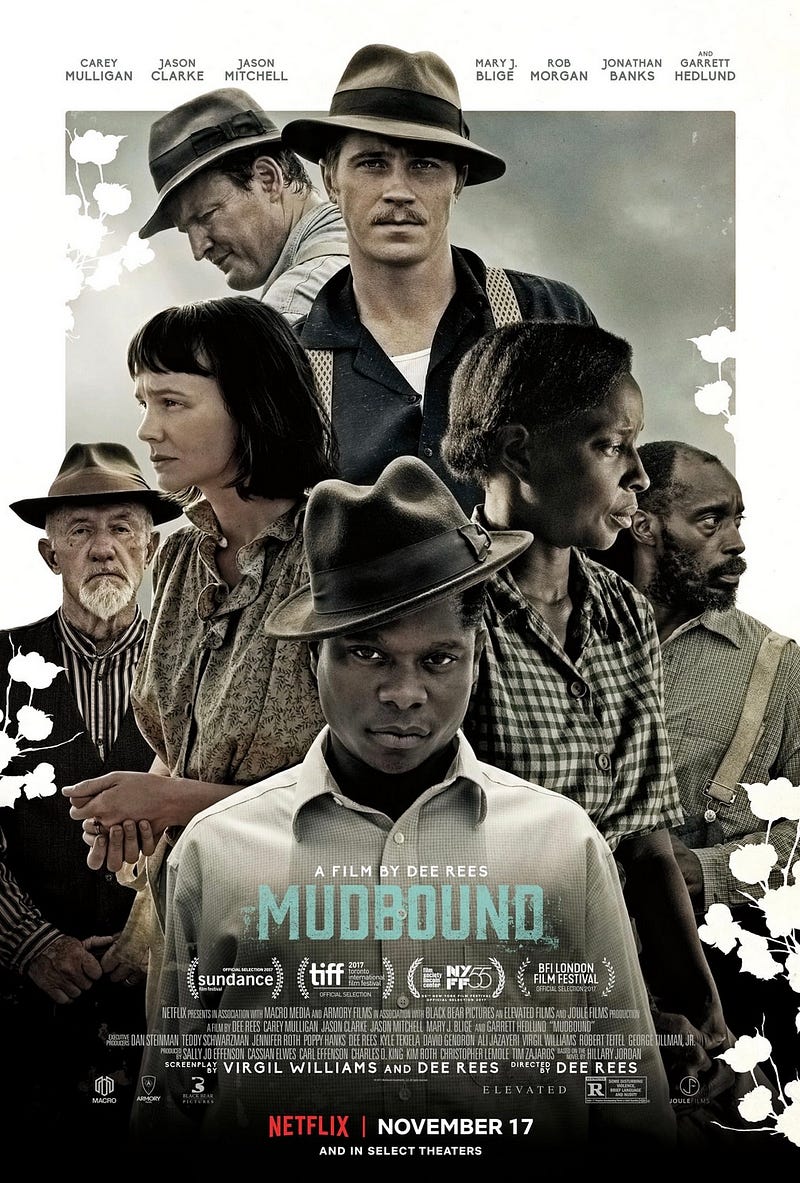
Today: Mudbound (2017). You may download the script here.
Screenplay by Virgil Williams and Dee Rees, novel by Hillary Jordan.
IMDb plot summary: Two men return home from World War II to work on a farm in rural Mississippi, where they struggle to deal with racism and adjusting to life after war.
Mudbound
Scene-By-Scene-Breakdown
by Mark Furney
Gointothestory.blcklst.com
P 1–3 Jamie McAllan (M/late 20s), with a black eye and cut lip, shovels mud from a hole. His brother, Henry (early 40s), offers relief. The hole reveals a scull and body parts. Henry says “I ain’t burying my father in a slave’s grave — he’d of hated that.” However, an approaching thunderstorm leaves them no choice. The McAllan family is white.
P 3–4 Jamie, the hole deeper now, panics. He tells Henry of his fear of being left in a hole.
P 4–6 The brothers put their dead father, Pappy, into a ramshackle coffin and take the coffin through the mud to the grave, where they have difficulty lowering it into the hole. Laura (Henry’s wife), in V.O., says that when she thinks of the farm she thinks of mud. The Jackson family (African American), in a mule-drawn wagon, approaches. Henry asks Hap Jackson (the patriarch) to assist. Laura is skeptical. Henry: “Wasn’t my fault what happened.” Hap looks at his wife, Florence. Both consider what should Hap do?
P 6–8 Folks dine in a fine Memphis home. Laura (V.O.) informs us she was a 31 year old virgin when she met Henry in 1939; that she lives with her parents in the home she grew up in. Her world was “small.” Henry, an engineer with the Corps of Engineers, was her “rescuer from a life in the margins.” Laura’s mother facilitates the sparking going on between Henry and Laura, telling Henry that Laura has a teaching degree and she can play the piano. Laura, tired of being an old maid, decides she likes male attention and she wants a little more.
P 8–10 A series of shots of courtship between the quiet and awkward Henry and Laura. Henry wants her to meet his brother Jamie, who will be coming up from Oxford in a couple weeks. Jamie arrives at a buzzing train depot. Jamie, in contrast to Henry’s taciturn nature, is outgoing and cosmopolitan. Jamie, a playwright, charms Laura.
P 10–13 At a social function in a fine southern mansion, Black servants serve the gentry. Jamie tells how big-brother Henry, in 1927, saved Jamie during a flood. It’s revealed that Jamie has been “modeling clothes.” Henry questions this. Jamie offers a toast to the marriage of Laura and Henry, and the hope that the two have “many children.” Jamie dances with Laura. She is smitten. Henry notices. Jamie dances with and charms another Southern Belle.
P 13–14 In V.O., Laura says that Henry, while not a romantic, is a sturdy man who will provide and give her children and for that she “could love him in return.” A series of shots of the wedding, the modest Memphis home, the arrival of children. Then, “the day that changed everything” arrives. She and Henry listen to F.D.R.’s radio address announcing the Japanese bombing of Pearl Harbor.
P 14–16 At the Jackson family’s cabin, Ronsel is dressed in crisp traveling clothes. The family (Ronsel has two younger sisters and a younger brother) sees Ronsel off to join the war effort. Florence (V.O.) reveals worry for her son, whose “heartbeat I held in my hand.” Florence loves all her children equally, but during the four years he was off at war “I only prayed for him.”
P 16–16A In a country church, Hap preaches, quoting John 14:1–3 about how things will be better in “the Father’s house.” But Hap, distressed about something (the subtext is a lynching), wants things to be better “right now!”
P 17–19 A series of shots: Jamie, at war, is a bomber pilot. Henry (V.O.) was in the “great war” and when he was young, Jamie wanted to know how many Henry had killed. Henry walks with a limp, an injury from WW I. Henry goes off to work from his modest Memphis home, his children and Laura at home. Henry finds land for sale in the country. Henry grew up on a Mississippi farm which had for generations been “built” by his family and “their” slaves. That land, his father had said, would one day be Henry’s too. But upon his mother’s death, Pappy “gladly” sold the farm, depriving Henry of his inheritance — a farm of his own.
P 19–21 Henry, after making love with Laura, tells her he has bought a farm in Mississippi; that they will live in a rented house in a small town twenty miles from the farm. Laura is upset that Henry would uproot her and the family from Memphis without her consultation.
P 21–23 The McAllan convoy leaves Memphis, drives through rural lands, and arrives at their rented house in a small town. However, Orris Stokes meets them on the porch and tells Henry that he bought the house last week. Henry didn’t get the lease in writing. He is embarrassed and ashamed as Pappy says “you got swindled, like a damn fool.”
P 23 The McAllan family (including Pappy and two young daughters) sets off for the farm. They pass African Americans working the fields by hand. The sharecroppers’ shacks show the material poverty of the area.
P 23–23A Hap and his family toil the land they farm. Hap (V.O.) asks “what good is a deed?” His father, grand-father, great-grandfather, uncles and great uncles had toiled on this land, bleeding and dying there “with the dirt of 200 acres under their fingernails.” “But that don’t count — law says you need a deed.” During reconstruction Hap’s great uncle had a deed, but four white men with pistols “tore up that deed” saying the land was theirs.
P 23A Henry’s convoy crosses a river bridge. Henry: “this is it. We are home now.”
P 23a-24 Hap quotes scripture about pride and a haughty spirit before a fall. He tends to his mule and notes how it allowed him to be a share-tenant rather than a sharecropper and this has led Hap to dream of owning his own land.
P 24–26 Hap and Florence, with their kids at a dinner table, look at a map and discuss plans for buying their own land. A daughter says she will be a stenographer. Marlon says “they don’t allow colored to be typists.” Hap says “your sister will be the first.” The family asks when will Ronsel be home? There’s a knock, knock at the door. It’s Henry (who now owns the land Hap rents/farms). Henry demands help — now — unloading the furniture at the farmhouse.
P 26 It’s night. Pappy, in the front seat of the truck, tells Henry “I won’t move for no nigger.” Henry prevails upon Henry to let Hap into the truck as it’s late; they need Hap’s help.
P 27–28 Hap (V.O.) doesn’t think much of Henry who, Hap surmises, knows little of farming this land. Hap is not happy that Henry, by using a tractor, has put three family sharecroppers “off this land.” They arrive at the farmhouse, mud everywhere. A daughter has to tinkle. Henry tells Laura where the outhouse is; “there’s no indoor plumbing.” Laura must make the best of it.
P 28–31 The roof leaks rain into the house. A box containing books tips over and Hap reads the title “A Tale of Two Cities.” Laura asks “you can read?” Hap: “yes, my son, Ronsel, who is fighting under General Patton, taught me.” Pappy: no way the army would entrust a tank to a nigger. A dispute arises on whether Laura’s piano or Pappy’s bed will be in the living room. Laura wins, saying the piano “is the one civilized thing that will be in this house.” Pappy will sleep in a lean to outside.
P 31–33 Ronsel, in a village in Belgium, writes a letter to his family, extolling the beauty of Europe. Ambulances around, busy soldiers, as they prepare to move on. As Ronsel’s tank rolls, a white infantryman hurls an insult. Ronsel (V.O.) says when they do get liberty, the “locals treat us nice, not like the white folk back home.” Ronsel gives a bouquet of flowers to an attractive young German girl (Resl) at her apartment. The couple embraces; exchange a kiss.
P 33–34 Bullets ping and ricochet off Ronsel’s tank. Claustrophobic and hot. The tank engages a German Panzer. The tank is hit HARD; fire engulfs the tank. Ronsel gets out and sees a lone B-25 bomber limp through the sky.
P 34 Jamie, splattered with blood, pilots a damaged bomber. Jamie’s co-pilot slumps, dead. Air rushes through the shot-up cockpit. Outside, dead men dangle on parachutes. Smoke from damaged planes is thick. In his barracks, Jamie looks at empty beds. He steals a drink of liquor, his hands shake.
P 34 Henry works land with his tractor; Hap and a child work the land with their hands.
P 35–36 Carl Atwood, a white share-cropper, drinks liquor and tells his pregnant wife (Vera, late teens) to slop the hogs. Henry, driving by, observes Carl’s disgusting nature and the way he treats Vera.
P36–37 It’s raining hard. Henry hammers on something in the shed. Pappy arrives to tell him the girls are “coughing hard.” Laura tends the girls who have whooping cough. Henry can’t make it over a flooded river bridge to get the doctor.
P 37 Hap reads a happy letter from Ronsel to his family. A knock at the door. Henry gruffly insists that Florence come to the McAllan house to help Laura. Florence is reticent, as she will have to stay away for three days in order not to infect her own family.
P 38–39A-40. Before getting into Henry’s truck, Florence grabs a chicken and puts it in a burlap bag, telling a confused Henry, “girls gonna need some broth.” On the ride through the rain, in V.O., Florence tells us “she doesn’t have the luxury of loving only my own children.” Flo’s mother had cared for white children, not out of duty to the white folks, but out of love for “us,” because if “anything had happened to those white kids, it would have been the end of us.” Flo knows that Laura couldn’t — on her own — take care of the kids here in the delta. So Florence helps. Laura, upon meeting Florence, is disappointed the doctor is not present.
P 40–44 Florence gets to work comforting the children. Laura and Florence bond a little. Pappy demands water from Florence. The demand is rebuffed by Laura. Florence tells Laura “I can’t go home — I might infect my kids.” Pappy says no nigger will sleep in this house; Laura puts Pappy in his place. A few days later, before Florence does go home, Laura offers Florence a paying job helping in Laura’s house.
P 44–45 Florence tells Hap about the job. Hap, less than happy, quotes scripture about the man being the head of the house. Florence quotes scripture back about how an excellent wife is more precious than jewels. Florence has taken the job and Hap warms to the decision, realizing it will help save money to buy a farm.
P 46–48 Hap’s mule is sick. Hap must shoot it. Hap, at the church, is on a ladder nailing a repair. Hap (V.O.), talks of pride before a fall. He falls, breaking his leg. A series of shots depict Hap’s failed convalescence. The leg isn’t healing. He’s in pain.
P 47–50 Rain, rain, prevents all from work in the fields. The next crop is at risk. Henry hurries Hap to get out of bed. Henry to Hap: “you’ll have to rent a mule from me. You’ll be on half-shares till you pay me back.” Hap gets out of his bed, falls, and re-breaks his leg.
P 50–51 Henry tells Laura Florence isn’t coming back to work in their house because Flo has to work the field to get the seed planted and that he will “rent” Hap a mule. Laura, incredulous, asks “why not lend him a mule.” Laura, struck by Henry’s cold business approach, sneaks into a safe and takes money out.
P 51- 52 Dr. Pearlman arrives at the Jackson cabin and, with respect, addresses Florence as “Mrs. Jackson.” Florence sees Laura in the truck outside. Florence (V.O.) says that if asked before then, she would have said that “all white folk are the same.” The doctor attends to Hap’s badly infected leg.
P 52–53 Hap and Laura are in bed.. Hap registers his displeasure over Laura’s unselfish act by refusing to be intimate with her. Laura reveals that, while she hadn’t always enjoyed Henry’s lovemaking, it had at least been a needed “kind of sweet intimacy.”
P 53–54 Ronsel is in bed with his German girlfriend. Soldiers outside the window shout the war is over. The couple embraces. They know this means Ronsel will be going home.
P 54 Ronsel, in uniform, is on a bus (segregated by race). Ronsel (V.O) laments being home where he is insulted with racial epithets. Ronsel pulls out Resl’s necklace and crucifix, a keepsake. A little boy salutes Ronsel.
P 54–57 Ronsel, back in his hometown, enters the general store and buys items for his family. He engages in friendly chat with the nice white-lady storekeeper. At the front door he is confronted by Orris Stokes and Pappy. They tell Ronsel a nigger will leave by the back door. Ronsel, defiant, says that “Patton put us right on the front line, all while you were back here, safe and sound.” The racist white men’s mouths are agape. To avoid further conflict, Ronsel leaves by the black door.
P 57–61A At the Jackson family dining table, Hap prays over a family meal. Ronsel surprises the family when he enters. The family fusses happily over Ronsel. He gives his father a hug. Outside, Ronsel smokes a cigarette, surprising his father. Ronsel: “A lot has changed.” The future? Ronsel will stay on the farm awhile, until he “can put the war behind me.” Henry arrives and warns Ronsel that he’ll be in trouble if there are more incidents like the one at the store. When Henry says Ronsel needs to come to his home to apologize to Pappy, Hap says “Ronsel will say sorry after church tomorrow.” Ronsel gives his mother, Florence, a Hershey bar, a small yet significant token of the bond between mother and son.
P 61A-62. Henry meets up with Carl Atwood at a barn and tells Carl that because he has not been doing your job, that he and his family must get off the property by the end of the week. Carl begs to stay, saying we got not place to go.” Henry: not my problem.
P 62–63 Pregnant, Vera Atwood knocks on the McAllan farm house door with a very young daughter in tow. Their appearance screams “dirt poor.” Vera pleads with Laura not “to put us off the farm.” Laura says it’s Henry’s decision, not hers. Vera asks, “if you could decide?”
P 63–64 Laura confronts Henry about kicking Vera off the property. Henry — all business — “I ain’t a charity.” But Henry says he’ll give the decision a second thought. Pappy chimes in with “next, she’ll be telling you what to plant.”
P 65–66 With Laura in V.O, and in a series of shots, the violence and death of life on a farm is shown and described. Killing chickens, rabbits. Dead possum, being eaten by ants. Laura shows how she learned to use a shotgun, just to survive and eat.
P 66–70 Amanda (Laura’s daughter) yells someone is coming. In his aviator glasses, Jamie walks approaches. Hugs all around, but Jamie has ignored Pappy, who notices, our first clue at the gulf between Pappy and Jamie. Later, at night, Jamie’s hand shakes as he lights a cigarette. He, Henry, and Pappy share a drink. Pappy asks what it is like to be a “big hero?” Jamie is reticent. Pappy presses “how many did you kill.” Jamie: what does it matter? Pappy presses more, and says “a man ought to know how many he’s killed!” Jamie slices back with “I can tell you this, it was more than one.” Pappy: “at least I looked the one I killed in the eye when I did it, not from a mile in the air.” The party is over, but Jamie, showing signs of PTSD, talks to his brother. “From 20,000 feet up, the people aren’t even ants.” Henry is concerned.
P 70 Jamie gets groceries and bourbon at the general store. His polite but short interaction with the sales clerk show how important the bottle of bourbon is to him.
P 70–72 Outside the store, an older car backfires. Jamie, thinking it’s gunfire, hits the dirt. Ronsel is there to help him up. The white folk are watching. Jamie, shaking, drops his bottle. Ronsel, empathetic, says: “they say it stops eventually.” Ronsel holds out his shaking hand. An understanding comes to the two veterans. Jamie: “you’re Ronsel, Haps boy?” “Yes, sir.” Jamie offers Ronsel a ride. Aware of the rules, Ronsel gets into the back of the truck.
P 72–75 Outside of town, Jamie asks Ronsel to get into the cab of the truck. Ronsel is reluctant. Jamie, playfully: “Get in soldier, that’s an order.” Jamie and Ronsel swap stories, Ronsel proud that he served under “Negro captains.” The subject of Ronsel’s run-in with Pappy comes up and Jamie says “I’m sure Pappy had it coming.” Jamie finally coaxes Ronsel to share a sip. Soldier bonding. Stories about pissing into helmets, how both lost some good friends. Jamie drops Ronsel off at his farm. Hap observes, worried.
P 75–76 On a Saturday, Laura in V.O. and in a series of shots, we see Laura and her children’s bathing ritual. Outside, hauling water to a tub in the yard. Little privacy. Pappy wanders by and glimpses a little too long. Laura: “It was the only day I felt clean. The rest of the time, we stank.”
P 76–77 Laura tells Henry she is pregnant; interplay between Laura and Florence over carrying a child; Jamie spruces up the house with a lavender bouquet.
P 77–79 Jamie and Ronsel, at a sawmill, exchange stories of their youth. Jamie and Ronsel share a drink. Ronsel asks why Jamie is being “so nice.” Jamie: You look like you could use it. In flashback, Jamie’s co-pilot’s brain splatters in the cockpit. Jamie says, “I promised God if I was spared, I’d do something right. I didn’t know what, but I promised anyway.” Jamie relates how a “colored” fighter pilot had escorted his damaged bomber for awhile, and how each had saluted the other. Jamie: “the men who died that day — they were good men, fathers, husbands — better men than me.” Jamie suffers the survivor’s guilt. Ronsel understands.
P 80–81 Laura’s daughters make mud pies by the water pump. Vera, a knife in hand, saunters into the yard, an incongruous look on her face. She tells Laura, “take me to town — I’m gonna kill Carl.” Laura, worried about the knife, tries to talk Vera down. Vera tells about how Carl is “with the other woman.” The kids are scared. Laura tells them to go “around back.” Vera rocks back and forth on her feet. Laura finds a way to get the knife from Vera. Vera wonders off.
P 81 Carl’s dead body in the road. Via V.O., Laura says Vera stabbed him 17 times and then, covered in blood, walked to town to turn herself in to the sheriff.
P81–83 Laura has her own problems relating to her pregnancy. Laura draws her bloody hand away from between her legs. She sends a daughter to get Florence. Florence comforts Laura saying, “I understand, I lost one of my baby’s once too, Samuel.” Florence comforts Laura as Laura weeps, two women sharing the pain of a similar tragedy.
P83–84 Laura is bed ridden and depressed. Her daughters bring flowers and a rattlesnake’s skin. Laura feigns delight at the snake skin. Laura hears a hammer on nails outside. She finds Jamie building a decent, enclosed shower in the yard. Laura is touched by Jamie’s gesture. Laura gives him a hug as Henry walks up.
P 84–85 Laura takes a sumptuous shower at sunset. She feels and looks clean, for a change.
P 85 Henry’s tractor gets stuck in a muddy field.
P 85 Hap, still limping, works a wet field and falls into the mud.
P 85–86 At the cabin, the Jackson children play soldier, as if killing Nazis. White sharecroppers drive by. Lilly May Jackson (a daughter) points a play gun at the whites and says “bang, You dead.” Jamie’s truck pulls up and Ronsel hops in. Florence watches, worried.
P 86 Florence tells Hap “we got to let him go. He’s staying for us.” Hap hums a tune. Flo and Hap find a way to dance and steal a little joy amidst it all.
P 86–88 At the sawmill, Jamie and Ronsel drink, smoke and exchange war stories. Ronsel relates that “over there, I was a liberator. Here, I’m just another nigger.” They start talking about European girls. Ronsel admits he has been with “a few” white girls. Over there, “they didn’t mind us a bit.” The discussion veers to Ronsel remembering Resl, his German girlfriend, wistfully. Jamie: “She must have been special.” Ronsel: she was, but that was then, this is now.
P 89-Ronsel, in his bed and with resolve, puts Resl’s gold necklace and her crucifix into a tin box, trying to forget her.
P 89–90 Henry snores loudly. Laura can’t sleep, so she goes outside where she finds Jamie laying in the dirt, drunk, and mumbling incoherently. Jamie awakens. Laura tries to comfort him. Jamie panics and says “I got to get out of here.” He drives off, swerving from the drink. Jamie’s truck ends up in a ditch.
P 90 The Sheriff and Henry awaken Jamie in the truck. Henry shakes his head in disgust at Jamie.
P 90–92 Henry and Jamie milk cows. Jamie tips over a pail of milk. Henry, upset at Jamie’s ineptitude. Jamie pulls out money and asks “what do I owe you.” An argument, Henry wanting Jamie “to be a man.” Jamie, sorry that Henry’s little dream of being a farmer is being flooded out. Jamie mistakenly tells Henry “your wife is miserable.” That does it. Henry tells Jamie “I’m going to Greenville for a few days. When I get back, I want you gone.”
P 92–94 Jamie packs his luggage and tells Laura “Henry kicked me out.” Jamie will be going to Los Angeles. Jamie says he’ll say goodbye to the girls, but Pappy — “I’ll just leave him a note.” Laura tries to talk him out of it, but Jamie says “I’m suffocating here.” Laura understands. She kisses him; they make love.
P 94–95 In the Jackson cabin, a sister hands Ronsel a letter from Germany. Who is it from? Someone I know, Ronsel answers. He heads out the door. Hap, worried: “Where you going now?” Ronsel says “I’ll be back.”
P 95–97 Ronsel walks down a dirt road, shaking his head. A truck approaches. Ronsel shoves the letter in his pocket, sensing danger. The truck skids to a stop. Jamie, drunk and laughing, tumbles out of the truck. Ronsel: “That wasn’t funny.” Jamie: “Actually, it was indeed.” Ronsel shows Jamie the letter and the picture. “Congratulations, you are a father.” Ronsel and Jamie share a toast to Franz, Ronsel’s child in Germany. Ronsel: “She wants me to come to Germany.” A thunderstorm approaches.
P 97–98 Jamie and Ronsel, in the truck, drunk, sing war songs. Another vehicle approaches. Jamie tells Ronsel to put his head down. Do Pappy and Orris see Ronsel in the truck?
P 98 Jamie drops Ronsel off at the Jackson cabin. They say goodbyes, shake hands, and each thanks the other for being a friend.
P 99–100 In the cabin, Ronsel asks his mom if she’s seen the letter from Germany. He realizes he has lost it. He runs out the door, into the night, to search for the letter.
P 100–102 At the McAllan house, Pappy is mad and vulgar in front of Laura and the kids. Jamie shows up, drunk. Pappy and Jamie argue over Ronsel riding in the front of the truck. Pappy tells Jamie “you ain’t worth a damn.” Pappy insinuates to Laura that he is wise to her desire for Jamie.
P 102 Ronsel, trudging down the wet road, reacts to the approaching lights of vehicles. He runs, but the vehicles catch up and men in white sheets grab him.
P 102 Jamie, asleep at the McAllan house, is awakened by Pappy, Orris and the Sheriff, all in white sheets. He’s told to “put on your boots and come with us.”
P 102–109 At the sawmill, men in white sheets, heads covered with KKK hoods. Ronsel has a noose around his neck, his tip-toes barely touch the ground and a burlap bag covers his head. Jamie tells Pappy to turn him loose. Pappy, “like hell I will.” Ronsel is confronted with the photo of Resl and the child. They beat on Ronsel, but he won’t show fear. They ask “did you rut with a white woman?” Jamie: why do you care? She was a German cunt, they got a lot of our boys killed. While clever, this doesn’t work with the KKK. So they ask Ronsel, “are you the father?” Ronsel, defiant, says “yes.” The Sheriff quotes scripture prohibiting “mixing seed,” the penalty for violation — death. Jamie protests, killing a decorated soldier over an “enemy whore?” Jamie threatens to go to the law if they kill Ronsel. Pappy, “you’d betray your own blood for a nigger?” Jamie manages to grab a gun. Pappy: “you ain’t gonna kill anyone up close, don’t have it in ya.” A tussle happens, but Jamie is overcome. In order to spare Ronsel’s life, the criminals give Jamie a choice: Ronsel’s eyes, his balls, or his tongue. In a series of flashes, we see but can’t hear Jamie say something to the sheriff. A knife is put to Ronsel’s mouth and blood rushes out.
P 109 McAllan house. Pappy and Orris throw Jamie, unconscious, onto his bed.
P 109 At the sawmill, Hap and other black Deacons find Ronsel, still hung from the rafters, and cut him down. Florence’s hand goes to her mouth.
P 109 Pappy sleeps in his lean to. Jamie shakes Pappy, “wake up.” Pappy, what is going on? Jamie: “I wanted to look you in the eye” and Jamie puts a pillow over Pappy’s head and suffocates him, Pappy thrashing for a bit until death.
P 110 At the saw mill, Ronsel is cut down and wrapped in cloth. Florence, V.O. “I held his heartbeat in my hand. He was warm and alive.” Ronsel stirs and coughs.
P 110–111 Laura goes into the lean to, finds Jamie beaten and bloodied, and the KKK hood. Jamie: they got Ronsel, I tried to stop them. Laura sees Pappy, dead. She takes the pillow from Jamie’s hand.
P 111 At the Jackson cabin, Florence tends to Ronsel’s wounds.
P 111–112 Henry arrives back at the farm, greeted by Laura and Jamie. Henry prattles on about saving the crop. He looks at Jamie, “what happened to you.” Laura: your father, he died peacefully last night in his sleep. Henry says he is sorry over “our last meeting.” The two brothers hug.
P 112–114 Henry and Jamie try to get the coffin into the ground. The Jackson family arrives in their wagon. Henry asks Hap for help with the coffin, and suggests Marlon can help, but Hap says “my son is not gettin out of that wagon.” Hap offers final words over the grave about the unclean dying, and the good of a tree and nature … but man? Jamie gives Hap and Flo the letter from Resl. Jamie eyes a tarp and knows that Ronsel is under it. Jamie, rather than help Henry fill the grave with dirt, walks down the road.
P 114–115 Jamie is in Union Station in Los Angeles. Jamie (V.O.) says he hopes Pappy’s untimely death brings some relief to the Jackson family. Later, in an LA apartment, Jamie drinks with a pretty woman and says for now that he’s content to stay perpetually numb, but that he hopes his friend Ronsel “found happiness.”
P 115–116 Henry farms his land and laments the loss of his father and his brother. He recognizes his brother had to leave and that his wife would like to also.
P 116 The new McAllan house, in a small town. The McAllan children play in a yard. Laura, on the porch shows, she is pregnant. In V.O., she says she wouldn’t tell Henry the child she carries is Jamie’s rather than his. [This and the immediately preceding scene were omitted from the film].
P 116–117 Hap and Marlon work a new field next to a new house with a nice yard and a water pump. Florence and the girls work on the porch of a much nicer house. Hap has his own land.
P 117 Ronsel (V.O.) relates his nightmare: being in a tank, then in the back of a car with a burlap bag over his head, his enemies and the stench of their breath all about him; he screams, but no sound. He is a mute, and how he has been depressed but found a way to overcome it. We see scenes of a Berlin street as Ronsel walks to Resl’s apartment. Resl hugs Ronsel and Ronsel hugs his three-year old son. In the end, Ronsel says, he crossed the Atlantic again, not for war, but for love.
* NOTE: The film is edited significantly from the time of Ronsel’s near-death at the saw mill to the end, with the major beats in the script retained and re-arranged, except where omissions are indicated.
Writing Exercise: I encourage you to read the script, but short of that, if you’ve seen the movie, go through this scene-by-scene breakdown. What stands out to you about it from a structural standpoint?
To download a PDF of the breakdown for Mudbound, go here.
Kudos to Mark Furney for doing the scene-by-scene breakdown.