Script Analysis: “Luca” — Part 6: Takeaways
A week-long analysis of the 2021 Pixar movie.
A week-long analysis of the 2021 Pixar movie.
Reading scripts. Absolutely critical to learn the craft of screenwriting. The focus of this bi-weekly series is a deep structural and thematic analysis of each script we read. Our daily schedule:
Monday: Scene-By-Scene Breakdown
Tuesday: Plot
Wednesday: Characters
Thursday: Themes
Friday: Dialogue
Saturday: Takeaways
Today: Takeaways.
This week, we have been reading, analyzing, and discussing the script and movie Luca. In some ways, today’s exercise is the whole point of the series: What did you take away from the experience of reading and analyzing the script?
Screenplay by Jesse Andrews & Mike Jones, story by Enrico Casarosa & Jesse Andrews & Simon Stephenson, story consultant Julie Lynn & Randall Green.
Plot summary: A young boy experiences an unforgettable seaside summer on the Italian Riviera filled with gelato, pasta and endless scooter rides. Luca shares these adventures with his newfound best friend, but all the fun is threatened by a deeply-held secret: he is a sea monster from another world just below the ocean’s surface.
SCENE-BY-SCENE BREAKDOWN
Luca is a classic example of a Hero's Journey story structure: It begins in the Ordinary World (the ocean realm of the sea monsters). The Protagonist (Luca) yearns to see what life is like above the surface of the ocean, his curiosity eventually taking him to live in Human Town (the New World). He returns home in the sense that he bonds with his parents and they come to understand and accept his own ambitions. Thus, while Luca does not actually head back home, instead going off to school with Giula, he has found a psychological sense of "home" in that he has embraced an authentic aspect of his own psyche.Everything that happens, particularly in Act Two, serves Luca's character arc as he grows in confidence and embraces his innate curiosity about life in the Above World.As Joseph Campbell observed about the hero's journey:The passage of the mythological hero may be over ground, incidentally; fundamentally it is inward--into depths where obscure resistances are overcome, and long lost, forgotten powers are revivified, to be made available for the transfiguration of the world… [Now] it appears that the perilous journey was a labor not of attainment but reattainment, not discovery but rediscovery.All of the events in the Plotline are fundamentally about Luca's inner journey, discovering what is essential to his authentic nature. It has been there all along, evidenced from the beginning in his curiosity about life above the ocean's surface.Indeed, all of the characters with whom the Luca intersects on his journey serve his personal transformation, as we shall see in a later discussion about the story's characters and its archetypes.
PLOT
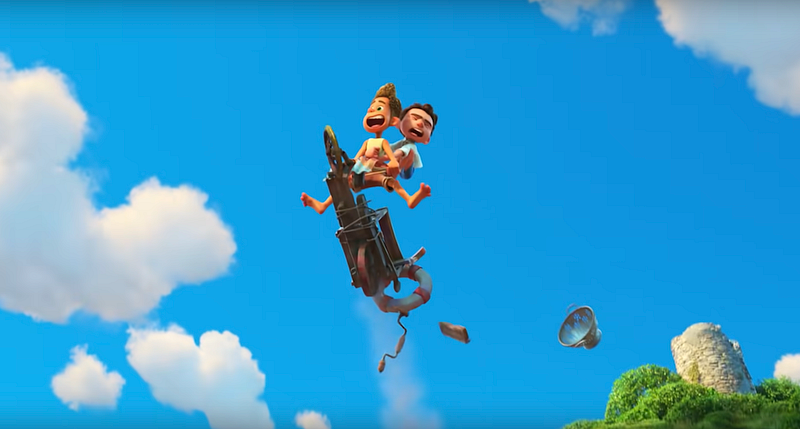
Call to Adventure (10-13): When Luca intersects with Alberto who drags Luca above the sea line, instigating the first "transformation" of Luca into human form. Luca is afraid and refuses to stay in the New World, only to return later.Act One end (26-28): Luca overcomes his fears and rides with Alberto on the Vespa, soaring high into the sky, then plunging into the ocean. Having survived, Luca takes a step toward embracing the courage necessary to prevail on his hero's journey.The predominant locale for the rest of the story is Human Town. That's where Luca and Alberto run away in an attempt to protect Luca from his parents who want him to go with Uncle Ugo to the deep ocean (this transition happens 34-36).The Plotline in Act Two focuses on preparation for the triathlon along with various characters searching for sea monsters, humans in the sea, Luca's parents looking for Luca.Meanwhile in the Themeline, two major characters undergo their own character arcs: Luca becomes more settled in Human Town to the point where he wants to attend school with Giula. As Luca and the girl grow closer, Alberto - fueled by jealousy - becomes a threat to Luca. The rising tension between the three comes to a head when Luca and Alberto begin to fight, the altercation stopped by Giula.This leads to a big blow-up between Alberto and Luca, and Giula, who finally uncovers the fact that Luca is a sea monster, sending Luca away (94-97), a fitting capstone of the All Is Lost plotline point at the end of Act Two.The centerpiece of Act Three is the triathlon, but the culmination of the story involves humans embracing the sea monsters, even some revealing themselves to be sea monsters in human form. Also, the dispensation of Alberto (who stays in Human Town to work with Massimo) and Luca (who heads off to school with Giula).Overall, the plot follows three-act structure as detailed in the hero's journey:Separation
Initiation
ReturnIn other words, it's a conventional story structure. It's the way in which characters are articulated that provides the story a unique quality.
CHARACTERS
I have this theory that there is something going on in terms of character archetypes in stories. We see five of them over and over again: Protagonist, Nemesis, Attractor, Mentor, Trickster.The Protagonist represents a forward-moving dynamic, a character or characters most often driven by a conscious goal.The Nemesis represents an oppositional dynamic, a character or characters pushing back against the Protagonist. Typically, this is the source of the story's central conflict.The Attractor is a character most associated with the Protagonist's emotional life, someone or something connected to their heart.The Mentor is a character most associated with the Protagonist's intellectual life, someone or something connected to their mind.The Trickster is a shapeshifter, switching from Protagonist's ally to enemy... enemy to ally. They pursue their own ego-needs. If that aligns with the Protagonist's goal. great. If not, so be it.Here is my take of the key characters in Luca:Protagonist: Luca.Nemesis: Ercole (lead), Ciccio, Guido (minions). Ercole is not only a bully toward Luca and Alberto, he also provides a threat (he intends to win a prize by catching sea monsters) and an opponent (in the local triathlon competition, the Portorosso cup).Another Nemesis: Massimo's grumpy cat Machiavelli who actually sees Luca and Alberto transform into sea monsters, and thus, represents an ever-present threat.Mentor: Alberto. This character knows -- and when he doesn't actually know, he pretends -- all about the above-world.Attractor: Giula. This character offers an interesting spin on the archetype. The Attractor is a character most closely associated with the Protagonist's emotional development. In imparting knowledge to Luca she learns at school about the stars and the above-world universe, this feels like Mentor territory. However, Luca has such passion for the subject matter Giula shares with him that it fuels Luca's desire to pursue that passion into his own life-path.Trickster: Daniela (mother) and Lorenzo (father). They are supportive and loving parents (ally), but also provide a threat to Luca as he attempts to find his own way. Once they make their way into Human Town, their intention is to find Luca, take him back below sea level, and end his foolish fantasies about living amongst the humans. Interestingly, they experience a bit of trickster activity toward them: They do not know what Luca looks like as a human, thus, mistake random young boys as their son. This dynamic reverses as the sea monster parents use soccer ball kicks to knock children into the town fountain in an attempt to find Luca.Massimo, Guila's father also plays the role of a Trickster, a threat given his job (a one-armed fisherman), but also supportive of the boys, especially Alberto who becomes a worthy fisherman.Befitting the theme of transformation (see tomorrow's article and my comments), characters evolve from one archetype to another. For example, Alberto goes from Mentor to Trickster to Nemesis to Co-Protagonist. Even the cat Machiavelli shifts from Nemesis to Trickster (ally).
THEMES
One of the most prominent themes is Transformation. Of course, this is common to most Hero Journeys. As J. Campbell says of the hero at the end of their journey, "They return home a transformed individual."We see this dynamic in several different ways and it is introduced quite early in the story when Alberto pulls Luca above the surface and Luca 'transforms' into a human form. This dynamic -- shapeshifting from sea monster to human, human to sea monster -- is a wonderful way to convey a truth about transformation: It's a tricky proposition, not a simple matter of switching from one mode of being to another. In this case, what happens on the surface of the character -- their fleshly changes -- does not necessarily reflect how much or little the character has changed from within.This dynamic -- the tricky nature of transformation -- is echoed with the emergence of the makeshift Vespa. Yearning to explore this New World and even to fly (a sign of Luca's aspirations to "soar" above his old life), Luca puts together a bunch of parts, transforming them over time into a viable motor scooter. Here again, a mixed blessing.--Consumed with the first attempt to build the Vespa, Luca loses track of time and returns home late, endangering his status with his parents, saved only by his Grandmother who makes an excuse for Luca.--It takes several attempts by Luca and Alberto to successfully build the Vespa, symbolic of the challenge of personal transformation (i.e., it's not easy and it takes time).--Eventually they get to ride, but the Vespa transports both he and Alberto into a harrowing and dangerous ride.Even the rusty Vespa Luca hopes to buy by attaining the cash prize by winning the triathlon dovetails into the transformation theme. The ultimate prize is not the Vespa or winning the race. It is what Luca discovers within himself, a sense of empowerment which enables him to prevail in the race and beyond.Learning to ride a bicycle also speaks to the challenge of personal transformation. The fact Luca masters cycling provides proof that he can change.Transformation continues its importance throughout the rest of the story capped off by an ending in which the entire human-sea monster dynamic is turned on its head.
DIALOGUE
I'm going to focus on a fun runner. The line first appears on 16:ALBERTO
Piacere, Girolamo Trombetta.
(off Luca’s bafflement)
It’s a human thing. I’m kind of an
expert.Here Alberto uses the line to impress Luca that he (Alberto) knows a lot about the human world.It appears again on 90:Luca, overjoyed, takes Giulia's hand--and shows her the handshake that Alberto taught him.LUCA
Piacere, Girolamo Trombetta.Here, Luca "takes over" the phrase. This and the fact Luca uses it to increase his connection with Giula angers Alberto. In fact, this line of scene description follows Luca's dialogue:Alberto, watching this betrayal, FUMES.It is a key moment in the end of Act Two development where Alberto and Luca fight, and end up splitting up.The third use of the line occurs on 118, right at the very end of the script:Luca stands on the steps of the train, and does one last handshake with Alberto.ALBERTO
Piacere, Girolamo--
Trombetta.LUCA
Seriously, what does that mean?ALBERTO
No idea.
Go find out for me, will ya?Here the usage seals the friendship between Luca and Alberto while providing a bit of comedic relief: As it turns out, Alberto had no idea what the Italian words meant. His final line is a way of Alberto not only acknowledging he sometimes spewed "knowledge" based on nothing more than his imagination and he has come to accept the fact that Luca needs to head off to school to follow his curiosity and thirst for learning.I love the use of runners. This example shows how they can reflect characters in their evolving states of being.
Major kudos to Denise Devoy for doing this week’s scene-by-scene breakdown.
To download a PDF of the breakdown , go here.
For Part 1, to read the Scene-By-Scene Breakdown discussion, go here.
For Part 2, to read the Plot discussion, go here.
For Part 3, to read the Character discussion, go here.
For Part 4, to read the Themes discussion go here.
For Part 5, to read the Dialogue discussion go here.
To access over 100 analyses of previous movie scripts we have read and discussed at Go Into The Story, go here.
I hope to see you in the RESPONSE section about this week’s script: Luca.