Movie Analysis: “In Bruges” — Part 2: Plot
Watch this critically acclaimed indie movie and analyze it all week.
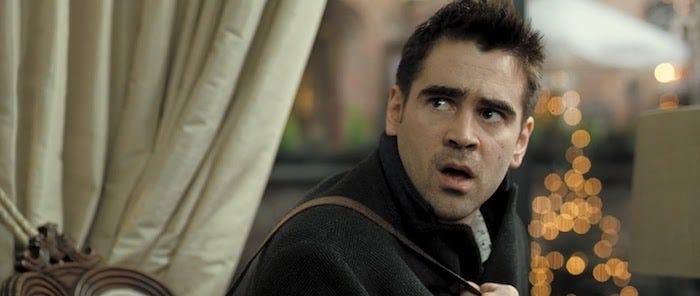
Watch this critically acclaimed indie movie and analyze it all week.
Another in our series in which we analyze notable movies. Why? To quote the writing mantra I coined 9 years ago: Watch movies. Read scripts. Write pages. You will note which one comes first. Here are my reflections from that post about the importance of watching movies:
To be a good screenwriter, you need to have a broad exposure to the world of film. Every movie you see is a potential reference point for your writing, everything from story concepts you generate to characters you develop to scenes you construct. Moreover people
who work in the movie business constantly reference existing movies when discussing stories you write; it’s a shorthand way of getting across what they mean or envision.
But most importantly, you need to watch movies in order to ‘get’ how movie stories work. If you immerse yourself in the world of film, it’s like a Gestalt experience where you begin to grasp intuitively scene composition, story structure, character functions, dialogue and subtext, transitions and pacing, and so on.
This week’s movie: In Bruges, written by Martin McDonagh, starring Colin Farrell, Brendan Gleeson, and Ralph Fiennes.
IMDb plot summary: Guilt-stricken after a job gone wrong, hitman Ray and his partner await orders from their ruthless boss in Bruges, Belgium, the last place in the world Ray wants to be.
Our schedule for discussion this week:
Monday: Scene-By-Scene Breakdown
Tuesday: Plot
Wednesday: Characters
Thursday: Themes
Friday: Dialogue
Saturday: Takeaways
Today: Plot.
Using the scene-by-scene breakdown in yesterday’s post, track the major plot points, sequences, and act breaks. Click on Write a Response below and join the conversation.
A shout-out and bounteous thanks to Mark Furney for working up the scene-by-scene breakdown for this movie.
You can download a PDF of the breakdown here.
Here are some thoughts from Mark about the value he has experienced in doing scene-by-scene breakdowns:
Scott, I’ll offer a few thoughts on what I find valuable in doing a scene-by-scene (or sequence) “breakdown” of a film.
First of all, it sharpens the focus on time management. I watched an interview of one of the screenwriting masters (I think it was William Goldman) who said a screenwriter must manage time.
By doing a breakdown, one gets a sense for the rhythm and pacing of scenes and sequences. I like long scenes. What makes them work? How long can you make an action scene?
Secondly, after doing a breakdown, it is fairly easy to then add your own notes on structure. Where is the end of Act 1? Midpoint? The end of Act 2A and Act 2B? What is the inciting incident or the hook? Is is early or late? For instance, In Bruges’ inciting incident (Ray’s accidental killing of the young boy), while hinted at, isn’t revealed until the end of Act I. This appears to break many rules. Why does it work? Doing a breakdown helps to put these questions into focus.
Thirdly, after doing a breakdown I like to do short notes on character relationships. Doing the breakdown simply assists in focusing the mind to think about these things, and it is not an additional huge investment of time. Your own notes can be short and sweet; they need not be publication ready.
Over time, a writer will have a nice little library of notes upon good movies he or she can look back upon.
I am looking for volunteers to do more movie scene-by-scene breakdowns. Pick your favorite movie, classic or contemporary, and immerse yourself in it by going through it scene by scene. Trust me, this is a terrific learning opportunity and a fantastic way to study a movie’s story structure.
If you’d like to volunteer, let me know which movie you want to break down in this thread Response section.
For Part 1 in this series on In Bruges and a Scene-By-Scene Breakdown, go here.
For more Go Into The Story Movie Analysis posts, go here.
For Go Into The Story Script Analysis posts, go here.