Script Analysis: “BlacKkKlansman” — Part 3: Characters
Read the Oscar-nominated screenplay and analyze it this week.
Read the Oscar-nominated screenplay and analyze it this week.
Reading scripts. Absolutely critical to learn the craft of screenwriting. The focus of this bi-weekly series is a deep structural and thematic analysis of each script we read. Our daily schedule:
Monday: Scene-By-Scene Breakdown
Tuesday: Plot
Wednesday: Characters
Thursday: Themes
Friday: Dialogue
Saturday: Takeaways
Today: Characters
Characters are the players in our stories. They participate in scenes, move the plot forward through action and dialogue, influence each other, evolve and change. Each has their own distinct backstory, personality, world view, and voice. When a writer does their best, digging deep into their characters, tapping into their souls, the players in our stories magically lift up off the printed page and come to life in a reader’s imagination.
But there’s this: In a screenplay, characters exist for a reason. Hence my principle: Character = Function. Writers can shade and shape a story’s character in limitless ways. But if you dig down deep enough, you can find each character’s narrative function, and that can become a lens through which you develop the players in your stories.
Same thing with script and movie analysis: Look at each character and think about why they exist and what their function is.
I think there are five primary character archetypes we see in movies all the time. They are:
Protagonist: The lead character, the character through whose perspective the story is told, the character who typically goes through the most significant metamorphosis.
Nemesis: Provides opposition to the Protagonist, often represents the Protagonist’s shadow, their dark impulses, tied somehow to the Protagonist’s goal.
Attractor: Characters who are most intimately tied to the Protagonist’s emotional development, often a love interest, Heart.
Mentor: Characters who are most intimately tied to the Protagonist’s intellectual development, wisdom, Head.
Trickster: Characters who test the Protagonist, switching allegiance from ally to enemy, enemy to ally, intentionally or not helping to prepare the Protagonist for their Final Struggle.
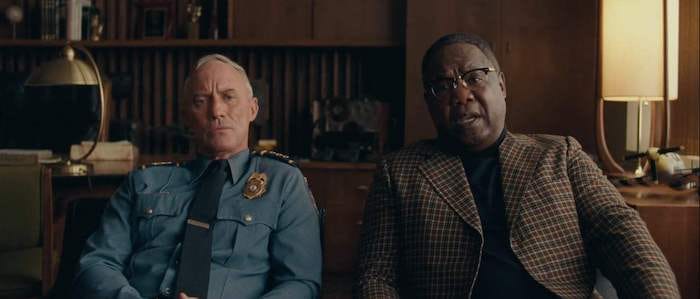
Today we discuss the characters in the script for BlacKkKlansman. You may download a PDF of the script — free and legal — here. A list of the key players:
Ron Stallworth
Chief Bridges
Flip Zimmerman
Patrice Dumas
Master Patrolman Andy Landers
Walter Breachway
Felix Kendrickson
Connie Kendrickson
David Duke
Screenplay by Charlie Wachtel & David Rabinowitz and Kevin Willmott & Spike Lee, based on a book by Ron Stallworth
IMDb plot summary: Ron Stallworth, an African American police officer from Colorado Springs, CO, successfully manages to infiltrate the local Ku Klux Klan branch with the help of a Jewish surrogate who eventually becomes its leader. Based on actual events.
Writing Exercise: Think about each character. What’s their function? And see if you can use character archetypes to help in your analysis.
Major kudos to Julianna Hartke for doing this week’s scene-by-scene breakdown. Julianna is a DePaul University School of Cinematic Arts senior getting a B.F.A. with a concentration in screenwriting and took time out of her busy academic schedule to read the script and do the breakdown.
To download a PDF of the breakdown for BlacKkKlansman, go here.
To read my in-depth interview with the screenplay’s co-writers David Rabinowitz and Charlie Wachtel, go here.
For Part 1, to read the Scene-By-Scene Breakdown discussion, go here.
For Part 2, to read the Major Plot Points discussion, go here.
To access 72 analyses of previous movie scripts we have read and discussed at Go Into The Story, go here.
I hope to see you in the RESPONSE section about this week’s script: BlacKkKlansman.
Onward!