Screenwriting Tip: Is My Screenplay Big Enough to Be a Movie?
This is a fundamental question screenwriters must ask themselves at all stages of a screenplay’s development and writing. Why? Because it’s…

This is a fundamental question screenwriters must ask themselves at all stages of a screenplay’s development and writing. Why? Because it’s a question movie studio execs will ask as one of the key determining factors whether to say ‘yes’ or ‘no’ to buy your script.
For years, movies have been known as playing on “The Big Screen,” as opposed to TV (the “small” screen). Typically movies have big budgets, big marketing campaigns, and big stars. Their running times, clocking in at an average of two hours, are big. The film industry is our nation’s second biggest export business (behind airplane manufacturing). So much about movies is about being big.
Being ‘big enough’ pertains not only to huge blockbuster action-thrillers, but also to small character-driven scripts. While the plot may be ‘small’ in scope, what happens and what those events mean to the story’s characters must have a ‘big’ enough meaning and emotional resonance with a big enough potential audience to warrant a studio’s green light.
The central question here — Is my script big enough to be a movie — is a… well… big topic. What I’ve done is put together 10 questions you can ask in relation to any of your writing projects, current and future, to test if it’s big enough to be a movie.
1: DOES MY SCRIPT HAVE A BIG ENOUGH STORY CONCEPT?
A significant part of a studio’s assessment of any screenplay submission is the central story concept. I say this because marketing movies has become as important to the studios as the script development process (the cost of marketing a major studio movie can be $50M or more). And after A-list actors who are well-known box office draws, the single most important component of a marketing campaign is the movie’s story concept — which is why high-concepts still rule the day.
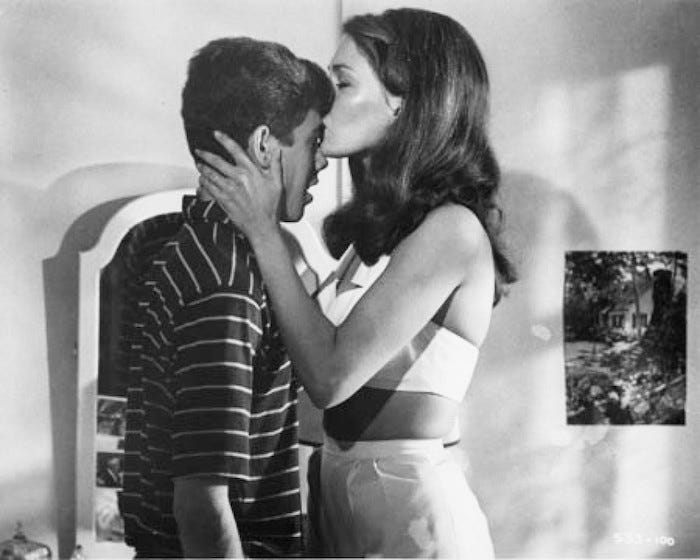
The experiences you had during the summer when you were fifteen might be meaningful to you, but are they ‘big enough’ to be a movie? Likely not. But if, say, you had an affair with a beautiful young woman, twice your age, who had just discovered her soldier husband had died, maybe you do have a big enough story to tell, as they did when they produced Summer of ‘42.
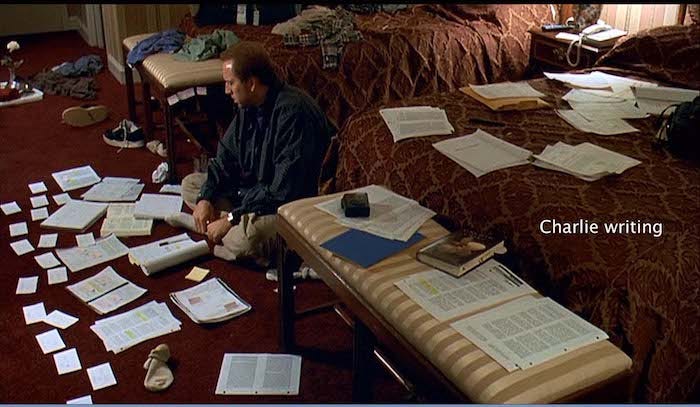
What about Adaptation? Screenwriter gets stuck adapting a novel into a screenplay. That sounds as exciting as watching the proverbial paint dry. But it’s now been the basis of two hit movies — Adaptation and Sunset Blvd., so there must be something there. Interesting that both stories involve mysteries, murder, and larger than life characters, and it makes one wonder had they not included those narrative elements, if those screenplays would have been ‘big enough’ to become movies.
If I ask you to consider whether The Dark Knight’s story concept is big enough, you’d just laugh. Of course, it’s big… everything about the movie is big. But what is it about Slumdog Millionaire that makes it ‘big?’ What is it about Milk? Frost/Nixon? What’s big about those story concepts?
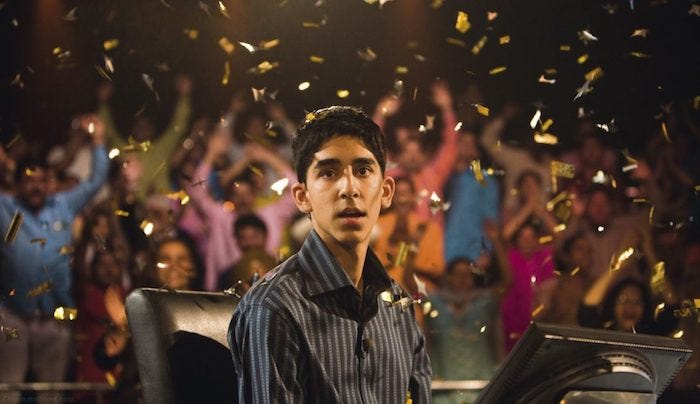
Slumdog Millionaire
- The Protagonist is an orphan who grew up in the slums
- He is a contestant on a nationally televised game show
- He is one question away from winning $20M
- He gets arrested by the police
- He has had violent encounters with local gangs
- He is part of an improbable love story
- It is a classic underdog story
- The story is set in India, a big, mysterious (to the West), and visually alluring world
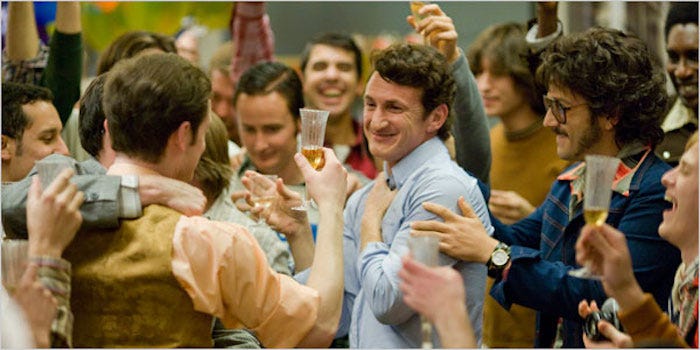
Milk
- The story is based on the real life figure of Harvey Milk
- Milk was the first openly gay elected official in California
- Milk was assassinated, an infamous incident in U.S. history
- The story tracks the assimilation of the homosexual culture into the mainstream of American life
- The evolution of Milk’s life — coming out to becoming a political leader — is a gripping story of transformation
Frost/Nixon
- Even though the movie is essentially two talking heads, they are two famous heads
- The events in the movie are based on an actual historic interview
- Nixon was a former president, one who left office in disgrace
- The two men represent opposing side of the 60s culture wars
- The interview set-up builds in conflict between the two characters
- The story provides insight into the inner workings of two compelling figures

Is my screenplay big enough to be a movie?
The first question goes directly to your script’s heart — the story concept. And while it does not need as big a canvas as The Dark Knight, the core elements of your story concept must be big enough to feel like something that belongs on The Big Screen.
2: DOES MY SCRIPT HAVE BIG ENOUGH CHARACTERS?
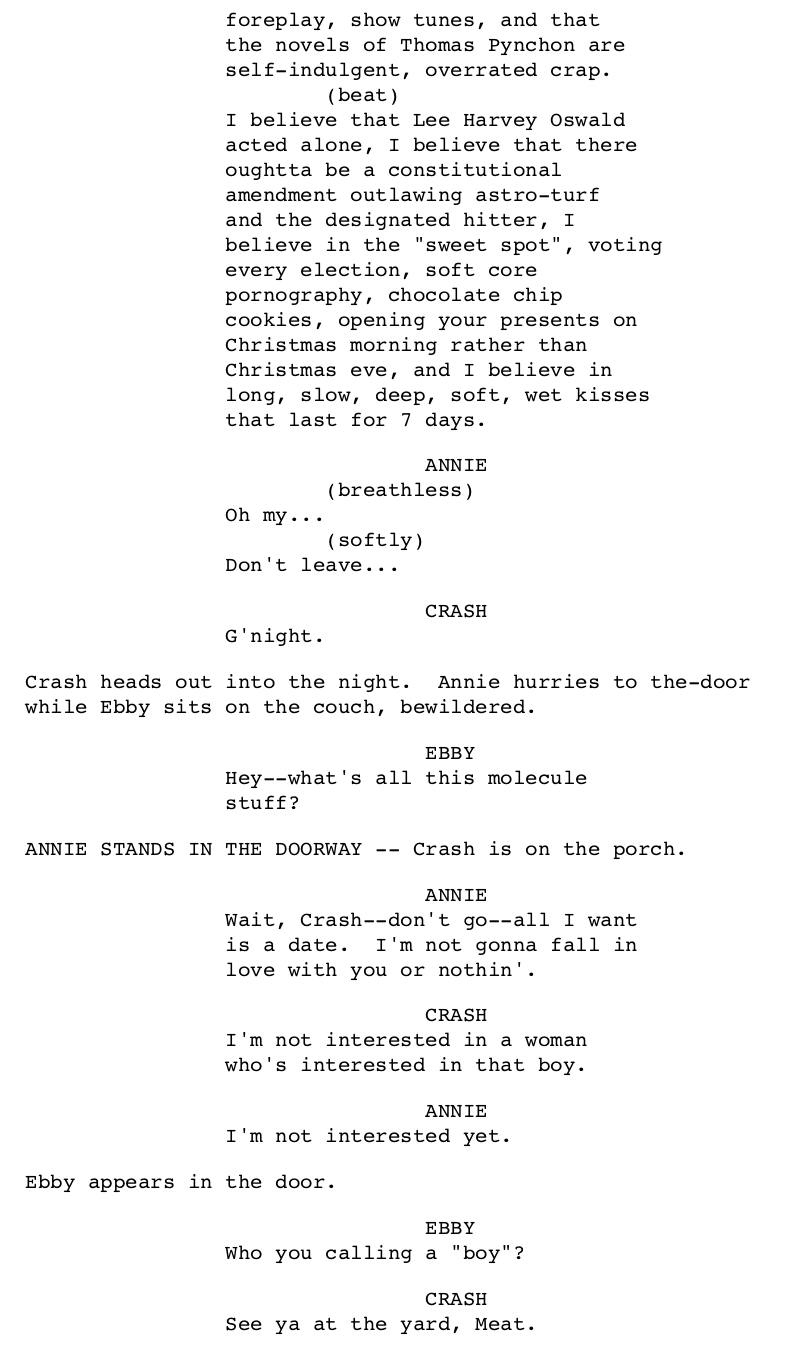
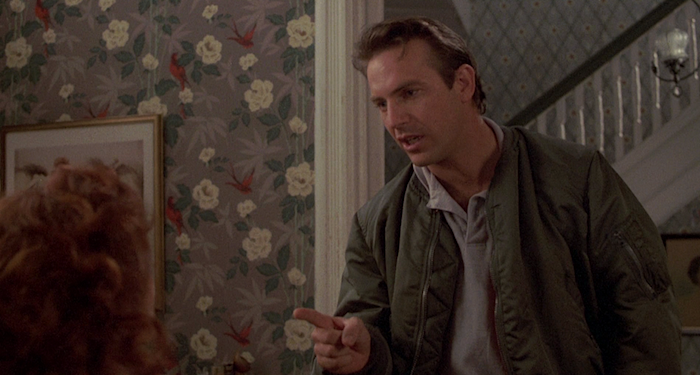
It’s easy to look at Indiana Jones, Rambo, and “Dirty” Harry Callahan and figure that they’re ‘big enough’ to deserve film treatment. But what about Red and Andy in The Shawshank Redemption, Malcolm Crowe and Cole Sears in The Sixth Sense, or Crash Davis and Annie Savoy in Bull Durham? Why are they ‘big enough’ characters to work on The Big Screen?
In the case of both Red and Andy, and Malcolm and Cole, it’s the plot, driven by the underlying story concept, which helps to make them big: In the former, a pair of convicts, one of them innocent, who manages to escape; in the latter, Cole sees “dead people”, one of which turns out to be Malcolm. But Crash Davis and Annie Savoy are just two characters in a ‘small’ Rom-Com set in the world of minor league baseball. Not major league baseball, mind you, which might be ‘big’, but minor league.
What did writer-director, Ron Shelton, do to make this pair of characters ‘big enough’? He created what I like to call “atypical typical characters”.The typical part are those aspects of a character with which the reader / audience can identify, the part of who we are represented on the page / the silver screen. The atypical part are those aspects of a character to which the reader / audience might aspire, we wish we were that smart, that talented, that insightful. So even though the character is someone whose typical-ness we can relate to, their atypical-ness transforms them into larger than life.
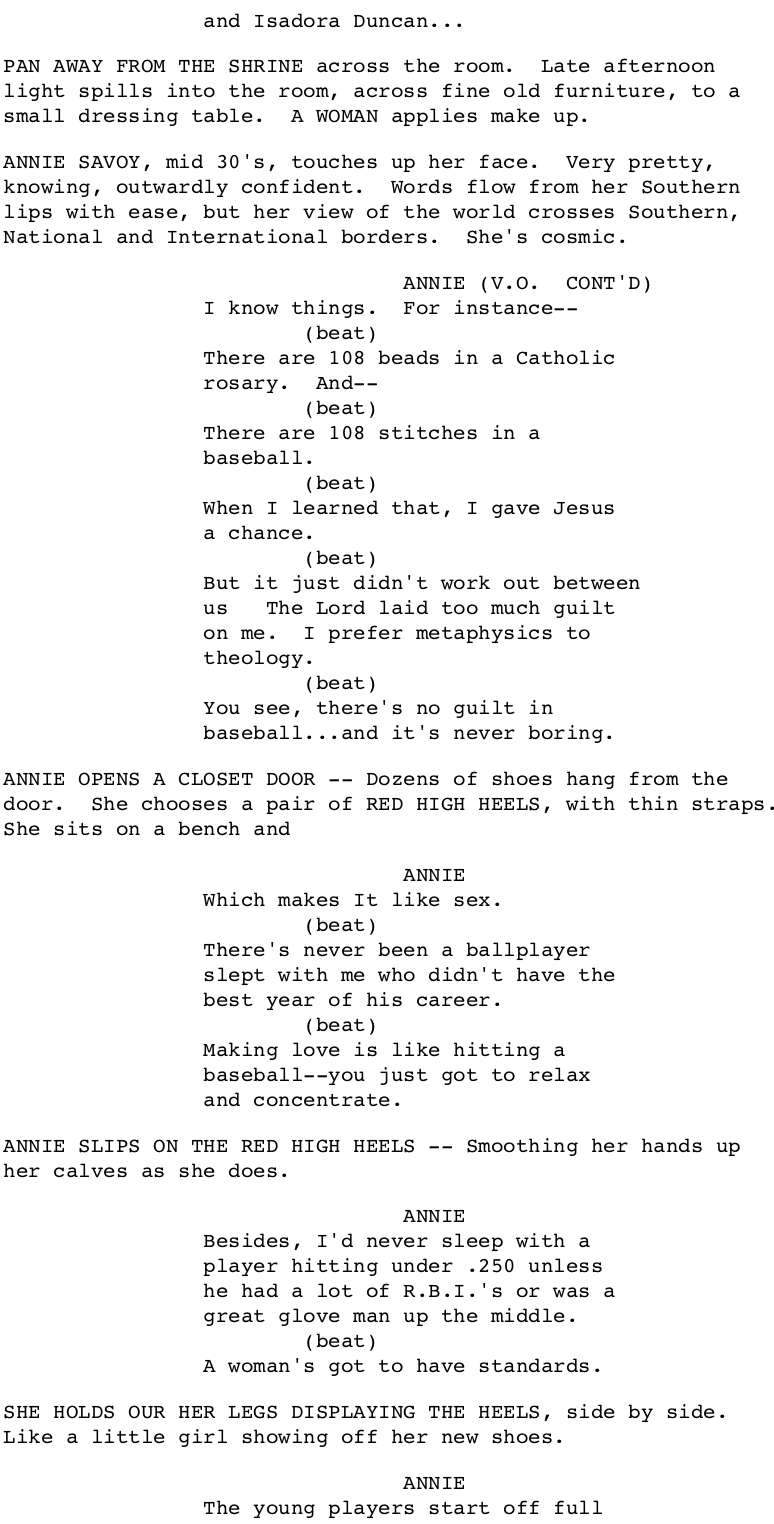
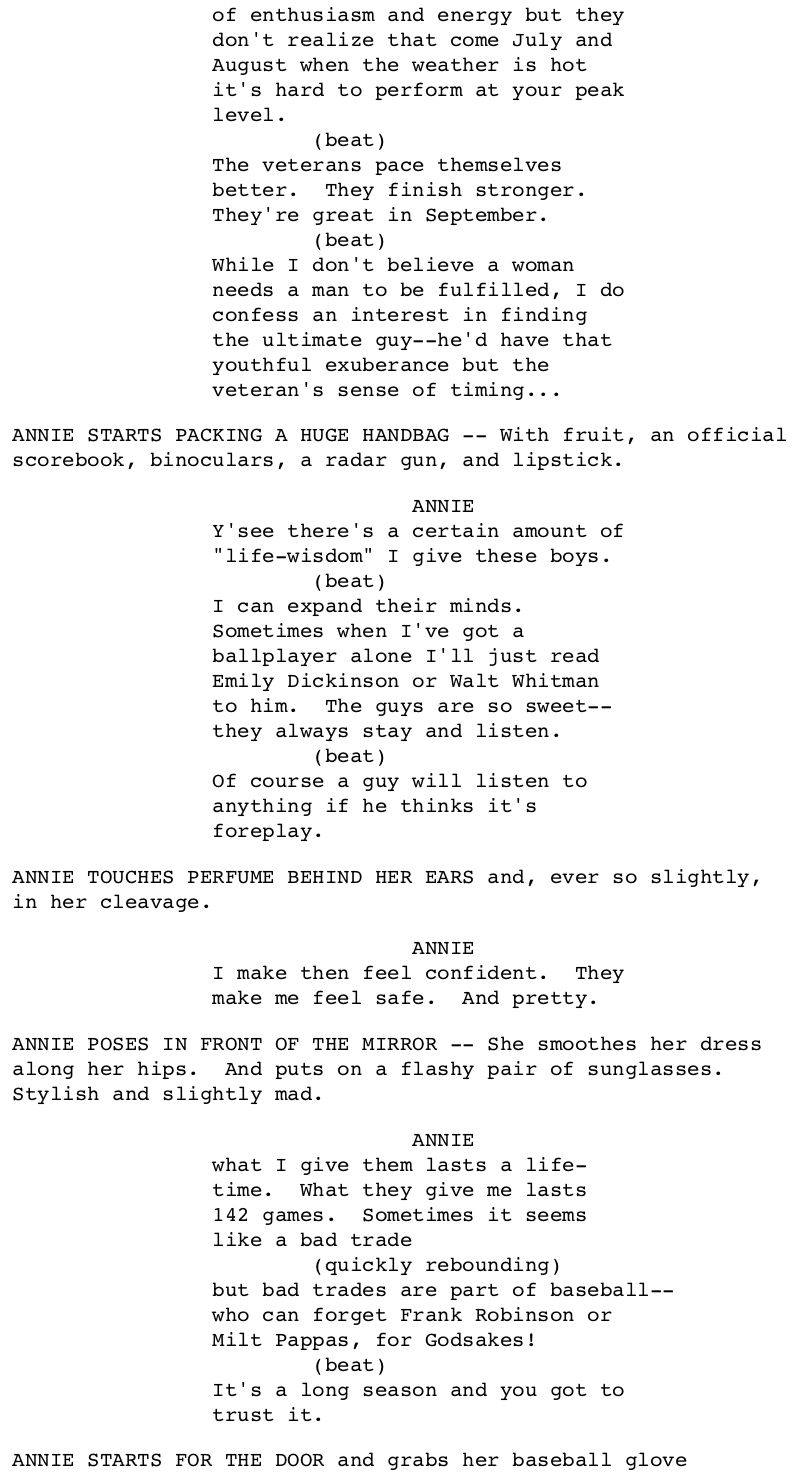
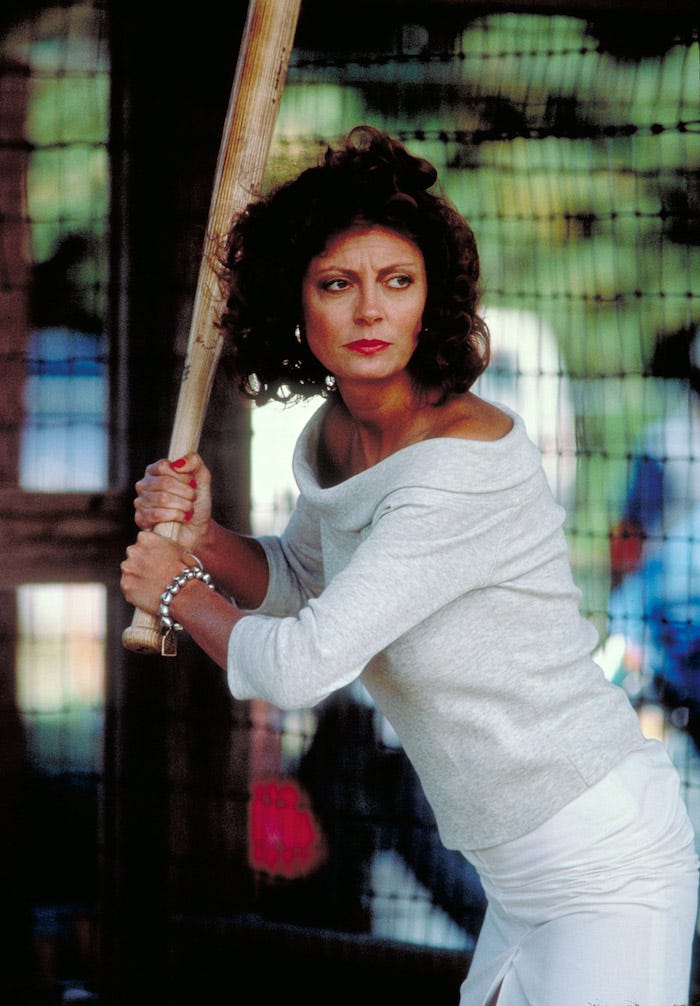
Consider Annie Savoy. She’s a baseball fan. How many people do we know, including perhaps yourself, who are sports fans? That’s rather typical. She lives in a modest home in a modest city. Again, typical. And yet Annie has a unique world view, a life-philosophy based upon and infused with her passion for baseball. She is, or at least likes to think of herself, as a sage, a wisdom figure of sorts, interpreting reality through baseball tinted glasses. Oh, and there’s the sex thing: Every season, she chooses one new minor league baseball player to partake in her wisdom as well as her body. Decidedly atypical.

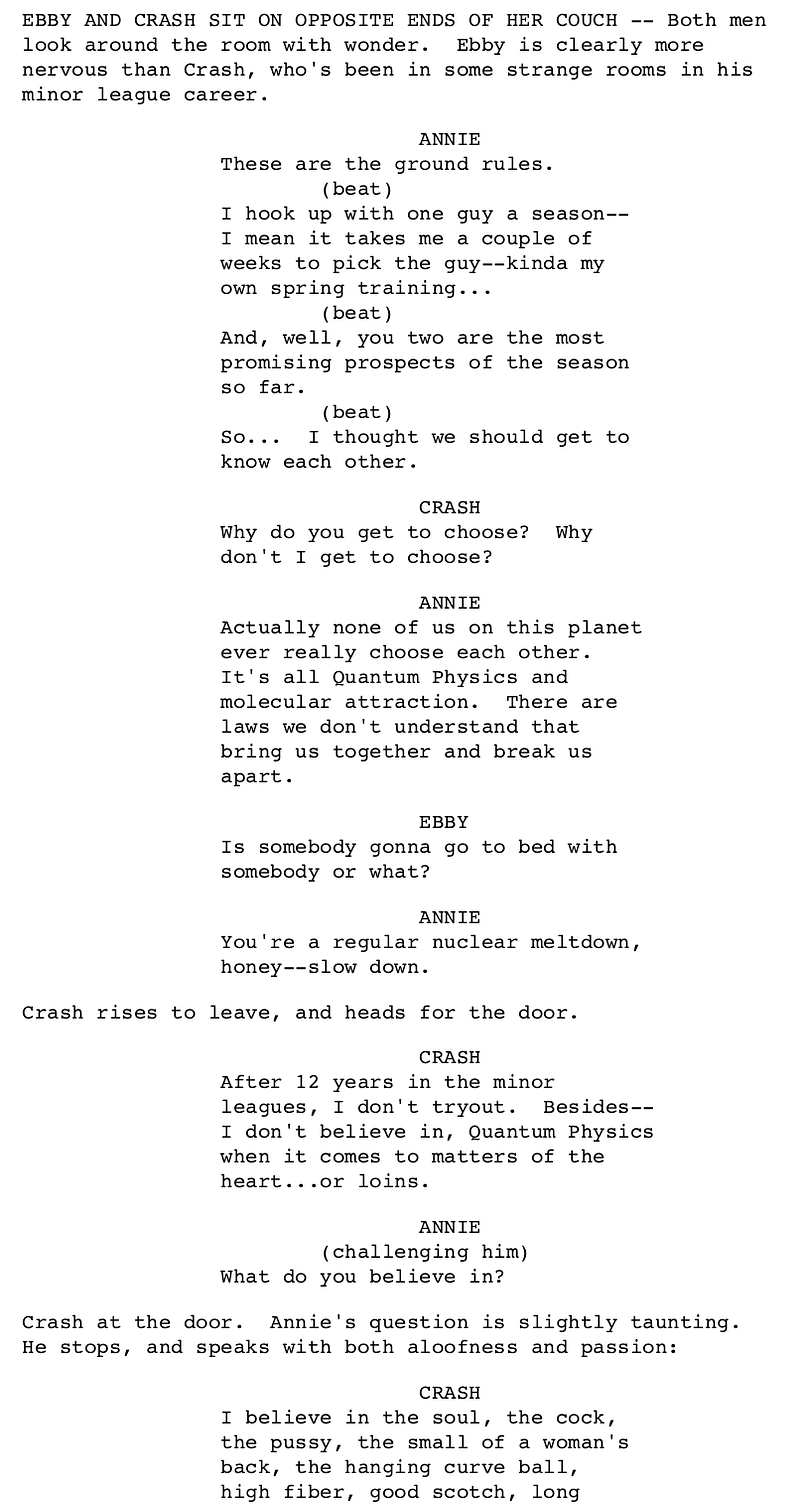
Now consider Crash Davis. He’s spent the better part of 15 years playing baseball in the minor leagues. Not typical you say, but the way Crash carries himself, baseball, at this point in his life, has evolved into a job. And what started out with such promise has lost its sheen. Can any of you relate to that emotional place regarding a line of work you’ve been in for any length of time? Crash Davis stands in the tradition of Willy Loman, the indefatigable salesman, whose product they’re hawking is their Self — and like Willy, Crash sees the writing on the wall and the future doesn’t look pretty. That experience is very typical for many moviegoers. But then, Crash gets brought in to train crazy rookie phenom, Nuke LaLoosh. Furthermore, he gets involved in a mangled romantic triangle with these two off-beat characters. And just to round out the character set-up, Shelton gives Crash his own life-philosophy, also grounded in baseball, but of a more cynical sort, interwoven with romanticism. Not typical.
So are your characters ‘big enough’? If not, perhaps you should dig into them more to create atypical typical characters.
3: DOES MY SCRIPT HAVE BIG ENOUGH SET PIECES?
This goes back to “Is there a movie here?” Does the script have 6–8 scenes or series of scenes that qualify as movie trailer moments? In the old days, they called these “set pieces,” significant scenes requiring the construction of big sets. The chariot race in Ben Hur, Dorothy’s introduction to the land of Oz in The Wizard of Oz, the final stand-off at the foggy airport in Casablanca — those are all set pieces.
In some ways, big set pieces are what the current state of Hollywood production does best. Specialty movies like Napoleon Dynamite can transform a high school auditorium into a showcase for Napoleon’s dancing talent. Foreign movies like Millions can use a child’s imagination to transform a cardboard box into magic. But Hollywood can use artists and computers to transform models and binary code into pirates battling gigantic sea creatures and hobbits fighting hordes of sword-wielding Orcs.
This, in a way, is what Robert McKee is telling Charlie Kaufman in that bar scene in Adaptation: You can save a story by giving the audience a big ending, a big third act. And that’s precisely what Charlie Kaufman, the screenwriter — not the character — does, throwing in everything but the kitchen sink, a satirical homage to mindless endings and, yes, set pieces.
Kaufman can get away with that type of thing, but for the rest of us mere mortals, we have to make sure that our scripts have some key, big set pieces.
For those of you writing sprawling geopolitical or sci-fi thrillers, or action / action-adventure movies, this type of consideration is a given. But what about when we write ‘small,’ character-driven pieces: Do set pieces have a place in those type of movies?
This is where I end up turning away from the phrase “set piece” because finally, for a great movie, it’s not about the CGI, the set dressing, and the art direction. As important as those are in the filmmaking process, sometimes the best trailer moments are those which end up not in the trailer, but in the mouths of moviegoers as they talk about the movie with their friends afterward. This is known as “word of mouth” and for smaller movies, the reason people talk up a movie is that they connected with it emotionally, there were magic moments where they laughed, they gasped, they cried. Sometimes the scenes which help to make a movie big are not their scope or visual complexity, but the depth and power of what is going on in the story’s emotional world.
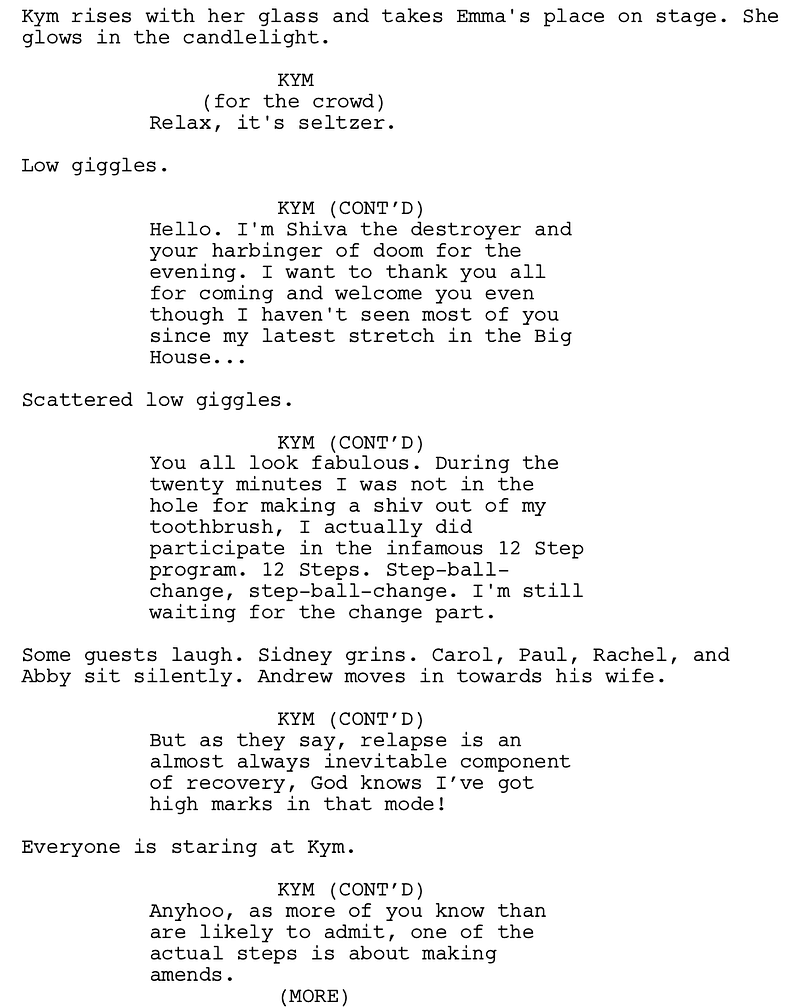
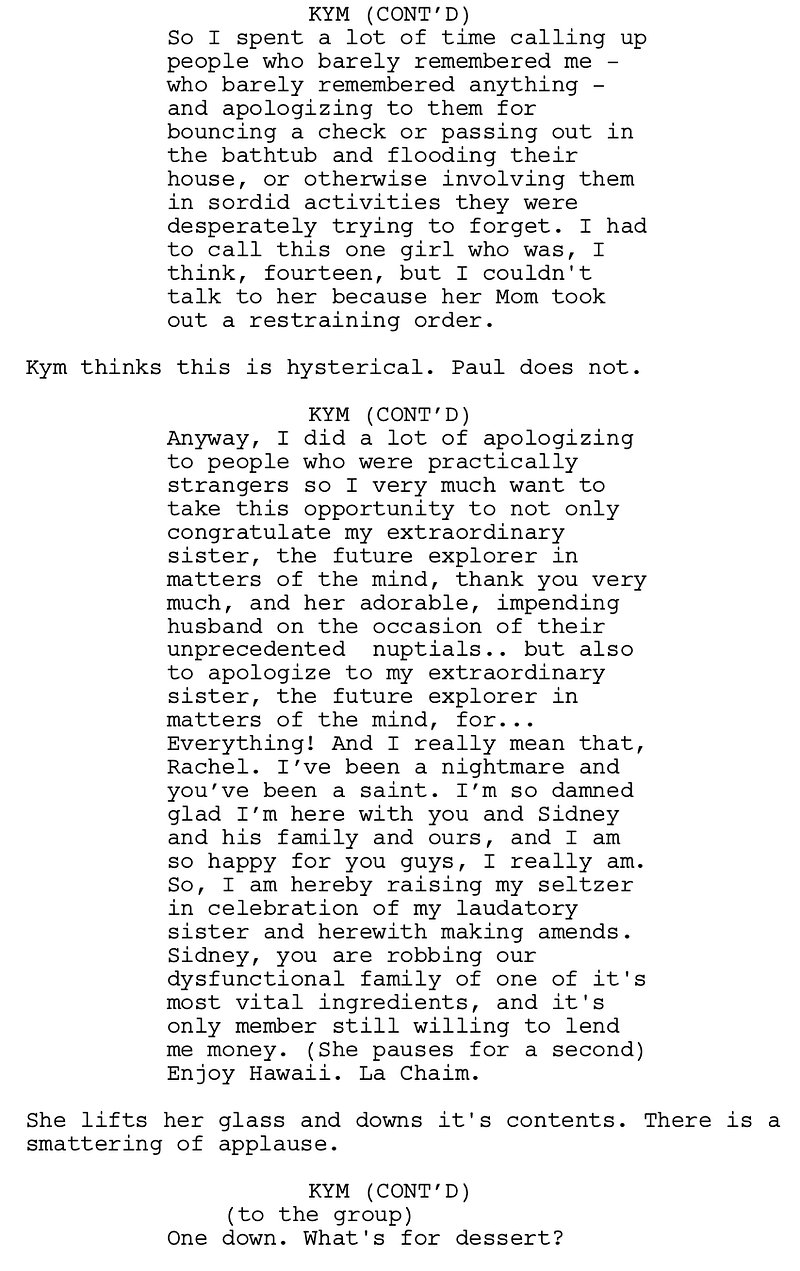
A great example of such a moment occurs in the movie Rachel Getting Married. In an unforgettable scene, Kym (Anne Hathaway), a barely recovering addict stands up at her sister’s wedding rehearsal dinner and ventures into a meandering toast, excruciating for its content and delivery. As noted in this post featuring a NY Times article by Stephen Holden:
“By turns bizarrely perky, hostile and self-pitying, her rambling four-minute toast at the rehearsal dinner for the wedding of her sister, Rachel (Rosemarie DeWitt), offers an indelible, if sometimes repellent portrait of a recovering addict who makes people squirm. Every word and nuance of Jenny Lumet’s dialogue for Kym rings painfully, uncomfortably true.”For those who have not seen the movie, the screenplay is available here. It is proof positive that a scene can be ‘big’ while not involving any other pyrotechnics than one person uttering some words — but some very well chosen words by screenwriter Jenny Lumet.
4: DOES MY SCREENPLAY HAVE BIG ENOUGH CONFLICT?
This is a direct transition from the previous point as conflict is the central ‘stuff’ of a story’s emotional world. I’m sure you’ve heard this countless times, but I read so many scripts with little, let alone good, conflict, that it bears repeating: Without conflict, you have no drama, no spark, no intensity. And without those dynamics, you’re not going to have much in the way of a movie.
The apex of conflict in most scripts is the struggle between the Protagonist and Nemesis. Almost always, they have a contested end point — that is, Protagonist and Nemesis share a goal, each with their own version of how that goal should be realized, each version not leaving room for the other. One of them will win, the other will lose.
Again, it’s easy to see how in a movie with huge stakes, like Star Wars, where a struggle between Luke Skywalker and Darth Vader can translate into a visceral battle. But what about smaller movies? Can their conflict be ‘big’? Of course, if, as noted above, the dynamics of the players in the story’s emotional world are crafted well, played out with imagination, and the human ‘stuff’ they’re confronting and dealing with is something with which the reader / audience can resonate.

Adaptation is a ‘small’ story: A screenwriter adapting a book. But look at the some of the conflict subplots therein:
- Charlie vs. Donald — different screenwriting world views
- Charlie vs. Donald — sibling rivalry
- Charlie vs. Donald — misunderstood past and present
- Charlie vs. Charlie — screenwriting as art vs. commerce
- Charlie vs. Charlie — shadow self loathes everyday Charlie
- Charlie vs. Charlie — undermines his ability for romance
- Charlie vs. “The Orchid Thief” — writer’s block
- Charlie vs. Susan — who the hell is she
- Charlie vs. agent — when the hell will the script be ready
And that’s just conflict centering around Charlie. None of these is particularly ‘big’ and yet, each of them provides an emotional touch point for the reader / audience, so that both individually and collectively, they end up feeling big. Of course, it doesn’t hurt to throw in a gator attack!
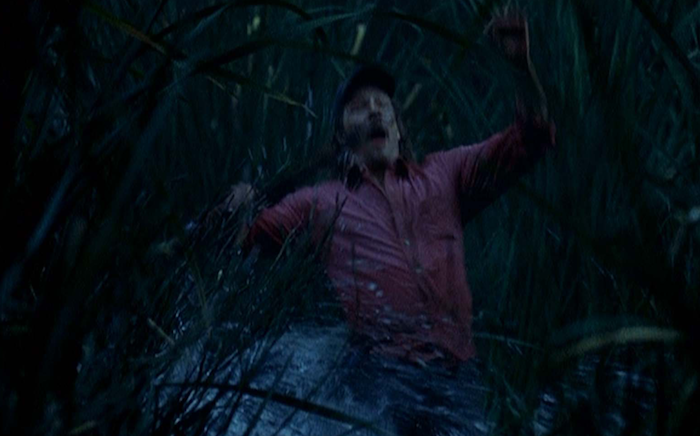
A good exercise: Go through your script and determine each area of conflict. Are they big enough individually? Collectively? Are they big enough to be a movie?
5: DOES MY SCREENPLAY HAVE BIG ENOUGH STAKES?
This is a way of summing up the previous four questions — because story concept, characters, set pieces and conflict combine to create a sense of what stakes are involved. But it’s such a fundamental issue, that I think many writers may overlook it, so it’s worth parsing out on its own.
Ask this question: What can be ‘won’ in my script? How significant is a ‘victory’ going to mean for the Protagonist? How big will that be in transforming their lives? If you have a hard time going there, try imagining what the Denouement is because that should be the physicalization of what the Protagonist’s ‘victory’ means.
Conversely, what can be ‘lost’ in your script? If the Protagonist were to fail in their struggle, what would that mean? Consider the life of your P after FADE OUT: If they ‘lost’, how might you envision that existence?
Note how in answering this question, I went to the Internal World of the script, the emotional life of the story. In Adaptation, there’s this whole slew of plot ‘stuff’ that goes on throughout Act II and especially Act III, and yet in a way, all that services the tiny little subplot between Charlie and the woman he loves and wants to love: By the Denouement, he’s vanquished some of his demons and gathered enough wisdom and strength of character from his now dead brother that he’s able to screw up the courage to express his feelings for his Attractor character (Amelia).
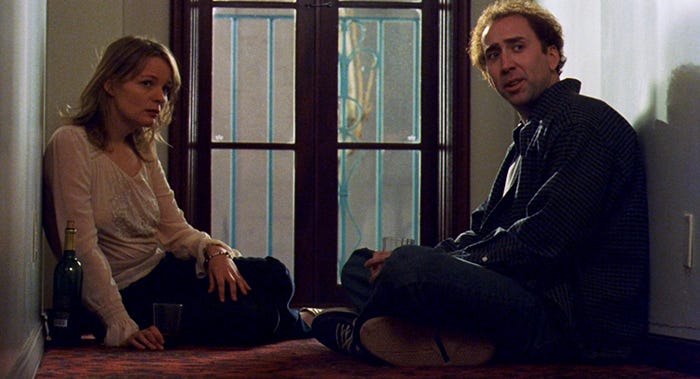
Obviously, in a movie like Armageddon, the stakes aren’t so much about guy gets girl as guy gets asteroid. If you’re writing that type of movie, you’d think you can answer this question in seconds and move on.

But for ‘smaller’ character-driven movies and yes, even big blow-up blockbuster type flicks, stakes like everything else in a screenplay work on two levels: The External World of the Plotline and the Internal World of the Themeline. So when you consider stakes, figure out what they are for both and ask yourself if they’re big enough on both fronts.
6: DOES MY SCREENPLAY HAVE BIG ENOUGH VISUAL STYLE?
At their core, movies are a visual medium. Until The Jazz Singer debuted in 1927, movies existed quite well for three decades without sound. Remember what they were first called: motion pictures. And, of course, one of the first mantras of screenwriting is “Show it, don’t say it.”
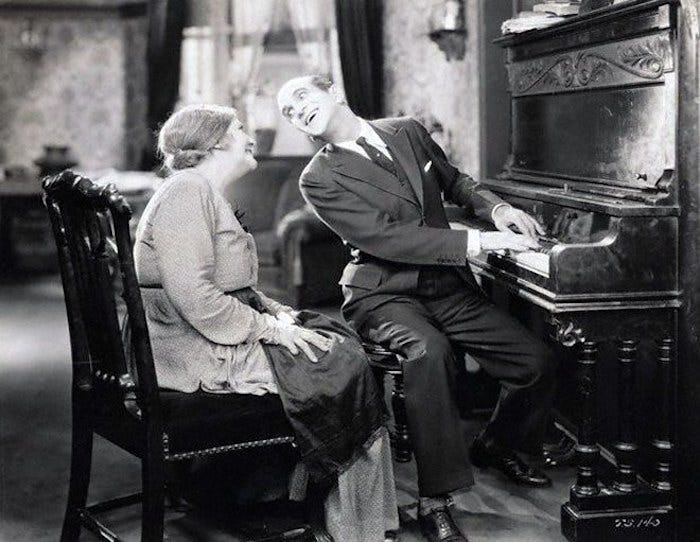
So at all times and in every scene, a screenwriter needs to be actively aware of their story’s visual potential. Some basic things you can do in this regard:
- Put the scene into motion. If you have a scene which has a lot of exposition, put the scene into motion: A careening car ride, pedestrians slaloming through foot traffic, two golf carts chasing each other, and so on. Almost anything is better than two talking heads.
- Inject a loose cannon. A nosy hot dog vendor intrudes on a couple’s argument. Thunder and lightning chase a mother and daughter across the beach and into a cave. In the midst of making love on a remote hillside, a couple is interrupted by the sudden arrival of the Goodyear blimp overhead. The visual can also be surprising.
- Use dreams, nightmares, memories, and imaginings. A screenwriter has the right to enter ‘into’ a character’s mind and convey those visuals on the page. Much better to see than hear the character describe through dialogue.
- Don’t forget contrast. Follow a day scene with a night scene. A dry scene with a rainy scene. A slow scene with a fast scene. An interior scene with an exterior scene. Contrast emphasizes visuality.
- Visual to visual transitions. In Tokyo, a character hangs up a phone / in Midland, Texas, another character clicks on his cellphone. In 1947, a boy throws a baseball / in 2009, an old man catches it. An Italian family dances away, crushing wine grapes / a glass of wine sipped with relish by another character. These type of transitions can enhance a script’s visuality and also create seamless segues from one scene to the next — like this remarkable match cut in 2001: A Space Odyssey.
I call it imagematic writing. Don’t concern yourself with looking up ‘imagematic’. I made it up. To me it means that every word of scene description a screenwriter uses in a script should work to conjure images in the mind of the reader. Use graphic descriptors (e.g., wind-swept, slump-shouldered, bovine), strong verbs (e.g., skitter, vault, careen) — hell, you can even make up words as long as they engender images (e.g., barrel-asses his way, skip-trips across the floor, shadow-slinks into the night).
Then there’s that word style. Style consists of many elements, but certainly how a writer approaches the visual dimension of a script contributes to it — and the more visual your script, the ‘bigger’ it can be.
7: DOES MY SCREENPLAY HAVE A BIG ENOUGH BEGINNING?
By the end of Act One (The Beginning), a reader not only should know where the story is headed, they have to be gripped by it. The combination of the Plotline and the Themeline has to have enough going on to grab a reader’s imagination, excite their curiosity, and propel them into Act Two (The Middle).
Certainly, one way to do that is through a set of bombastic circumstances. Another is to establish sizable stakes at play in the story. But movies often fail when they don’t provide any emotional connection between the events that transpire and what the characters are experiencing. This is especially true with the Protagonist.
Often the Protagonist begins the story with an acknowledged goal, but over the course of Act One, a second goal emerges, usually related to what they need as opposed to what they want. For example, in The Silence of the Lambs, Clarice Starling begins with this Want: To rescue Catherine Martin, Buffalo Bill’s latest kidnap victim. However, once she meets Hannibal Lecter and experiences how he can see into her ‘soul’, she feels compelled to open up to him in order to explain the mystery of her recurring nightmares. And that transforms her goal. Yes, she wants to save Catherine, but she needs to kill Buffalo Bill, an act of redemption for her father’s death.

One way of looking at Adaptation is that at the start, Charlie wants to accomplish the goal of adapting “The Orchid Thief” into a screenplay. However, once he becomes consumed with Susan Orlean, he finds himself lured deeper and deeper into the author’s private life, needing to find the secret to the mystery of his own writer’s block (which is itself a metaphor of his own emotional blockage).
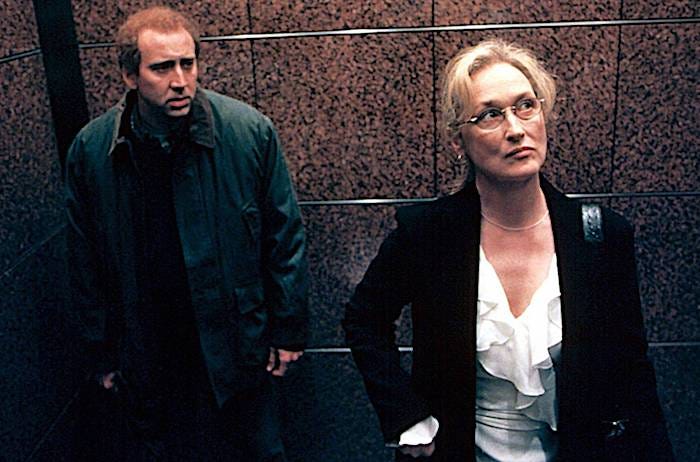
If your story’s Beginning feels too small, dig more deeply into your Protagonist and search for a deeper dimension tied to their goal, one that speaks to their Need.
8: DOES MY SCREENPLAY HAVE A BIG ENOUGH MIDDLE?
Many writers have trouble with their script’s middle part. Either they get confused and lost to the point where they drop the project out of frustration, or if they do succeed in getting through, the pages come off as a string of episodic events with no coherency to them, no build-up to a big All Is Lost Act Two end.
This is a big reason why I’m such a proponent of the Protagonist metamorphosis arc (Disunity to Unity), a dynamic we see at work in movie after movie. I’ll speak more on that later, but in terms of the story’s middle, let’s consider Deconstruction and Reconstruction.
Broadly speaking, the Protagonist emerges from Act One in a state of full-blown Disunity. Typically they will have a Want (a conscious goal), but are either unconscious of a deeper need or aware of it and actively repressing it. In general, the way they have been living in their ‘ordinary world’ established in the story’s beginning is to stitch together a semblance of a viable existence through a variety of coping skills and defense mechanisms, but there is at the core of their being something real and powerful and authentic from which, for whatever reason, they are in essence disconnected. Hence, the term Disunity.
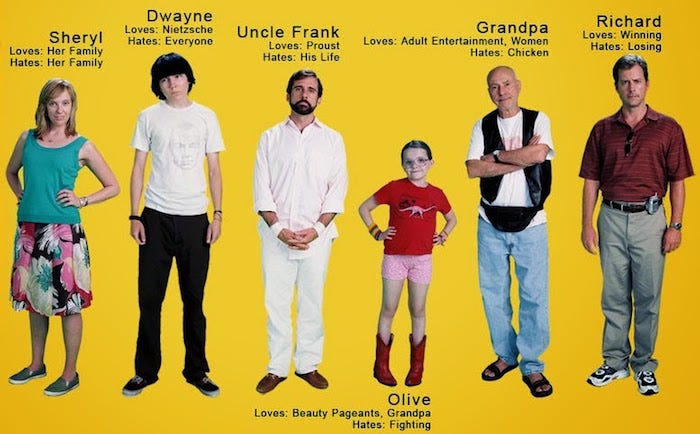
In the first half of Act II (Deconstruction), events occur which assault the Protagonist’s preexisting modes of behavior. Furthermore, as they move out of their ordinary world into the extraordinary world of adventure, the Protagonist is unsure of the rules and the new personalities they are meeting along the way, who they can or can’t trust. The challenges in the first part of the story’s middle, often involving attacks on the Protagonist’s physical self, are seemingly a ‘negative’, but in fact, the cumulative effect of the events is to batter the Protagonist’s status quo, forcing them to open up, allowing that authentic part of their self from which they had been disconnected to emerge into the light of day (consciousness). This is accompanied by a sense of growth and empowerment.
In the second part of the story’s middle (Reconstruction), the Protagonist moves from reactive to active, tapping into their newly found power, and in fits and starts using it to begin constructing a ‘new’ self. As they gain experience, they move toward joining their external (Want) and internal (Need) selves. The All Is Lost moment at the end of Act Two sets the Protagonist back on their heels, yanking them away from their goal, doubly upsetting because they had come so close to achieving ‘victory’.
Now look at these previous two paragraphs: Don’t they present a coherent plot? Don’t they build to a dramatic ending? Don’t they sound like a big middle of a story? And these are generic concepts, not the specifics of this or that Protagonist’s journey.
Not all stories follow this paradigm, but most do. If your story’s middle is more like a muddle, feeling either confused, inconsequential, or both, go deeper into your Protagonist and look for psychological elements there that can become the basis of their metamorphosis, where Act Two can be about Deconstruction and Reconstruction.
9: DOES MY SCREENPLAY HAVE A BIG ENOUGH ENDING?
How frustrating that is when a movie pumps you full of hope with its compelling Beginning, surprises you with twists and turns in the Middle, then peters out with a wimpy, diffuse Ending.
Wimpy endings do not = a big movie. So here are a few things to consider when approaching your script’s Ending.
Typically, there’s no down time in Act Three. Little or no exposition. Once the Protagonist goes on the offensive leading toward the Final Struggle, the script’s ending becomes one continuous chain of events, each leading directly into the other.
Think of Act Three as a replay of the movie:
- On The Defensive recalls the Disunity state of the story’s Beginning, the Protagonist tempted to call it quits and go back to their ordinary world, leaving their goal — and their life — unfulfilled.
- On The Offensive recalls how the Protagonist moved through the story’s Middle, at first reactive (Deconstruction), but then proactive (Reconstruction) as they got more and more in touch with their core essence.
- The Final Struggle recalls all the previous tests the Protagonist has survived, presenting one last challenge to see if their ‘new’ reconstructed self has taken root or not.
Think of the story’s ending as the resolution not only of the events in the Plotline, but also the final dispensation of the Protagonist’s psychological, emotional, and spiritual issues. Whatever transpires in the Plotline, the emotional resolve in the Themeline should represent an ‘answer’ to a critical life-question about the Protagonist raised in Act One.
In Adaptation, Act Three is pretty much everything but the kitchen sink time. Of course, that’s precisely what the Robert McKee character suggested to Charlie in that bar in New York: “The last act makes the film. You can have an uninvolved, tedious movie, but wow them at the end, and you’ve got a hit.” And that’s precisely what Kaufman — the actual screenwriter of Adaptation — did in the script’s ending.
Consider some of the subplots and dynamics which get addressed in the story’s final act:
- Charlie and Donald’s fractured relationship
- Charlie’s writer’s block
- Charlie’s romantic inhibitions
- The mystery of Susan Orlea
- The mystery of Laroche
Combine all that with sex, drugs, guns, kidnapping, escape, chase, car crash, one brother’s death and a tearful goodbye, a gator attack and another death, and you’ve got a “wow” (i.e., big) ending.
The events in a story’s ending can be enormous or intimate. As long as they provide a sense of completion to the Plotline and a resolve to the emotional dynamics in the Themeline, then you have the makings of a big ending.
10: DOES MY SCREENPLAY HAVE A BIG ENOUGH PROTAGONIST ARC?
I have a theory. Beyond entertainment, people watch movies because they want to see characters change. In TV shows, everything from reality TV to sit-coms to police procedurals to home renovation series, it’s mostly about problem-solving. But in a movie, we want to be taken away from the mundane world of solving problems and swept up into a place where in a matter of 120 minutes, a character’s entire life can change — because if we see a character go through a significant psychological metamorphosis, then it reinforces our belief that we can change.
It’s more than just about some generic desire for change. When a movie character endures all the struggles they do through the course of the story and move toward some sense of emotional wholeness, that speaks to one of the most fundamental callings of the human experience.
Carl Jung talks about the process of individuation and that the goal toward which we evolve — or try to — as individuals is unity.
Does the Protagonist in your story start out in Disunity and end up in a Unity state?
Do they go through a world of stuff in Act II, full of tests and challenges, twists and turns, and emerge on the other side, having ‘won’ the Final Struggle to end up in their ‘new’ home (as seen in the Denouement), a transformed person?
That is the big type of psychological event a moviegoer is seeking in a film — to reinforce their belief / hope that they, too, can be transformed, their lot in life can change.
The change doesn’t have to involve geopolitics or a massive plot. Consider the very end of As Good As It Gets where Melvyn (Jack Nicholson)escorts Carol into the bakery:
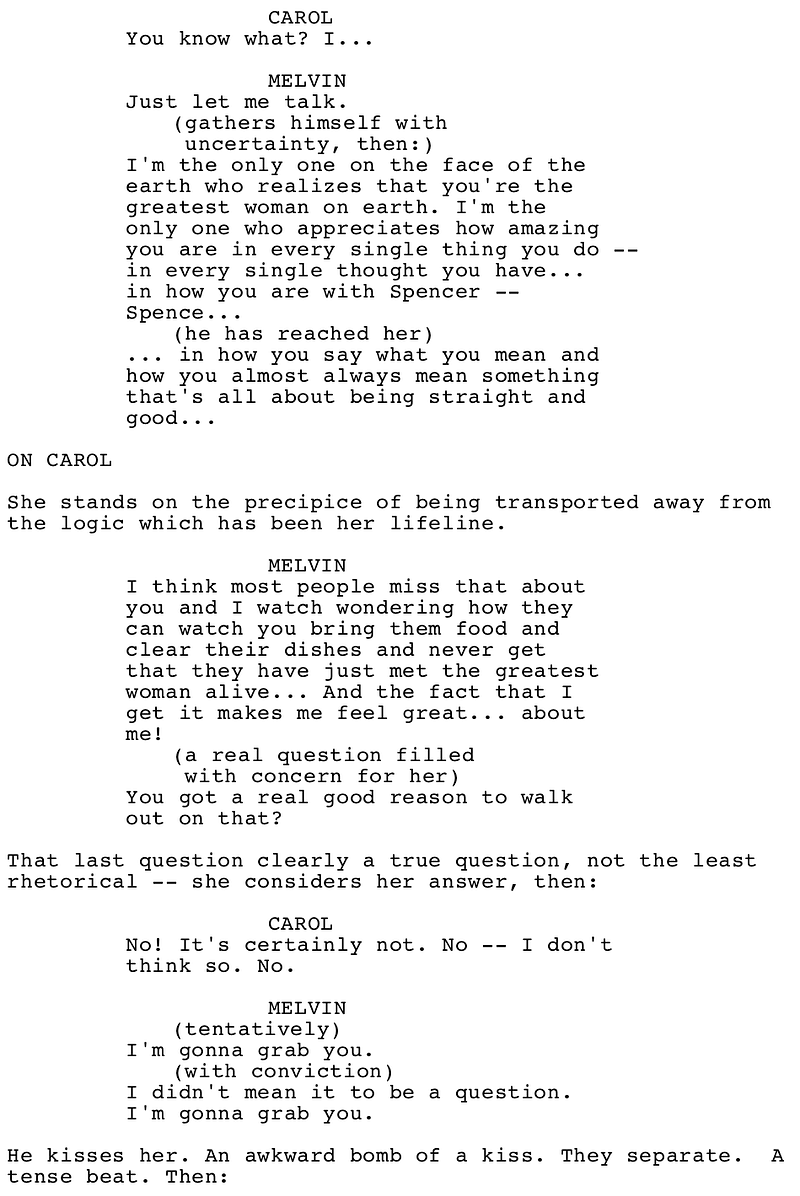
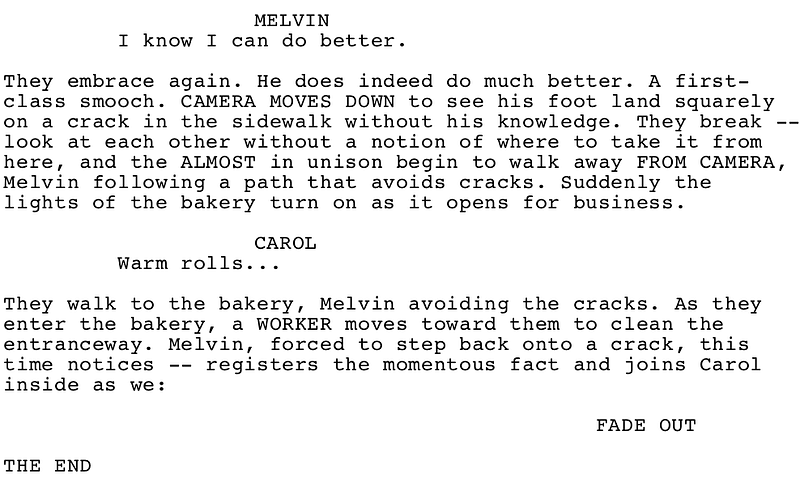
Melvin steps on a crack — and survives. He wins out over his obsessive compulsive condition. A tiny event, but one filled with meaning, signifying a big character arc.
Not all movies have a Protagonist go through a positive metamorphosis. And in some movies, the Protagonist doesn’t change, rather they are they change agent. But in a majority of movies, the Protagonist does undergo a metamorphosis. It can be a radical transformation or a small one — but it always has to be “momentous” enough to translate into something that can sustain a movie.
Is my screenplay big enough to be a movie?
Use these 10 questions to help you determine the answer to this critical issue:
1: Does my screenplay have a big enough story concept?
2: Does my screenplay have big enough characters?
3: Does my screenplay have big enough set pieces?
4: Does my screenplay have big enough conflict?
5: Does my screenplay have big enough stakes?
6: Does my screenplay have big enough visual style?
7: Does my screenplay have big enough beginning?
8: Does my screenplay have big enough middle?
9: Does my screenplay have big enough ending?
10: Does my screenplay have a big enough Protagonist arc?
For hundreds of topics and thousands of articles about screenwriting, writing, movies, television, and the business of Hollywood, visit the Go Into The Story archives. Tons of information and all of it free!