Screenwriting Lessons: “The Wizard of Oz” — Part 1: Disunity to Unity
A five-part series exploring lessons we can glean from classic 1939 movie.
A five-part series exploring lessons we can glean from classic 1939 movie.
Joel Coen of the Coen brothers has said: “Every movie ever made is an attempt to remake The Wizard of Oz.” True or not, all I know is I constantly reference the film in my teaching. Why? Because it contains so many classic narrative elements.
Therefore I was inspired to take on a week-long series focusing on screenwriting lessons we can draw from The Wizard of Oz.
Today: Disunity to Unity.
In most movies, the Protagonist goes through a transformation, starting off in one psyche state, ending up in quite another. Typically in Hollywood movies, the transformation represents a positive change. Going beyond the surface-level idea of flaw or wound, if we look at the totality of the Protagonist’s psyche, what we very often find at the beginning of the story is this:
The Protagonist exists in a state of Disunity.
NOTE: This is my language: Disunity-Deconstruction-Reconstruction-Unity.
It echoes the sentiment of Joseph Campbell who says of the hero at the beginning of the story:
The Hero is making do, but feels something missing, a sense of discomfort or tension. The Hero needs to change, even if they are unaware of that need.
And Carl Jung who asserts:
The psychological rule says that when an inner situation is not made conscious, it happens outside, as fate. That is to say, when the individual remains divided and does not become conscious of his inner contradictions, the world must perforce act out the conflict.
[Emphasis added]
A sense of discomfort. Remains divided. Disunity.
From a screenwriter’s perspective, a good Protagonist is one who has emotional and psychological dynamics at work in the character’s psyche which are at odds with each other. This is the basis of conflict.
They “need to change”… and that happens “outside, as fate”.
Enter Dorothy Gale in The Wizard of Oz. Remember that beautiful song “Somewhere Over the Rainbow”? What about this line of lyrics:
“Someday I’ll wish upon a star
And wake up where the clouds are far
Behind me.
Where troubles melt like lemon drops
Away above the chimney tops
That’s where you’ll find me.”
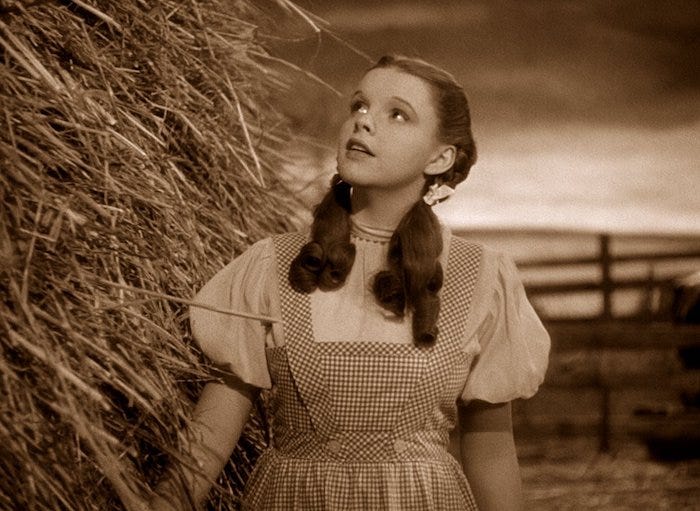
What are her clouds? What are her troubles? As it turns out, the song conveys a sense of Dorothy’s discomfort deriving from these factors:
- She’s a young girl surrounded by people older than she (in the Kansas scenes, there are seven other humans and each of them is an adult).
- Everyone on the farm — from Auntie Em and Uncle Henry to the hired help Hunk, Zeke, and Hickory — has a specific job or task. Dorothy does not.
- Nor does she have anyone (other than Toto) to play with, one reason she gets into trouble while “walking along the railing between the pig pens” and falling in, necessitating Zeke to rescue her (this incident reinforces how she just doesn’t fit in with the ways of the farm).
- She even dresses differently than everyone else in a crisp blue-and-white dress whereas the others wear dingy work clothes.
- Perhaps the single biggest contributing factor for Dorothy’s sense of alienation is a fact we may tend to overlook: she is an orphan.
She’s living in a home that doesn’t feel like home. She yearns to “fly away” to some dream-like place “over the rainbow” where she hopes to find a sense of belonging.
And there you have it, right at the beginning of the story: Her Disunity state, fundamentally a feeling of alienation, indicates the end point of her metamorphosis: Unity = Connection.
In other words, Dorothy’s journey is one in which she goes from a sense of being Home-Less to one in which she embraces the Kansas farms in which she lives by proclaiming: “There’s no place like home.”
Disunity: Home-Less
Unity: Home-Coming
The Disunity to Unity iteration of a Protagonist’s transformation is one common to Hollywood movies, often referred to as the character’s arc.
It’s right there, smack dab at the heart The Wizard of Oz. In order to move toward Unity, the Universe acts as Fate and creates a Call To Adventure which compels Dorothy to leave her Ordinary World then transport her to the Extraordinary World of Oz, a journey she must take.
Tomorrow: Another screenwriting lesson from The Wizard of Oz.