Screenwriting Lessons: “The Social Network” — Part 2: Narrative Framework
A five-part series exploring lessons we can glean from Aaron Sorkin’s script.
A five-part series exploring lessons we can glean from Aaron Sorkin’s script.
The Social Network won the Academy Award for Best Adapted Screenplay in 2011. It is an audacious script which breaks many so-called screenwriting ‘rules’ and thus is worth analyzing.
Today: The Social Network — Narrative Framework.
Aaron Sorkin has a reputation as a great writer of dialogue, as well he should. One need only read the opening scene of The Social Network, 9 full pages of rapid-fire dialogue, to see proof of his talent with what characters say. But perhaps the single most creative choice Sorkin made about this story was its narrative framework. To spotlight the value of that decision, consider this issue that confronted him: How to tell the story not only of a complicated anti-hero such as Zuckerberg, but also the origins and phenomenal growth of Facebook? From this interview Sorkin did with Written By magazine, we learn how Sorkin solved the problem:
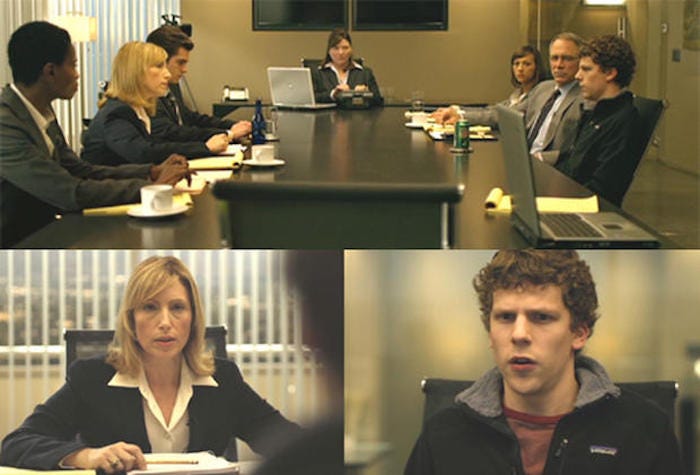
There’s a lot of available research, and I also did a lot of first person research with a number of the people that were involved in the story. I can’t go too deeply into that because most of the people did it on the condition of anonymity, but what I found was that two lawsuits were brought against Facebook at the roughly same time, that the defendant, plaintiffs, witnesses all came into a deposition room and swore under oath, and three different versions of the story were told. Instead of choosing one and deciding that’s the truest one or choosing one and deciding that’s the juiciest one, I decided to dramatize the idea that there were three different versions of the story being told. That’s how I came up with the structure of the deposition room [which Sorkin uses as a narrative frame from which to tell the story in chronological sequence].
Sorkin used the “structure of the deposition room” to allow him to cut from two different legal settings in the present to critical narrative moments in Zuckerberg’s past. Furthermore this allowed him to use the exposition offered in those legal depositions to transition the story in and out of the past, and help construct that Plotline into a coherent whole. In other words:
- Plotline: Zuckerberg and Facebook (Past)
- Subplot: Zuckerberg vs. the Winklevoss twins (Present)
- Subplot: Zuckerberg vs. Eduardo Saverin (Present)
There you have Sorkin’s “three different versions of the story.” It’s reminiscent of other notable narrative frameworks in movies such as Citizen Kane (the reporter interviewing multiple characters in Charles Foster Kane’s past in an attempt to learn the truth about the story’s Protagonist) and Rashomon (multiple versions of the same events, each with their own perspective).
So yes, Sorkin is great with dialogue. But in the case of The Social Network, we must not forget the crucial creative decision he made that enabled him to tell a complex saga in a coherent way — the story’s narrative framework.
It’s a good lesson for writers. While most Hollywood movies will have a straight linear narrative, one of the beauties of cinema is we can manipulate time. How about that script you’re currently writing? Might it benefit from a different approach to the narrative?
Part 1: Compelling Protagonist
Tomorrow: Theme.
UPDATE: Some excellent insight provided in comments by James. Here is a copy/paste in its entirety:
From script to movie, it also appears Fincher had a hand in this effect as well. The script I read had Zuckerberg literally leave one court case to walk into the next.
Fincher’s take actually intercuts the two cases that works as both a humorous effect (that isn’t present in the script) and gives the same “exposition” without ever needing a setup.
The setup is literally, talking about the other case and its defendant/witness in one room, cutting to it, seeing a piece of that case, and then coming back.
While not exactly the same, the opening to SHAWSHANK REDEMPTION has a similar effect. The court case, a supposed affair, Andy Dufrane in the car with booze and a gun, are all written as completely separate scenes, but when assembled are part of a retelling of the court case –
I always find this process of intercutting to be interesting as it seems that film captures it quite well, but illustrating it on the page can be somewhat problematic.
That and I think it points out one universal truth. Court cases are boring. What we really want to see are the actions and relationships behind the case and not the deliberation in the court room. They are almost always framing devices.
I noted the same thing about Shawshank in a post here, how the movie is cut differently than the script, cross-cutting between the nights of the murder and the court case. Much more cinematic.