Screenwriting Lessons [Part 1]: Michael Arndt
A series featuring insights from the Little Miss Sunshine screenwriter.
![Screenwriting Lessons [Part 1]: Michael Arndt](https://cdn-images-1.medium.com/max/800/1*JYJsa0N6KyNs8p3I_l7faw.jpeg)
A series featuring insights from the Little Miss Sunshine screenwriter.
Over the years, I have featured screenwriter Michael Arndt numerous times. Two reasons. First, he is a terrific writer whose movie credits include Little Miss Sunshine (2006), Toy Story 3 (2010), and Star Wars: Episode VII — The Force Awakens. Second, evidently he has spent a good deal of time reflecting about the craft of screenwriting witness his 2007 appearance at the late, great Cody’s Bookstore in Berkeley, California:

Back in 2012, I ran a 5-part series of screenwriting lessons based on what Michael Arndt says and writes. I thought it would be worthwhile to revisit that series. Here is Part 1:
Where it all began for Arndt:
On Tuesday, May 23, 2000, at 4:27 p.m., I sat down to write LMS [Little Miss Sunshine]. I wrote twelve pages the first day, thirty-seven pages the second, and–pulling an all-nighter–fifty-four pages on the third day. I finished the first draft at 9:56 a.m. on Friday, May 26. Then I spent a year rewriting it.
On July 29, 2001–a Sunday–I heard from Tom Strickler.
On December 21, 2001–the Friday before the holidays–the script was purchased by producer Marc Turtletaub.
Principal photography began on June 6, 2005, and ended–after thirty shooting days–on July 18.
The film had its world premiere on January 20, 2006, at Sundance, and was bought by Fox Searchlight the next day.
Little Miss Sunshine opened in theaters on July 26, 2006.
As of this writing (November 6, 2006), it has grossed $75 million worldwide.
So the film has “succeeded,” and I have (temporarily, at least) escaped from the jaws of failure.
In many ways, though, my life has remained much as it was in 2000. I still rent the same one-bedroom walk-up in Brooklyn, and I still spend my days sitting in a chair and staring at a computer (though the chair is more comfortable and the computer is nicer). The main difference is I don’t worry about having to get a day job. (Not yet, anyway).
A number of people who know my story have been quick to seize upon it as a rewards-of-virtue narrative–all that effort and persistence, they tell me, was bound to pay off. In this view of the world, character is destiny and success is the logical–almost inevitable–consequence of hard work, patience, and a shrewdly applied intelligence.
That is not how I see things.
From my perspective, the difference between success and failure was razor-thin and depended–to a terrifying degree–upon chance, serendipity, and all manner of things beyond my control. A thousand things could have gone wrong in the five years it took to turn Little Miss Sunshine into a movie, any one of which could have destroyed the project.
Yet at every turn the script was met with good fortune; every setback was revealed to be a blessing in disguise. I was lucky to stumble upon the right agents, who got it to the right producers, who chose the right directors, who cast (perfectly) the right actor and hired the right crew. A single misstep in this concatenation and the film would have been made badly or, more likely, not at all.
Which brings me–in a roundabout way–to Richard Hoover, Winning and Losing, and the underlying concerns of Little Miss Sunshine.
All of us lead two lives–our public lives, which are visible to others, and our private lives, which are not. Richard is obsessed with the values of public life–status, rank, “success.” His view of the world, divided into Winners and Losers, judges everyone–including himself–accordingly. These values have become seemingly inescapable–including himself–accordingly. These values have become seemingly inescapable in our media-saturated culture–from American Idol, to professional sports, to the weekend box office reports. Everything, it seems, has become a contest.
The problem with this worldview is that it neglects and devalues the realm of the private–family, friendship, romance, childhood, pleasure, imagination, and the concerns of the spirit. Our private lives–invisible to the outside world–tend to be far richer and more gratifying than the rewards of public life. We would do well, as poets and philosophers have long advised, to turn away from the bustle of the world and cultivate the gardens of our souls.
And yet–as I learned in July 2001–it is extremely difficult to set aside the judgments of the world and march to your own drummer. To “do what you love and fuck the rest,” as Dwayne says. That is a hard path, and not often one that leads to happiness or fulfillment (see van Gogh’s letters). I wouldn’t recommend it to everyone.
What I would recommend–and this is the central hope of the movie–is that we make an effort to judge our lives and the lives of others according to our own criteria, distinct from the facile and shallow judgments of the marketplace.
James Joyce once said we should treat both success and failure as the impostors they are. I would humbly concur–the real substance of life is elsewhere.
– Michael Arndt, “Little Miss Sunshine: Screenplay and Notes by Michael Arndt,” PP. x-xii.
Takeaway:
Follow your bliss. If you feel a creative call, somehow do it, follow it. You don’t have to give up your day job, but you do have to respond to your instincts and impulses. Yes, the odds against success are insane. The path you will have to take is fraught with peril, voices in your head whining, “What are you thinking… stop embarrassing yourself… you can’t be serious.”
But consider this: Each of us has one shot at life. If you hear creativity’s clarion call and don’t respond to it, what chance do you have — really! — of finding pure, existential happiness?
If you are called to write stories, somehow… some way… you need to carve out the psychic energy and physical space to do precisely that.
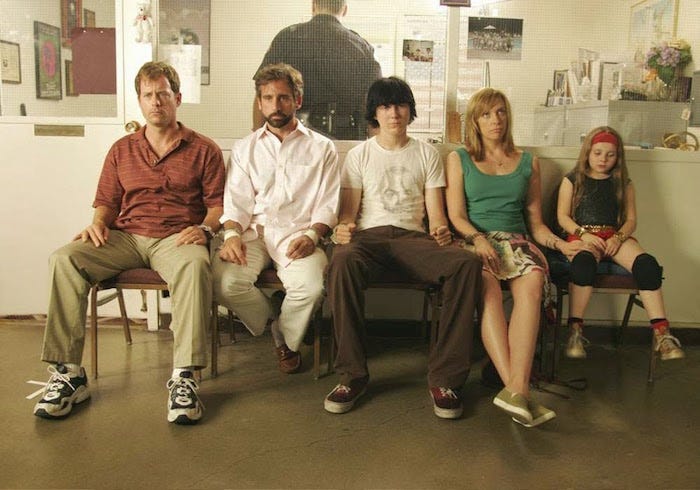
Theme is critical. Stories are always about something. Little Miss Sunshine is about winning and losing, success and failure. The Hoover family is — on the surface — a bunch of losers. And yet on their Hero’s Journey, they discover commonality, even filial love in their shared state. Three characters in particular — Richard, Frank and Dwayne — confront the very idea of what is success / what is failure on a deeply personal level. In the end, the Hoover clan will go back to their deeply flawed world. But as a culminating act of supporting Olive in her catastrophic beauty pageant routine, where all of them get on stage and dance with her, they connect as a family. Flawed, fractured, fucked up, yes. And yet they have found at their core a profound sense of commitment and love to each other. They may be ‘losers’ in a beauty pageant view of the world, but they transform into ‘winners’ as a family.
Writing is writing… and rewriting. Get a vision of what your story is, then do everything you can to jam out an initial iteration of it. Then rewrite, rewrite, and rewrite some more, honing the story until it really works.
Tomorrow more screenwriting lessons via observations from Michael Arndt.