Screenwriting Lessons from ‘American Pie’
Specifically the scene featuring an apple pie. Yeah, that scene.
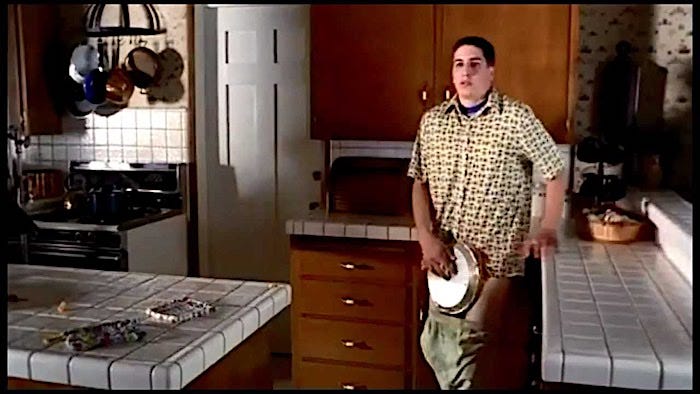
Specifically the scene featuring an apple pie. Yeah, that scene.
In July 1999, American Pie was released in North America. The movie, which had a reported production budget of $11M, went on to generate a worldwide box office total of $235M.
Talk about a solid R.O.I.!
When the spec script was sent to studios, it went out with this title: “Untitled Teenage Sex Comedy That Can Be Made For Under $10 Million Which Studio Readers Will Likely Hate But I Think You Will Love.”
Screenwriter Adam Herz and his representatives were absolutely right!
One reason for the movie’s box office success is the buzz a certain scene created in which one of the lead characters Jim, played by Jason Biggs, has an… encounter… with an apple pie.
The New York Times recently ran a 20th anniversary feature about that scene in which they interviewed many of the people involved including screenwriter Herz, Biggs and fellow actor Eugene Levy who played Biggs’ father, producer Chris Moore, and co-director Chris Weitz. Here are a few choice comments.
ADAM HERZ [The pie scene] wasn’t in my original draft. There was this line somewhere early in the first act where the kids are talking about rounding the bases of sex. I wanted this line to show Jim’s naïveté but also show, do the other guys know what they’re talking about either? I wrote this line “What does third base feel like?” And Chris Klein was like, “Warm apple pie, dude,” and he does this gesture. That line always stuck with me.
CHRIS MOORE It was my first big studio movie, and there was this whole conversation about, “What would a pie look like if somebody had done that?” [Everyone had] different opinions: “Well, would it be crushed? Would it be mangled? Would it actually have fallen out of the pan? Should we do a scene where you see some of it on ‘him’?”
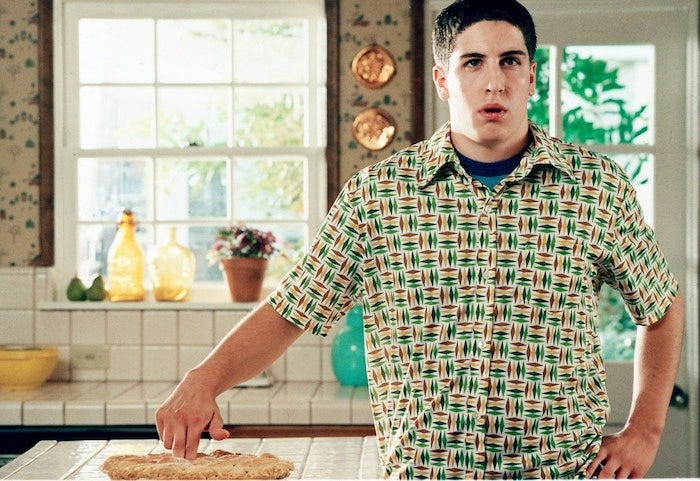
JASON BIGGS I was just like, “I’m going to put my penis in a pie? I’m really going to do this. Could this come back and just totally haunt me? Am I about to ruin my career before it even starts?” I called my manager, and I was like, “Man, I am about to go film that scene, and I’m kind of having a bit of a moment. Should I be freaked out?” He was like, “Jason, you go and [have sex with] that pie with all you got, man.”
EUGENE LEVY For me it was more anti-climactic than one might think. I walked into the kitchen and I was only looking at a piece of tape marked on a light stand where my son would have been humping the pie. So, I had to react to a piece of tape.
MOORE At one point we tried to see if we could get McDonald’s apple pie, and as a producer that was one of the funniest phone calls I’ve ever been on, listening to the representative from McDonald’s say, “Wait. You want a character to put on the apple pie as if he was trying it out on his manhood.”
BIGGS We did it once where I straddled the counter and the pie on that island in the kitchen. Then we did it a second way where I was doing it standing up. I believe the latter was the version that was in the theaters, and then the former was where I was on top of the counter, I believe that was in the DVD or the unrated version.
PAUL WEITZ [For the scene], our first assistant director J.B. Rogers called out “Start humpin’” instead of “action.”
Here is the infamous scene:
If you’re a screenwriter, what this scene should bring to mind is two words.
No, not prurient sex. Not even apple pie. Rather, it should conjure up this term: Trailer Moment.
In Hollywood’s lexicon, a trailer moment is any scene which is viewed to be entertaining enough, it is worthy of inclusion in the movie’s trailer. Like the apple pie scene in American Pie:
Sticking with the sex theme, what about one of the most talked about scenes in the comedy There’s Something About Mary.
Or the fake orgasm scene in When Harry Met Sally?
When I was writing my movie Alaska at Castle Rock, I had a conversation with Rob Reiner who said he thought that scene was responsible for an additional $10M in box office revenues. Why? Because audience members left the theater and talked about “that scene in the deli!”
The thing is a trailer moment scene doesn’t even have to go in the trailer, it just needs to be big enough to create buzz.
Hollywood’s first great producer Irving Thalberg would tell the writers under his employ at MGM, “Just give me five great scenes. I can sell that movie.”
Five great trailer moments.
Takeaway: Take a good look at the story you’re working on. Be honest with yourself. Do you have at five scenes you feel would rise to the level of being in your movie’s trailer?
Why? What makes each scene cinematic… compelling… entertaining?
If your story is lacking scenes which the audience will be talking about on their way out of the theater… into bars for late night conversation… or around water coolers at work the next day…
Time to start brainstorming some trailer moments.
To read the rest of the New York Times article, go here.