Screenwriting “Hats”: Editor
When we write a screenplay, I like to think of the process as one in which we wear several “hats”. Primarily, of course, we wear our Writer…
When we write a screenplay, I like to think of the process as one in which we wear several “hats”. Primarily, of course, we wear our Writer Hat where we get in touch with our vision for each story and give evidence on the page to our unique voice. That is the foundation, to write something that is a reflection of our distinctive creative expression.
But there are other “hats” we can don in the writing process which can help us craft a script which has the most resonance with other people key to the filmmaking process: Director, Actor, Editor.
Today: Editor Hat.
As I’ve discussed before, when I do story prep, I love working with index cards. I use them to brainstorm, make connections, but most importantly to figure out the plot, scene by scene.
Let’s say you write down every beat and every scene you can think of, one for each index card. If you’re writing a movie script, divide the cards into four piles: Act 1, Act 2A, Act 2B, Act 3. Sort the cards into what pile you feel like they might go in. Then work through each pile, scene by scene, trying to construct a linear flow. Some scenes will feel out of place, so you move them to another pile. Some scenes will feel useless, so you set them aside. There will be gaps from this scene to that, so you simply pick up an index card and write on it, “Need a bridge scene here,” put it into its place, and move on, eventually brainstorming the requisite scene. Then you put all the four piles together into one stack. Now go through that stack over and over and over again, telling the story so it flows one scene to the next.
The single biggest key is to determine what the Protagonist’s Conscious Goal is, the object of their desire toward which they make their way through all the twists and turns of the plot. And to make that journey emotionally compelling, delve into the Protagonist’s inner life so while they make progress toward their goal, they go through some sort of psychological transformation. Those duel pistons — the Physical Journey and the Psychological Journey — create a sense of narrative drive.
That’s both important and great. However that does not necessarily translate into smooth reading experience. For that, we don our Editor Hat and look to do create this: Flow.
We want scenes to flow one to the other, a seamless passing of the narrative baton from one scene to the other, FADE IN to FADE OUT.
Here are two tips on how to use our Editor Hat to help craft flow in our scripts.
First, pay attention to transitions. Any time the narrative shifts from one scene to the other, the reader has to make a jump — from this location to that, this character’s perspective to that, this time frame to that. Those can disrupt flow.
When we don our Editor Hat, we can zero in on those transitions and think like an editor would: What would work best to help make that jump from the end of this scene to the beginning of that scene? Some editor tricks:
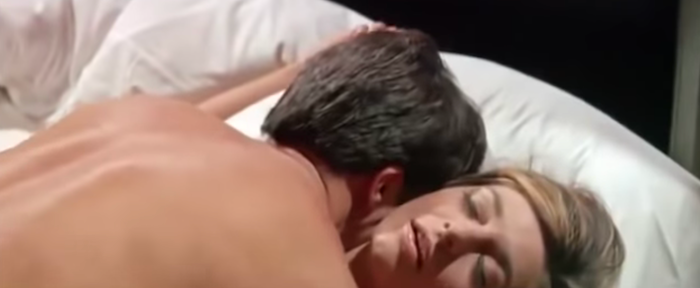
- Visual to Visual Transitions: If one scene ends with a movement, for example a character’s sudden closing of a door enshrouds a room in darkness, the next scene begins in darkness. A character walks out the door of his bedroom, then into the hotel room where he’s carrying on an affair. A character leaps atop a pool float, then lands on the body of his mistress. That is precisely how this montage in The Graduate was edited.
- Audio to Audio Transitions: There is something known as a pre-lap in which a line of dialogue from the next scene gets laid over the end of the preceding scene. Go here to read a post John August did on the subject.
- Juxtaposition: Sometimes by embracing the contrast between a scene end and a scene beginning, the clash of images can create a compelling narrative twist. Compare the end of the first scene in The Shawshank Redemption in which Andy is sentenced to prison to the clunk of the prison cell door at the beginning of the next scene, then go wide into prison life at Shawshank.
As writers, we can do and should be mindful of transitions in our scripts. An excellent example is the screenplay for Saving Mr. Banks written by Kelly Marcel. There must 15+ transitions from the present to the past and back again. Those are some of the toughest jumps a writer has to face. In my December 2013 interview with Kelly, we go into detail about how she slaved over each one of those transitions. You can download the script here.
A second thing you can do when wearing your Editor Hat is embrace this mantra: Enter Late, Exit Early. Scenes which drag along can easily disrupt flow. Slow to get into the action. Slow to get out of the action.
Don your Editor Hat and look at every single scene with a ruthless eye. Do you need the character walking down the hallway. Stand at the doorway. Knock on the door. Wait for someone to answer. Door opens. Conversation begins.
Why not just start in the middle of the interchange inside the apartment?
Likewise do you really need a character to spell things out through dialogue at the end of the scene when by cutting into the next scene, we can see what the character did?
Let’s check out three contiguous scenes from The Shawshank Redemption: Tommy talking with Red when he hears about the crime Andy supposedly committed; Tommy telling Andy and Red about Elmo Blatch; Andy sharing Tommy’s news with Warden Norton. Pay special attention to the end of one scene and the beginning of the next one.
Each time, it cuts out early and enters late. Boom. Boom. Boom. It’s as if it’s one scene, not three. Now that’s seamless, that’s flow.
Trust me when a manager, agent, studio executive, producer, actor, or director reads a script in which the writer pays attention to transitions, gets into scenes late and gets out early, that is a sign of a writer who grasps movies as a cinematic experience — and understands how important editing is in creating a sense of narrative flow.