Screenwriting “Hats”
Sometimes when a writer is writing a screenplay, we have to wear other “hats”: Director, Actor, Editor, Producer.

Sometimes when a writer is writing a screenplay, we have to wear other “hats”: Director, Actor, Editor, Producer.
When we write a screenplay, I like to think of the process as one in which we wear several “hats”. Primarily, of course, we wear our Writer Hat where we get in touch with our vision for each story and give evidence on the page to our unique voice. That is the foundation, to write something that is a reflection of our distinctive creative expression.
But there are other “hats” we can don in the writing process which can help us craft a script which has the most resonance with other people key to the filmmaking process: Director, Actor, Editor, Producer.
Director Hat
While the trend over the last two decades or so has been to remove camera shots and directing jargon from screenplays — at least spec scripts / selling scripts as compared to production drafts — that does not mean we, as writers, can’t bring a directing vision to our storytelling. Indeed if a fundamental goal of a script is to translate the words we write into a movie ‘screening’ inside the imagination of a readers, we absolutely must bring our inner director to bear on our writing. We put on our Director Hat when…
- We decide how to approach the composition of every scene.
- We steer the narrative point of attack.
- We shift focus from one character to another.
While a director is involved in all aspects of the film production process, as far as wearing a Director Hat is concerned, our focus as writers can pretty much be summed up with one word: VISUAL.
Movies are primarily a visual medium. So donning a Director Hat during our writing process reminds us — always — to think visually.
Here are two tips on how to bring our directing vision to the page. First: Think visually, write visually. Consider these lines of scene description excerpted from the opening sequence in The Matrix:
The Big Cop flicks out his cuffs, the other cops holding a
bead.The eye blinks and Trinity's palm snaps up and his nose
explodes, blood erupting.Trinity moves again, BULLETS RAKING the WALLS, flashlights
sweeping with panic as the remaining cops try to stop a
leather-clad ghost.A GUN still in the cop's hand is snatched, twisted and
FIRED.A flashlight rocks slowly to a stop.
Strong verbs. Vivid descriptors. Visual writing. That reflects a writer who sees the movie in their mind’s eye and thinks of it like a director — how to convey that movie in the most visual way possible.
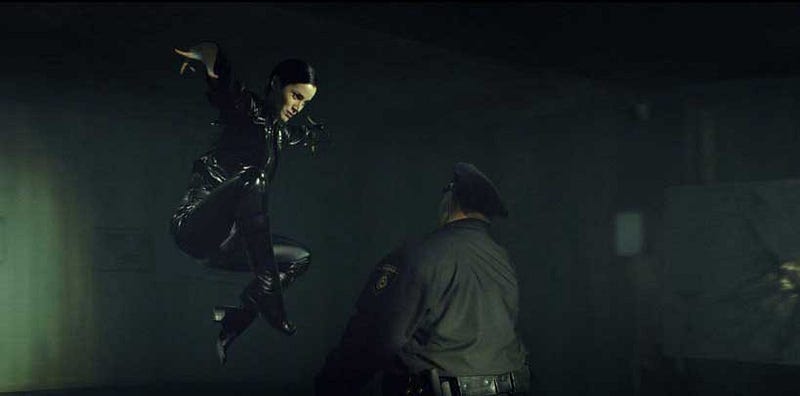
The second thing is this: We can use lines to suggest specific camera shots. Look at those paragraphs above. Think how each one translates into an individual camera shot:
Medium Shot: The Big Cop flicks out his cuffs, the other cops holding abead.
Close Up: The eye blinks and Trinity’s palm snaps up and his noseexplodes, blood erupting.
Wide Shot: Trinity moves again, BULLETS RAKING the WALLS, flashlightssweeping with panic as the remaining cops try to stop aleather-clad ghost.
Close Up: A GUN still in the cop’s hand is snatched, twisted andFIRED.
Extreme Close Up: A flashlight rocks slowly to a stop.
By using lines and paragraphs to suggest individual camera shots, we not only enhance the visual dynamics of our script pages, we do so without stepping on the actual director’s toes. We’re not telling them how to do their job, but we’re speaking their language by framing each scene with specific visual details and elements.
As we write, we can from time to time don our Director Hat. The key word to remember when we do that is this: VISUAL.
Actor Hat
A key job of a screenwriter is to immerse oneself in the lives of our characters, learn as much as we can about them to help them come alive in our imaginations, step back and discern what each of their respective narrative functions are, how their relationships play out as plot and subplots, get them talking so we hear their dialogue, and essentially have them lead us into and through the story-crafting process.
But here’s the thing: Since a script exists to produce a movie, that means all of those characters we spend our time getting to know eventually — if we are lucky! — are inhabited by actors. Therefore it stands to reason it behooves us to don an Actor Hat as part of our scripting process. We put on our Actor Hat when…
We delve into our characters asking what they Want and what they Need.
We track their transformation arc.
We discern in every scene where each character is in relation to the script’s physical and psychological storylines.
In this regard, what we do as writers is quite close to what actors do when digging into a role, so when we put on our Actor Hat, thinking of our story through an actor’s perspective, the one word which gets at the heart of that process is this: Connection.
We want to write characters with whom actors feel a connection because if they do and the part is a good one, we can attract them to the project. While computer generated imagery is increasingly an important player in getting a movie green lit, actors still play a vital role in the success of a movie project going forward.
Furthermore, if an actor feels a connection to characters, there’s an awfully good chance that everyone else in the script development process — agent, manager, producer, studio executive, director — will, too, even ultimately a movie-going audience.
Here are two tips on how to use an Actor Hat to a script’s benefit. Consider these scenes from the Academy Award winning movie The King’s Speech.
In The King’s Speech, screenwriter David Seidler uses the relationship between the story’s Protagonist Bertie (Colin Firth) and his father King George V (Michael Gambon) to crystallize the nature of Bertie’s struggle.
We get an inkling of the father’s role in Bertie’s life in the opening scene where the Prince tries to make a public speech:
The King, growing impatient, hisses:KING GEORGE V
Get on with it. Show what you’re made of!Bertie moves forward diffidently, without an ounce of
confidence, knowing deep within he’s doomed. His stomach knots,
chest muscles contract, constricting his breath.

The pressure his father — the King — puts on Bertie can only contribute to the anxiety Bertie feels about speaking in public, thereby making his stutter worse. In a way, the father’s pressure on Bertie is a form of mockery:
LIONEL
Did David tease you?BERTIE
They all did. “Buh-buh-buh-Bertie”. Father
encouraged it. “Spit it out, boy!” Thought
it would make me stop.
And a more direct example of the father’s communication regarding Bertie’s condition:
KING GEORGE V
Show who’s in command. If you don’t, this
devilish device will change everything.
Used to be, all a King had to do was look
reasonable in uniform and not fall off his
horse. Now we must creep cap in hand into
people’s homes that smell of boiled
cabbage, and speak nicely to them. We’re
reduced to that lowest, basest of all
creatures...we’ve become...actors! Don’t
give me a look of defeated pathos. This is
a family crisis!
So the pressure Bertie’s father puts on him in terms of his stuttering comes off as shame, personal failure, royal responsibility, and a “family crisis.” That’s a huge emotional and psychological weight on Bertie.
But then Bertie’s father dies, so the father’s shadow should be gone, yes? Not so because Bertie’s shadow is not just the father’s persona, it is also — and perhaps more critically — his position: Being a King. That is the ultimate fear Bertie has looming over him his entire post-stuttering life — the possibility that one day he would have to become King:
He exits quickly. Cosmo continues nervously as they walk
through the Abbey, the Archbishop pointing out the preparations
in progress, particularly a booth for broadcasters.BERTIE
Is this the scene of the crime?
That throwaway line as Bertie prepares for the crowning ceremony — Is this the scene of the crime — has so many levels of meaning. On the surface a joke, but reflective of the inner turmoil Bertie feels about ascending to the throne — a crime that he of all people, who can’t speak well in public, should be forced to assume the mantel of monarchical responsibility. How downright criminal!
What the script does with this key son-father relationship is create a sense of clarity about the Protagonist’s Disunity and this plays right into the wheelhouse of an actor’s approach to their craft: To have a clear understanding of who their character is and why they say and do the things they do.
A second way we can use an Actor Cap to elevate our writing is this: Give the characters memorable moments. Check out this scene late in The King’s Speech. It’s interesting to see how powerful the actual King’s throne is to Bertie. Note how he reacts when Lionel sits in it:
BERTIE (CONT’D)
What’re you doing? Get up!LIONEL
I’m tired.BERTIE
You can’t sit there!LIONEL
Why not? It’s a chair.BERTIE
It’s the Chair of Edward The Confessor! The
throne upon which every King for six and a
half centuries has been crowned.LIONEL
It’s falling apart. People have carved
their initials into it. Needs a stone to
keep from blowing away.BERTIE
That’s the Stone of Scone! The Stone of
Destiny that was once Jacob’s pillow.
By sitting on the throne, Lionel is attempting to demystify Bertie’s Shadow — his father / King / throne. Note where Lionel takes the conversation immediately following Bertie’s previous line:
LIONEL
You believe such ballocks I don’t care how
many royal backsides have sat on it, it’s a
building block with handles attached.
You’re just like me, an actor with tawdry
stage props you choose to believe are real.BERTIE
Listen to me... !LIONEL
Listen to you?! By what right?BERTIE
Divine right, if you must! I’m your King!!!LIONEL
Noooo you’re not! Told me so yourself. Said
you didn’t want it. So why should I listen
to a poor stuttering bloke who can’t put
one word after another? Why waste my time
listening to you?BERTIE
Because I have a right to be heard!LIONEL
Heard as what?!BERTIE
A man! I HAVE A VOICE!!!LIONEL
(quietly)
Well then...you’re cured.BERTIE
Stop trying to squirm off the hook.LIONEL
Bertie, you’ll make a bloody good king. And
you know it.
And there you have it — the truth behind the Shadow. Bertie has been caught up in the power of his Shadow for so many years, he has been unable to see or unwilling to admit a reality that exists deep within his soul: that he could be a good king. So while on the surface Bertie’s journey has been about overcoming his stutter, in the story’s Internal World, it’s fundamentally about confronting his Shadow and ‘defeating’ it — symbolically by making it through his big speech at the end (Final Struggle) in order to claim a deeper reality: He is a king. And that along with the conflict plus the visual of Lionel sitting in the King’s chair makes this a powerful moment.
When we write, from time to time it pays to don an Actor Hat and think about the characters we are crafting. Have we achieved clarity in conveying a character’s inner life and resulting motivations? Have we given our characters moments allowing the actor to shine in the spotlight and create cinematic scenes which help make the script feel like a movie? If we achieve both, we elevate the material we are working with.
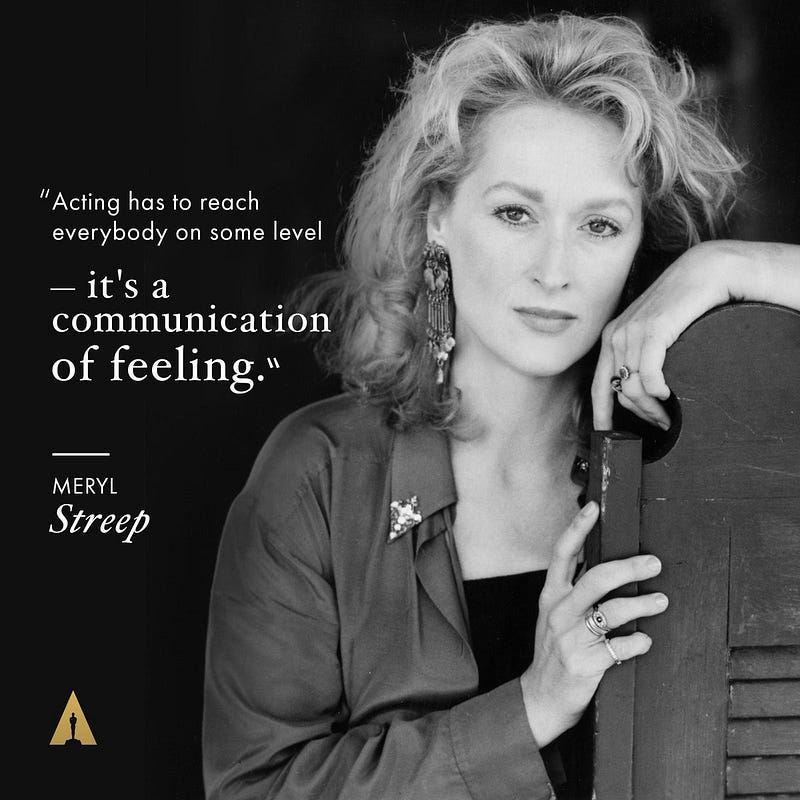
Character clarity and character moments help actors do this:
Editor Hat
As I’ve discussed before, when I do story prep, I love working with index cards. I use them to brainstorm, make connections, but most importantly to figure out the plot, scene by scene.
Let’s say you write down every beat and every scene you can think of, one for each index card. If you’re writing a movie script, divide the cards into four piles: Act 1, Act 2A, Act 2B, Act 3. Sort the cards into what pile you feel like they might go in. Then work through each pile, scene by scene, trying to construct a linear flow. Some scenes will feel out of place, so you move them to another pile. Some scenes will feel useless, so you set them aside. There will be gaps from this scene to that, so you simply pick up an index card and write on it, “Need a bridge scene here,” put it into its place, and move on, eventually brainstorming the requisite scene. Then you put all the four piles together into one stack. Now go through that stack over and over and over again, telling the story so it flows one scene to the next.
The single biggest key is to determine what the Protagonist’s Conscious Goal is, the object of their desire toward which they make their way through all the twists and turns of the plot. And to make that journey emotionally compelling, delve into the Protagonist’s inner life so while they make progress toward their goal, they go through some sort of psychological transformation. Those duel pistons — the Physical Journey and the Psychological Journey — create a sense of narrative drive.
That’s both important and great. However that does not necessarily translate into smooth reading experience. For that, we don our Editor Hat and look to do create this: Flow.
We want scenes to flow one to the other, a seamless passing of the narrative baton from one scene to the other, FADE IN to FADE OUT.
Here are two tips on how to use our Editor Hat to help craft flow in our scripts.
First, pay attention to transitions. Any time the narrative shifts from one scene to the other, the reader has to make a jump — from this location to that, this character’s perspective to that, this time frame to that. Those can disrupt flow.
When we don our Editor Hat, we can zero in on those transitions and think like an editor would: What would work best to help make that jump from the end of this scene to the beginning of that scene? Some editor tricks:
- Visual to Visual Transitions: If one scene ends with a movement, for example a character’s sudden closing of a door enshrouds a room in darkness, the next scene begins in darkness. A character walks out the door of his bedroom, then into the hotel room where he’s carrying on an affair. A character leaps atop a pool float, then lands on the body of his mistress. That is precisely how this montage in The Graduate was edited.
- Audio to Audio Transitions: There is something known as a pre-lap in which a line of dialogue from the next scene gets laid over the end of the preceding scene. Go here to read a post John August did on the subject.
- Juxtaposition: Sometimes by embracing the contrast between a scene end and a scene beginning, the clash of images can create a compelling narrative twist. Compare the end of the first scene in The Shawshank Redemption in which Andy is sentenced to prison to the clunk of the prison cell door at the beginning of the next scene, then go wide into prison life at Shawshank.
As writers, we can do and should be mindful of transitions in our scripts. An excellent example is the screenplay for Saving Mr. Banks written by Kelly Marcel. There must 15+ transitions from the present to the past and back again. Those are some of the toughest jumps a writer has to face. In my December 2013 interview with Kelly, we go into detail about how she slaved over each one of those transitions. You can download the script here.
A second thing you can do when wearing your Editor Hat is embrace this mantra: Enter Late, Exit Early. Scenes which drag along can easily disrupt flow. Slow to get into the action. Slow to get out of the action.
Don your Editor Hat and look at every single scene with a ruthless eye. Do you need the character walking down the hallway. Stand at the doorway. Knock on the door. Wait for someone to answer. Door opens. Conversation begins.
Why not just start in the middle of the interchange inside the apartment?
Likewise do you really need a character to spell things out through dialogue at the end of the scene when by cutting into the next scene, we can see what the character did?
Let’s check out three contiguous scenes from The Shawshank Redemption: Tommy talking with Red when he hears about the crime Andy supposedly committed; Tommy telling Andy and Red about Elmo Blatch; Andy sharing Tommy’s news with Warden Norton. Pay special attention to the end of one scene and the beginning of the next one.
Each time, it cuts out early and enters late. Boom. Boom. Boom. It’s as if it’s one scene, not three. Now that’s seamless, that’s flow.
Trust me when a manager, agent, studio executive, producer, actor, or director reads a script in which the writer pays attention to transitions, gets into scenes late and gets out early, that is a sign of a writer who grasps movies as a cinematic experience — and understands how important editing is in creating a sense of narrative flow.
Producer Hat
Apart from the screenwriter, the single most important person involved in the process of getting a movie project set up is the producer. Yes, talent attachments (actors and directors) may be a critical factor in a studio’s decision to green light a project, but it’s often the producer who uses their connections and influence to lure talent.
Once someone acquires a script, the producer continues to play an important role. Their focus may be on finding financial backing to make the film. The producer may be involved in meetings between the director and screenwriter. The producer may contribute ideas to the marketing plan. And so on.

All of which is to say that when a screenwriter dons a producer’s hat, we do so with one key aspect at the forefront of our minds: Hook. We look for a story that has some notable narrative elements which hook a reader’s attention, everyone from lowly script reader to president of production. These include:
- Great characters in the script which can attract the attention of name actors. Why is this important? Because name actors can help source sufficient funds to make a movie.
- While considering a script’s market viability, we should brainstorm compelling set pieces and trailer moments. It’s so much easier to pitch a project which naturally exhibits a film’s key “big moments.”
- Locations. Generally speaking, the fewer, the better as it cuts down on transportation costs and makes for a simpler production. Also, depending upon where the project is set, there are state tax incentives which can help with the budget.
The story is still the most important thing, but if we align what’s on the page with a producer’s concerns, we elevate the chances the project may not only get set up, but also produced.
Writer Hat
That said, we should never lose sight of the Writer Hat. From first to last, that is the POV we must bring to any script we produce. But there are times when we can bring other perspectives to bear on our writing — Directing, Acting, Editing — which can work in concert with who we are as writers.
Besides sometimes, a screenwriter wearing a hat can look pretty damn cool!