Screenwriting Advice From The Past: Theme
“Found your story on an original truth of such universal interest that when your climax comes everybody in the audience from stenographer…
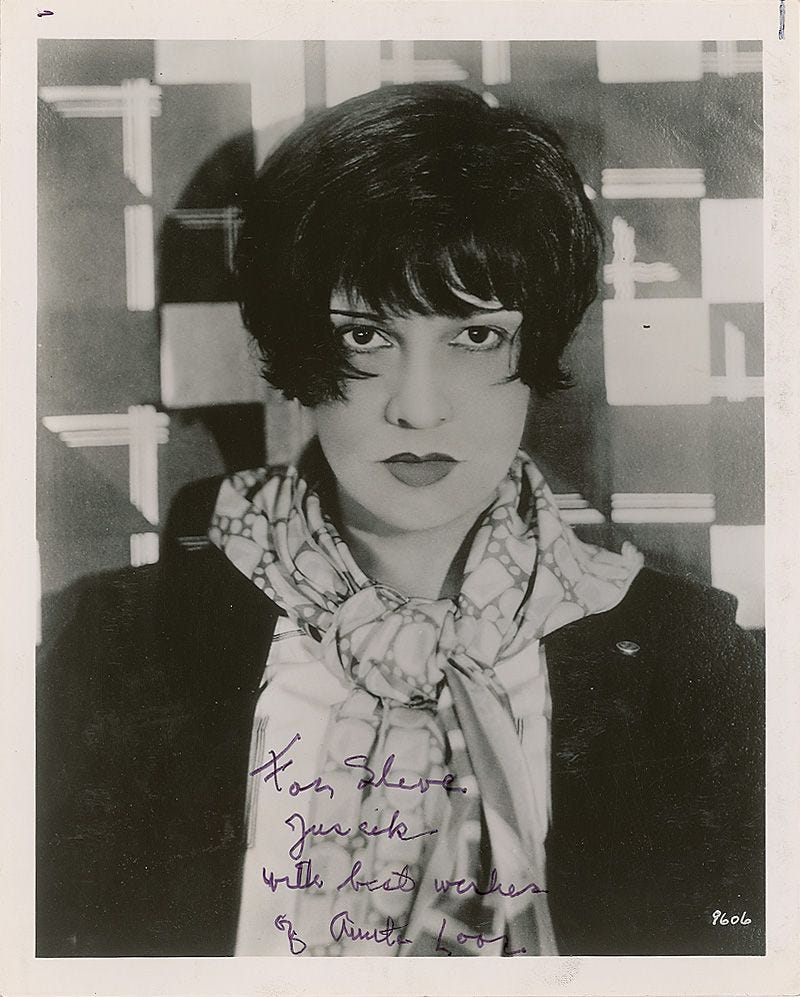
“Found your story on an original truth of such universal interest that when your climax comes everybody in the audience from stenographer to bank president will say to himself, ‘That’s just the way I have felt myself.’”
If you are a screenwriter, you should know about Anita Loos. Loos was one of the most influential writers in the early stages of American cinema, associated with 136 film projects per IMDb.
Married to writer John Emerson, the pair wrote one of the first books on screenwriting in 1920: “How to Write Photoplays”.
Today: Theme
In Chapter V, here is how they define theme [P. 21]:
Theme is the second great technical term which the playwrights must understand. It is the chief trick of the trade. A theme is a great universal truth such as “Honesty is the best policy” or “Don’t tell Masonic secrets to a woman.” It is not absolutely essential to a good story but it makes the writing of a plot many times easier by offering a definite objective.
This is the typical definition of theme as it relates to screenwriting and perhaps storytelling in general. In my view, this amounts to the first layer of a much more textured understanding of the concept, but more on that below.
The point they make about how “essential” a theme is to contribute to a “good story” is absolutely true. And probably how much “easier” it makes a story to write because if provides a “definite objective.” In general, theme can act as the substance that helps bind together all the disparate parts of a story into a whole, and provides a touchstone for the writer to help guide their vision throughout the writing process.
Loos & Emerson make an additional point of considerable value about theme on P. 23:
Last of all make your theme of as wide interest as possible a truth which every one has experienced and consequently can appreciate when viewing it in story form. Our first story for Douglas Fairbanks “His Picture in the Papers” was founded on the great American love of publicity; we knew that almost every one is thrilled at the prospect of seeing his or her name in print, while themes connected with aviation or foreign trade or a painter’s career would appeal to comparatively few people.
Found your story on an original truth of such universal interest that when your climax comes everybody in the audience from stenographer to bank president will say to himself, “That’s just the way I have felt myself.”
This speaks to two psychological dynamics that can occur between a reader and a story:
- Audience Identification: Where a script reader connects with key characters, thus experiencing some measure of what the characters go through in a vicarious but real way.
- Wish Fulfillment: Providing the script reader a specific context and set of circumstances which the reader would enjoy experiencing — again — in a vicarious but real way.
Both of these dynamics are of enormous value for a writer and a story’s themes can help on both fronts.
Notice I said “themes.” Whereas Loos & Emerson’s definition of ‘theme’ — essentially the idea of a story — may have worked for short-form films in the silent era, that understanding does not do well with feature-length movies. Playing upon one conceit for two hours can become repetitive and tiresome. In my view, a good story has multiple themes: there are sub-themes, each exploring and expanding a central theme, providing a richer, more diverse experience for the script reader. Moreover — again in my view — theme is not an intellectual exercise in movies, but rather an emotional one.
Tomorrow: More screenwriting advice from the past.
You can read “How to Write Photoplays” via Google books online here.
For the rest of the series articles:
Note: I ran this series originally in 2012. Unfortunately, the individual articles got bungled up on the site in some sort of technical snafu. So, I am recovering them one by one in this reprise of the series.