Screenwriting Advice From The Past: The Continuity (Part 1)
“The continuity writer visualizes the story in a series of scenes.”

“The continuity writer visualizes the story in a series of scenes.”
If you are a screenwriter, you should know about Anita Loos. Loos was one of the most influential writers in the early stages of American cinema, associated with 136 film projects per IMDb.
Married to writer John Emerson, the pair wrote one of the first books on screenwriting in 1920: “How to Write Photoplays”.
Today: Continuity.
These observations from Chapter IX [P. 35].
The continuity writer visualizes the story in a series of scenes. The total number of scenes in a five reel photoplay varies greatly according to the method used. And there are practically as many methods now in use for the handling of scenes in continuity as there are companies in the motion picture business. Because of this we will outline only the method which we ourselves have found best.
Two things to note here:
- (1) The earliest roots of what became the formalized screenplay is what was known as the continuity, a series of scenes comprised of a handful of narrative and production elements that tell a complete story from beginning to end.
- (2) Even from the beginning of the film business, how writers approached writing ‘scripts’ varied greatly. There was no set approach, no authorized guidelines or style books. Furthermore as the continuity eventually evolved into a Screen Play, then a Screenplay, that provided a default dynamic: Screenplay format and style is always changing. Beware script literalists who argue that you can only write a screenplay this way or that. At all times, story trumps form, not the other way around.
Even in 1920, Loos and Emerson note how the creative needs of the story supersede form, talking about the use of sub-titles, cards with text on them to convey dialogue or action [P. 37]:
Some photodramatists frown upon the use of many sub-titles or of any printed matter on the screen. We have been particularly successful in using as many sub-titles as we wish. In this way clever dialogue is carried over to the audience. There are some things which cannot be expressed in pantomime. For this reason we advise you to use explanatory sub-titles with as clever and forceful wording as possible whenever the action necessitates explanation [emphasis added] .
While these unnamed “photodramatists” represented a ‘literalist’ view of what could or could not be done in a continuity, Loos and Emerson — remember they are writers — state flatly that “some thing cannot be expressed in pantomime” in silent movies. Therefore, the story requires the writers to use “as many sub-titles as we wish.”
It was true in 1920. It is true today. Whatever you have to do to tell your story the best, most effective way, you may do it, as long as you do it well, it’s readable, entertaining, etc.
Yes, there are generally accepted ways of writing a screenplay, but there is nothing codified, nothing etched in stone, and no universal standard.
Here is an actual page of a Loos & Emerson continuity for a movie called In Search of a Sinner:
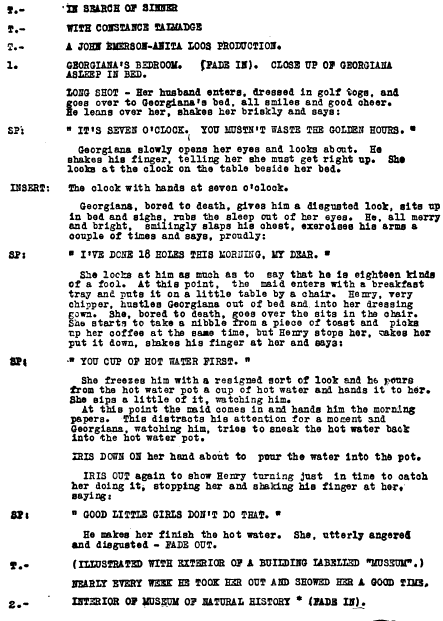
T = Title
1., 2., etc = Scene Number
SP = Sub-Title
INSERT: = A specific camera shot, typically a close-up.
This approach is an example of the roots of what eventually evolve into a screenplay. And note the ‘unfilmable’: “She looks at him as much as to say he is eighteen kinds of a fool.”
One final note from Loos & Emerson [P. 35]: “Remember that the story is being told in pictures.” Right there you have it, a primary concern for continuity writers: Movies are primarily a visual medium. And it’s still true today.
Tomorrow: More screenwriting advice from the past.
You can read “How to Write Photoplays” via Google books online here.
For the rest of the series articles:
Introduction
Getting Ideas
Conflict and Crisis
Situation
Theme
Star Sympathy
Action: Part 1
Action: Part 2
Action: Part 3
Action: Part 4
Action: Part 5
Story Synopsis
Note: I ran this series originally in 2012. Unfortunately, the individual articles got bungled up on the site in some sort of technical snafu. So, I am recovering them one by one in this reprise of the series.