“Screenplays don’t have to read like an instruction manual for a refrigerator.”
A couple of Chris Miller tweets reminded me of a William Goldman quote … and a solid piece of screenwriting advice.

A couple of Chris Miller tweets reminded me of a William Goldman quote … and a solid piece of screenwriting advice.
Chris Miller, he of the amazing writing-directing-producing team (Phil) Lord & Miller, recently dropped some wisdom upon the online screenwriting universe.
It reminded me of a line from William Goldman: “Screenplays don’t have to read like an instruction manual for a refrigerator. You can write them as a pleasurable read.”
One surefire way to do that is approach scene description like Chris Miller says: “… convey a tone … subjective to a character’s POV.”
I read through the first 30 pages of the script for Spider-Man: Across the Spider-Verse looking for examples in scene description. Here are just a few:





Preceded by: A DING-DONG!


There’s a consistent tone throughout the pages. It’s convivial as if the writer is giving us the inside scoop on the atmosphere of the moment and even the inner thoughts of characters.
I encourage my students to think of it as Narrative Voice, your screenplay’s invisible character. They are present in every scene, watching what happens and describing it in the stage directions. Narrative Voice has its own Personality, Perspective, and Proximity to unfolding events. I even have a nifty formula:
Narrative Voice = Genre + Style
I’ve written on this subject multiple times over the years including this article in which I compared Page One from four 2018 Black List scripts.
Frat Boy Genius, written by Elissa Karasik.

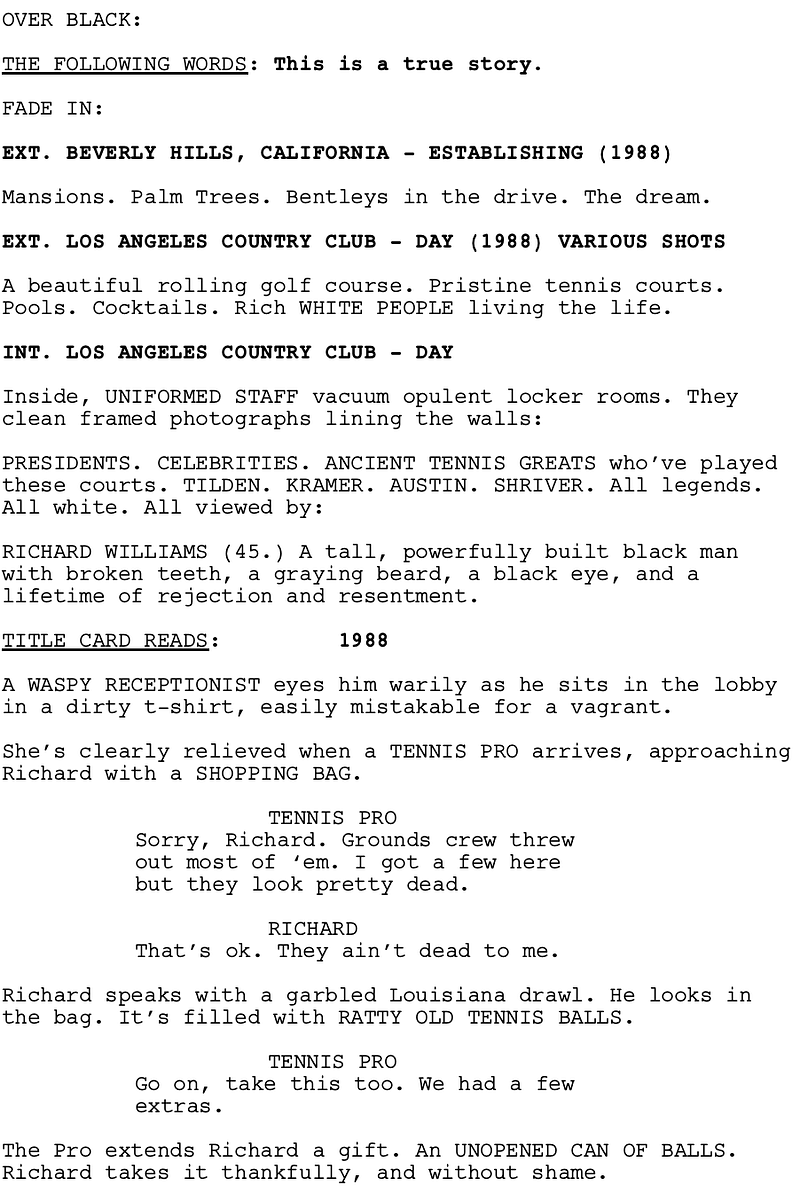
King Richard, written by Zach Baylin.
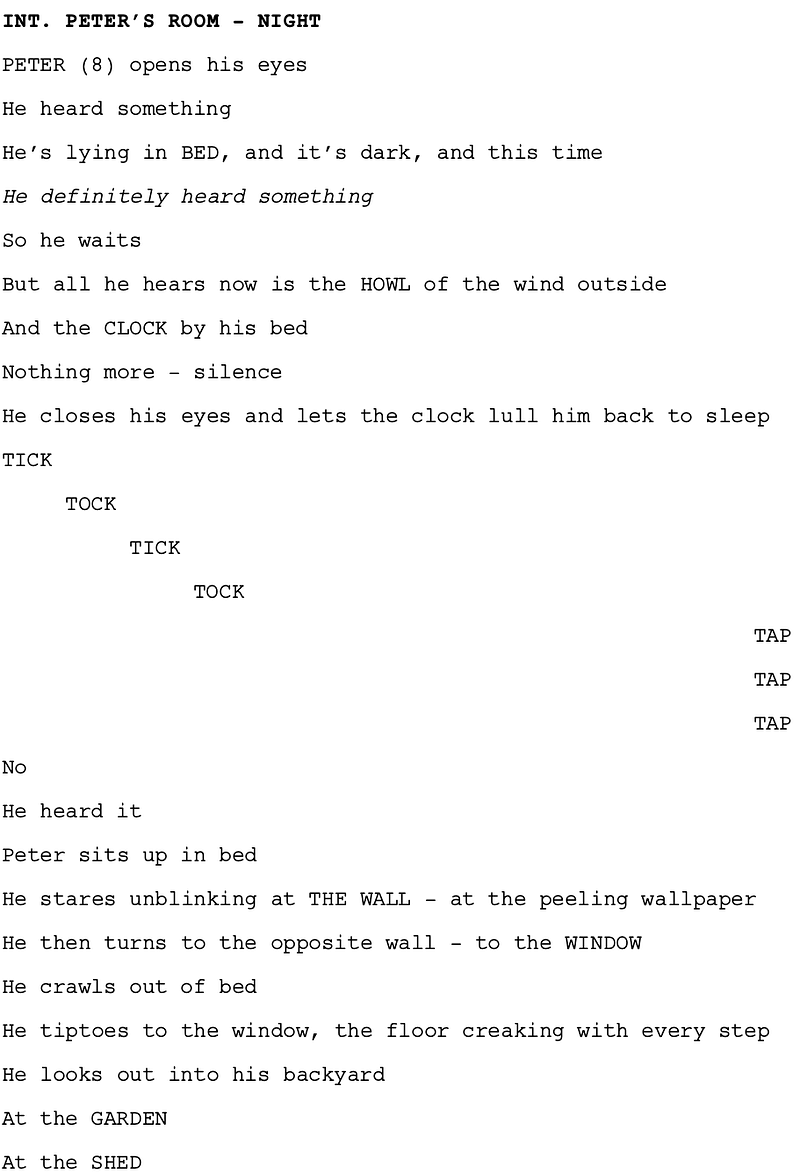
Cobweb, written by Chris Thomas Devlin.
The Worst Guy Of All Time, And The Girl Who Came To Kill Him, written by Michael Waldron.
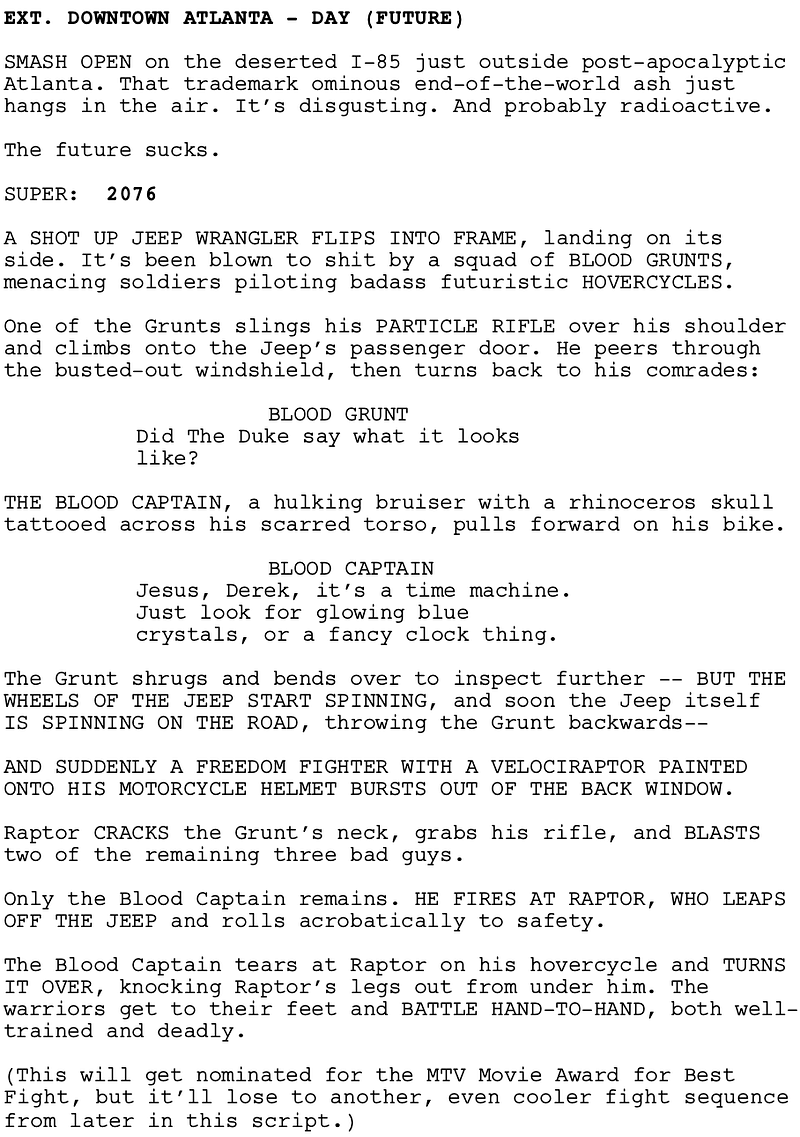
Notice how each establishes the tone and style from the very first lines of scene description … and how each has a different Narrative Voice.
I strongly recommend reading the scripts for both Spider-Man: Inside the Spider-Verse and Spider-Man: Across the Spider-Verse. Pay attention to the stage direction. Note the tone, the style, how much entertainment it adds to the read.
Definitely not an instruction manual for a refrigerator!
So, whoever tells you to approach scene description in a “very formal” or “bland” way … if they say you have to write only what the audience can see … that you can’t describe what a character is thinking or feeling in scene description … that you can’t write so-called “unfilmables” …
Run away as fast as you can. Because that advice is bull shit. Like Chris Miller says, as long as you’re clear in “what’s happening,” feel free to imbue the scene description with some personality.
Make your script a pleasurable read.
Twitter: @philiplord, @chrizmillr