Screenplay: The Importance of Establishing Narrative Voice
From Page 1, Line 1, you must convey your story’s tone and voice.

From Page 1, Line 1, you must convey your story’s tone and voice.
Let’s talk Narrative Voice. It is the invisible character in your script, the one present in scene description, pace, transitions from scene to scene, how you handle the writing of each scene, and so on.
I have a formula for Narrative Voice. It’s this:
Genre + Style = Narrative Voice
At a bare minimum, the style you use must be in concert with the genre. If you’re writing a comedy, the style must be funny. If you’re writing a thriller, the style must be thrilling. If you’re writing a drama, the style must be dramatic.
But Narrative Voice goes beyond that. If you fully embrace the idea of it, you will find yourself approaching your stylistic choices with a specific character in mind: the person who is ‘telling’ the story. Again even if you have no narrator, there is this invisible character — your Narrative Voice — who is handling the disposition of scene description and all the rest (as noted above), and they have their own voice.
And here’s the thing: You need not only to be proactive in aligning your style with your story’s genre, you also need to establish your script’s Narrative Voice from Page 1, Line 1.
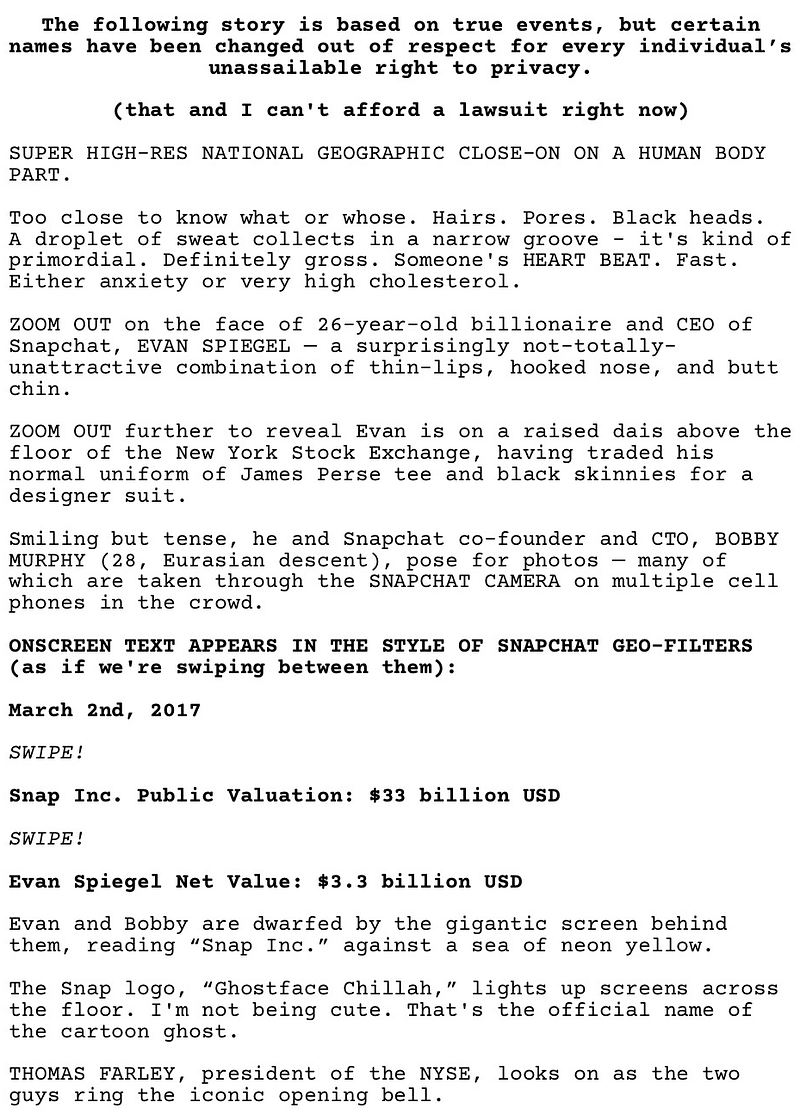
This discussion came up in one of my Core class teleconferences. To get my point across, I randomly chose P. 1 of four screenplays which made the Top 10 of the 2018 Black List. Here they are. Compare their respective Narrative Voices. First: Frat Boy Genius, written by Elissa Karasik.
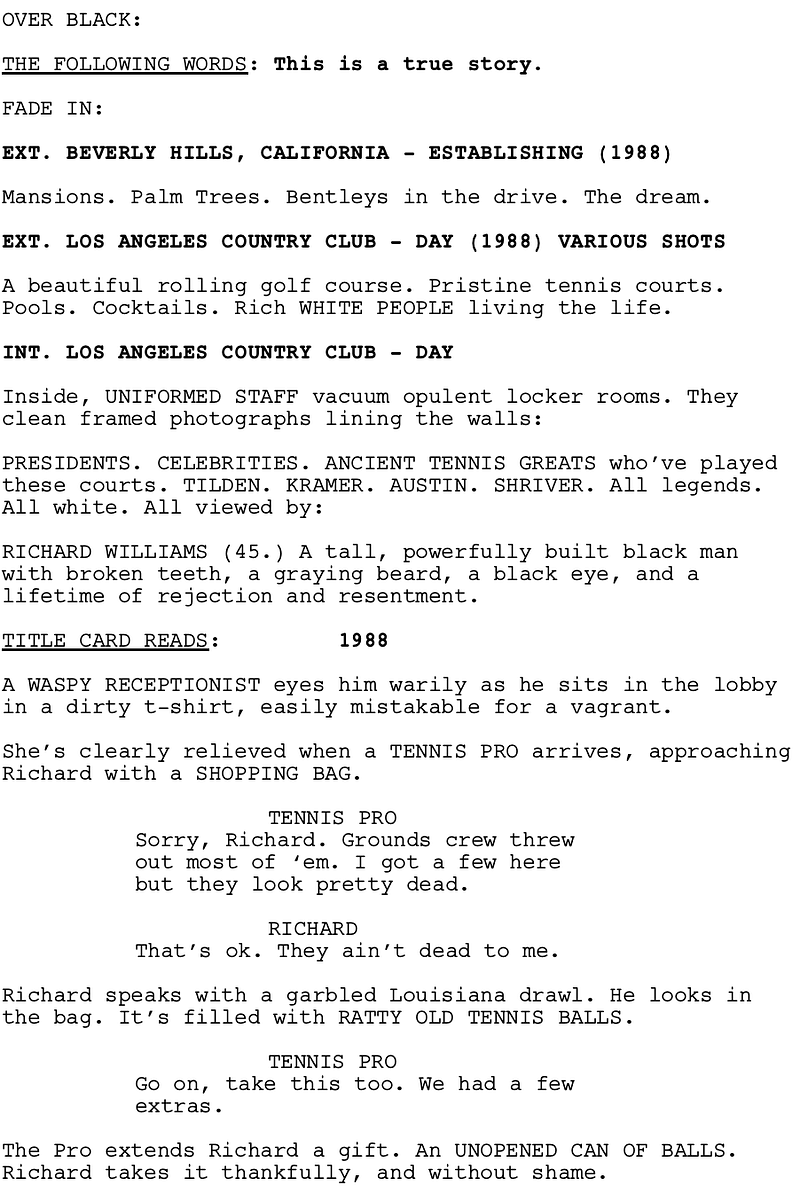
Next: King Richard, written by Zach Baylin.
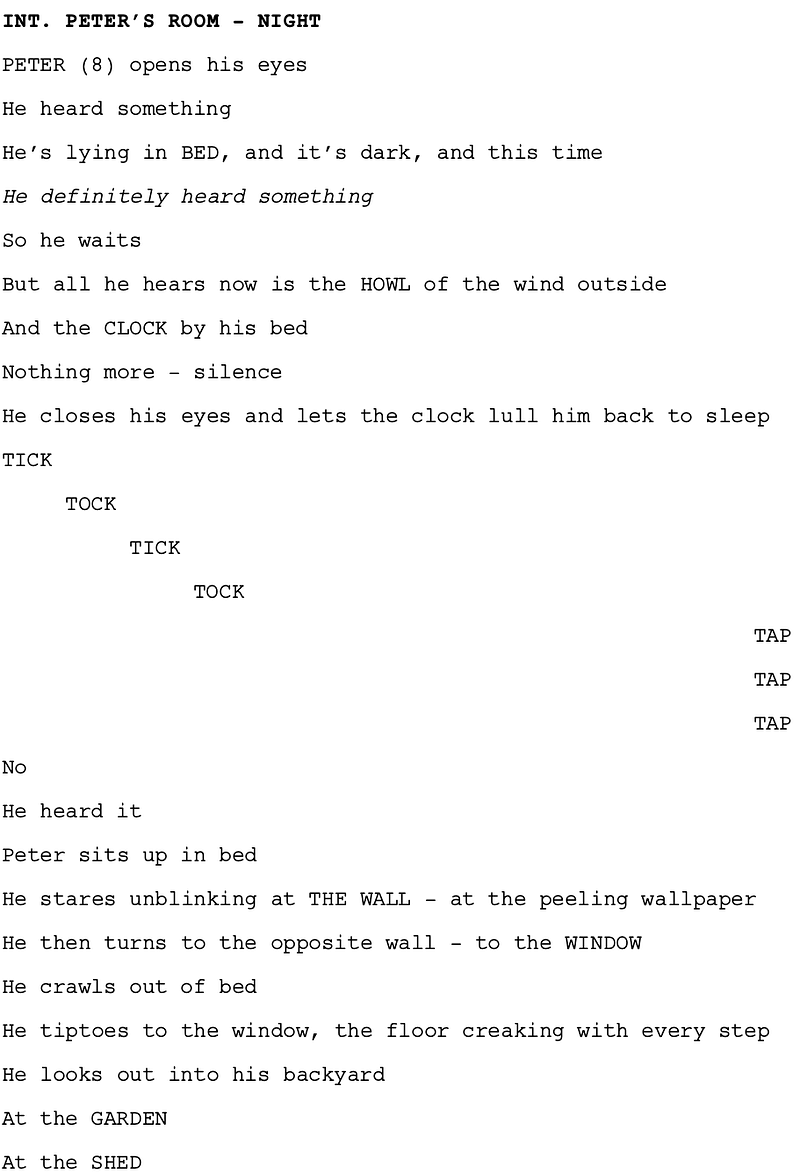
Next, Cobweb, written by Chris Thomas Devlin.
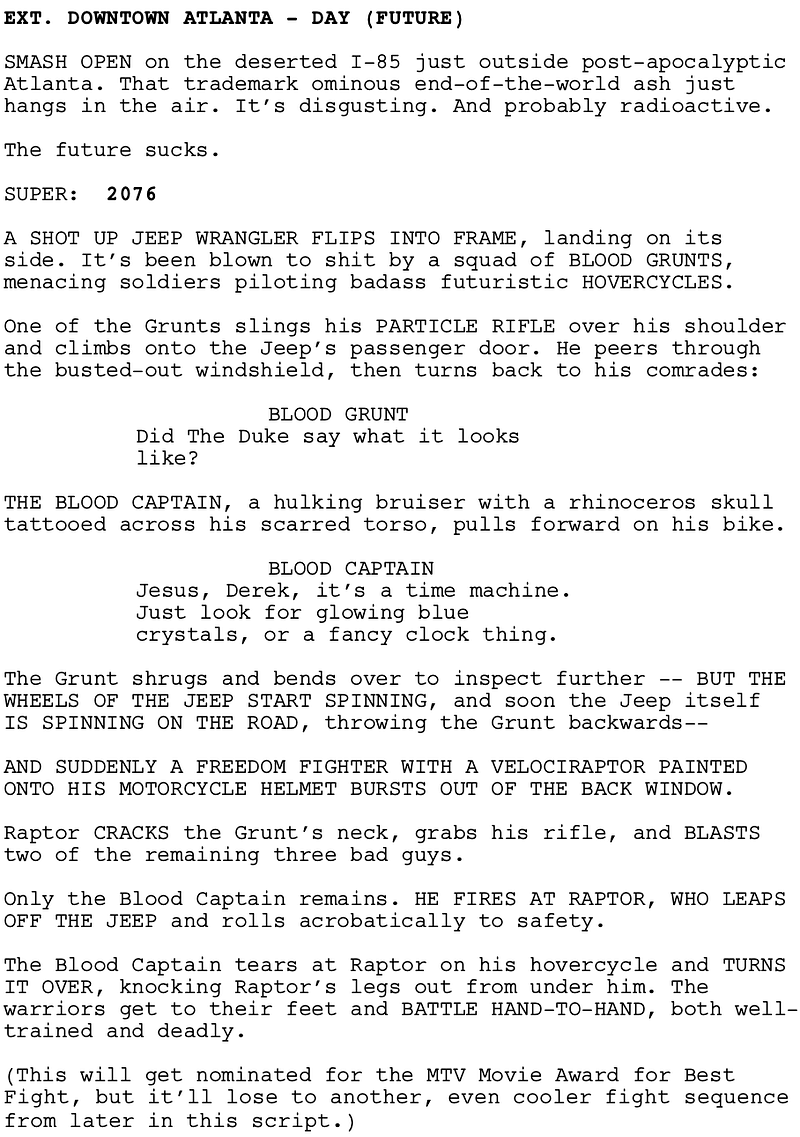
Finally, The Worst Guy Of All Time, And The Girl Who Came To Kill Him, written by Michael Waldron.
Notice how each Narrative Voice is different and how the scripts establish that voice as exhibited through scene description style from the get-go.
King Richard is a fairly conventional style befitting the story which is a traditional biopic of Richard Williams, father to legendary tennis pros Venus and Serena Williams.
Cobweb is a horror story and that is reflected in the single line paragraphs, not only in terms of their tone, but the way in which each line sets up and leads to the next line.
Both Frat Boy Genius and The Worst Guy of All Time convey a rather sardonic Narrative Voice, similar but different due to one being more of a drama and the other a science fiction action story.
Note how both break the fourth wall:
I can’t afford a lawsuit right now…
This will get nominated for the MTV Award for Best Fight…
The writers winking at the script reader and in effective inviting them to join in the fun narrative ride to come.
In each case, the writer’s approach to style matches their story’s genre. That is the bare minimum we have to do.
Beyond that, there is a clear, evocative, and entertaining personality exhibited in each script’s scene description.
When you do that, you embrace the true spirit of Narrative Voice.
Arguably the dean of contemporary American screenwriting, William Goldman said this: “Screenplays don’t have to read like an instruction manual for a refrigerator. You can write them as a pleasurable read.”
A script with a distinct Narrative Voice which exudes personality, flair, and flavor that is in alignment with the story’s genre is well on its way to receiving one of the highest accolades a script reader or development exec gives to a great script: “It was a good read.”
To do that, you must establish your Narrative Voice from Page 1, Line 1.