Scene Description Spotlight: “Wall-E”
I have discussed the writing style of the Pixar film Wall-E before here. On the subject of scene description, here’s a money quote from…

I have discussed the writing style of the Pixar film Wall-E before here. On the subject of scene description, here’s a money quote from co-screenwriter and director Andrew Stanton about how he was inspired by a draft of the screenplay for the movie Alien:
“The description paragraphs were not your typical paragraphs, they were actually small phrases that were all left justified, almost like a haiku, and they created this rhythm of just being in the moment of quiet and visual. And you found yourself reading the descriptions much more than you normally do a script because of that form, instead of just skipping to the dialogue. It really kind of paced you as a reader and gave you the much more visceral feel of what it will be like to watch that movie. So I used that for Wall-E — it really helped.”
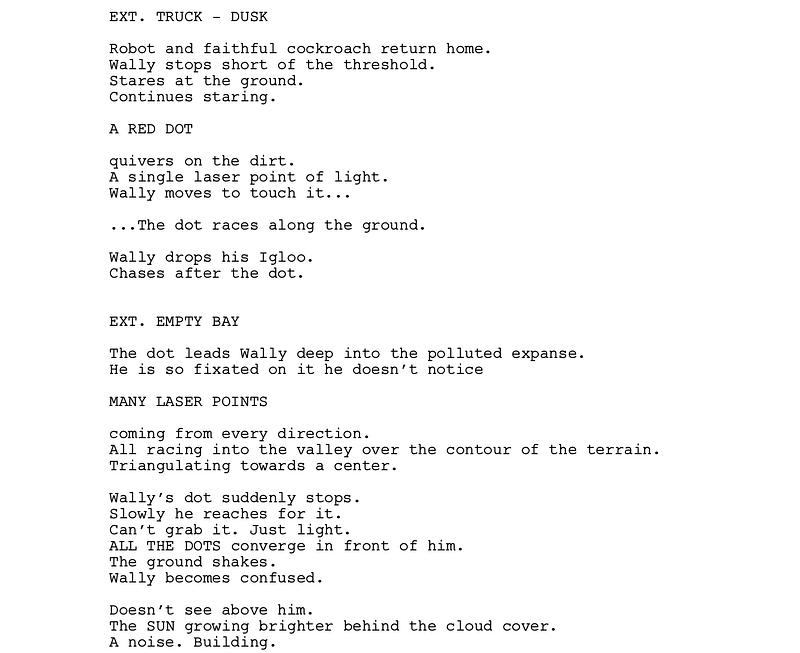
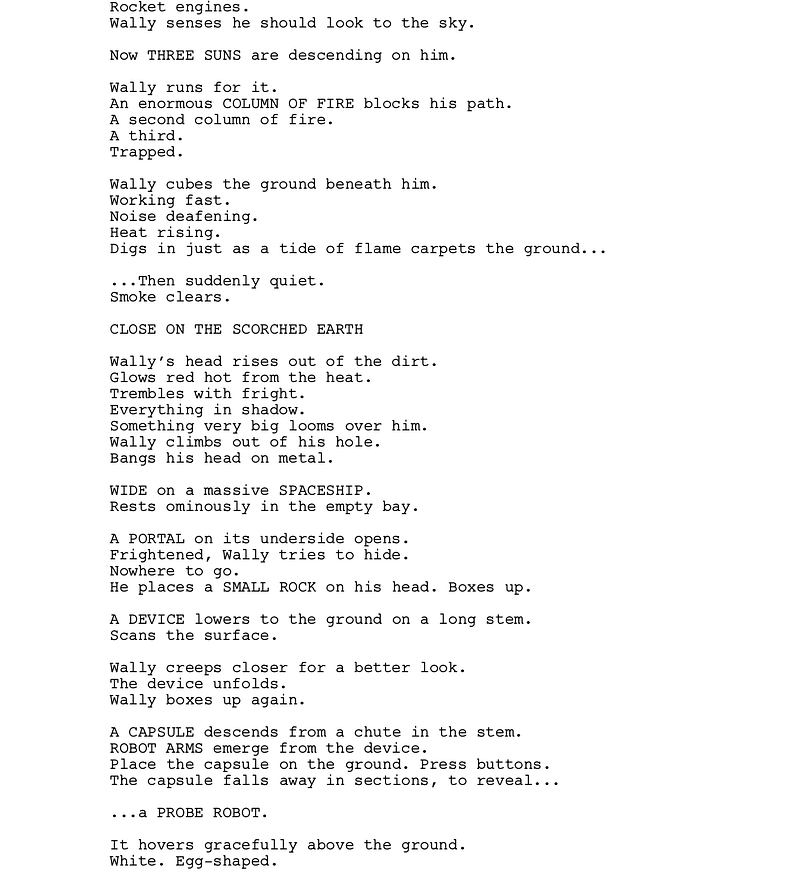
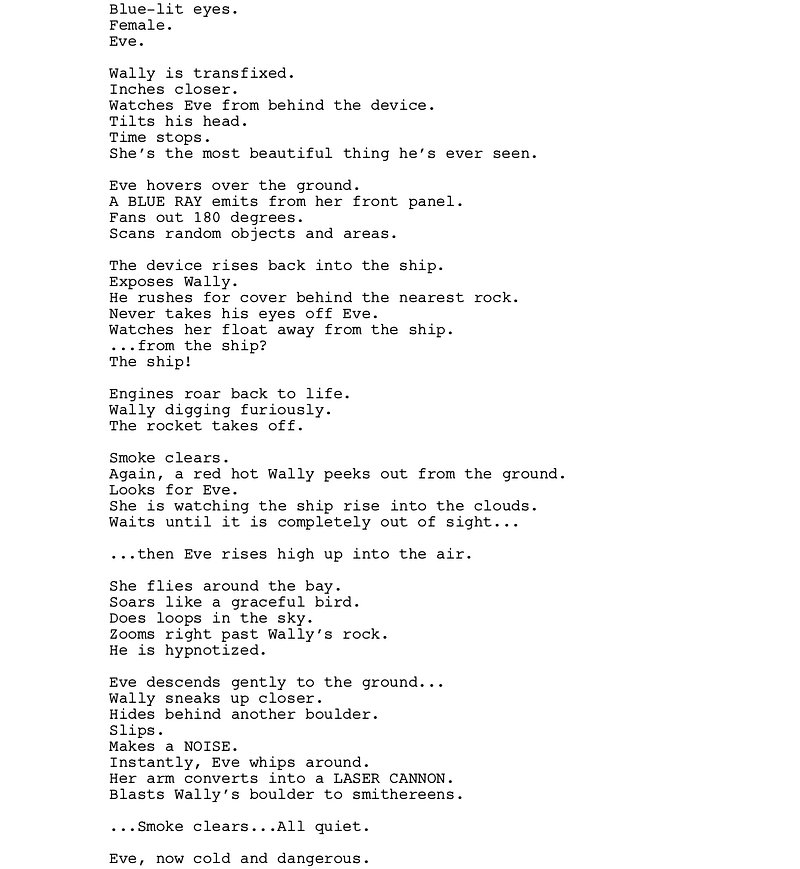
Let’s examine the haiku style that Stanton and co-writer Jim Reardon used in the script for the movie Wall-E. In this scene, Wally sees Eve for the first time.

Here is the movie version of the scene:
Wonderful stuff. Three things to note with this approach right off the bat:
1. Scene description does not need complete sentences. Stares at the ground… quivers on the dirt. A noise. Building… Noise deafening… Heat rising… Eve, now cold and dangerous… Trembles uncontrollably. None of them complete sentences, yet each conveys a strong image. Which leads to the second point:
2. Scene description as short bursts of imagery. If you use less words with incomplete sentences and a haiku style, then make sure the words you use are strong, imagematic words: polluted expanse… triangulating… flame carpets… digging furiously… soars like a graceful bird. And there’s another thing to note:
3. Almost each line represents a camera shot. I haven’t done it, but I bet if you compared this excerpt to a shot-by-shot breakdown of what appears on-screen, a majority of the lines in scene description would match up to specific camera shots — which means that with this approach, you can ‘direct’ the camera without once ever using directing lingo (i.e., ANGLE ON, PAN ACROSS, ZOOM IN, CLOSE UP).
My experience in the past when introducing students to the haiku style approach is they almost always fall in love with it. So clean to look at and easy to read. Then what happens is they try it with their scripts and most often, it doesn’t work. Why? Because it doesn’t fit the required narrative voice.
Genre + Style = Narrative Voice
The style needs to match the genre. Per Stanton’s quote above about reading the haiku style for the script of Alien — “they created this rhythm of just being in the moment of quiet and visual” — he chose to use this approach for Wall-E because it fit the story, especially the first act with Wally and Eve on Earth, infused with “quiet and visual.” But that doesn’t mean that the haiku style would work with your script.
Remember narrative voice is your story’s invisible character, the one ‘narrating’ the story, so they have their own unique personality. If haiku fits that persona, great. If not, don’t try to cram in the haiku approach.
For dozens more articles in my Scene Description Spotlight series, go here.