Scene Description Spotlight: “Se7en”
I posted this sequence in the movie Se7en as a Great Scene here and you can go there to see an analysis and commentary about it. But this…
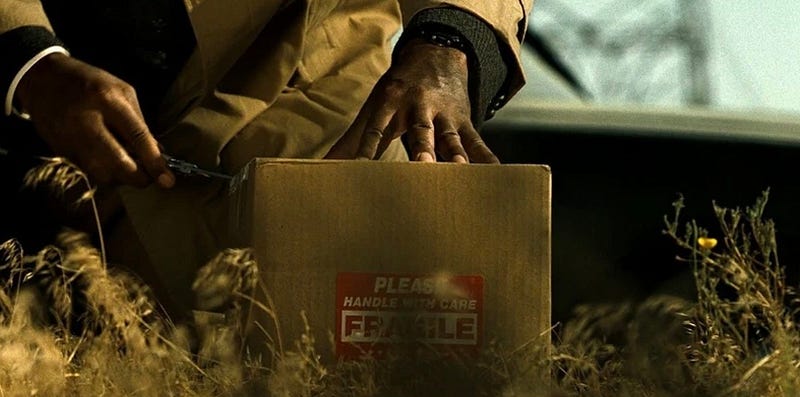
I posted this sequence in the movie Se7en as a Great Scene here and you can go there to see an analysis and commentary about it. But this time, let’s focus on the scene description. Here is my original introduction:
When a movie builds to the climactic face-off between Protagonist and Nemesis, I call that the Final Struggle. Typically it’s a case of fists-versus-fists or guns-versus-guns. But the movie Se7en (1995), written by Andrew Kevin Walker, provides an unorthodox twist — befitting a movie with so many plot surprises: The Final Struggle takes place largely within the Protagonist, a battle between will and hatred, logic and the desire for revenge.
Young Detective David Mills (Brad Pitt) and veteran Detective Lt. William Somerset (Morgan Freeman) have escorted serial murder suspect John Doe (Kevin Spacey) to a remote desert location. From nowhere, a van rolls up. Somerset heads off to stop the van. The driver emerges, there to deliver a box. And that’s where this scene begins.
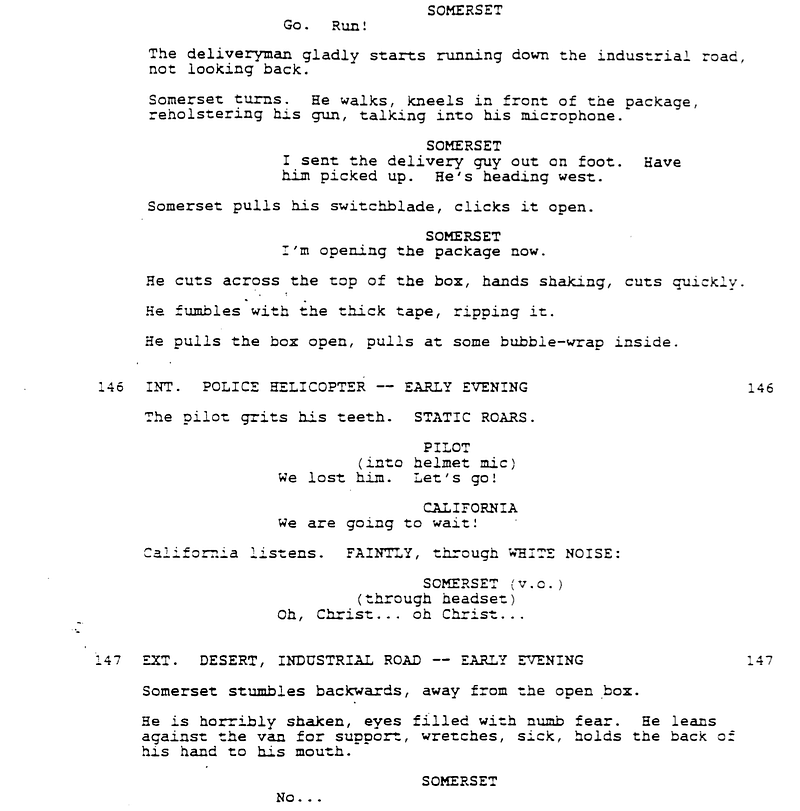
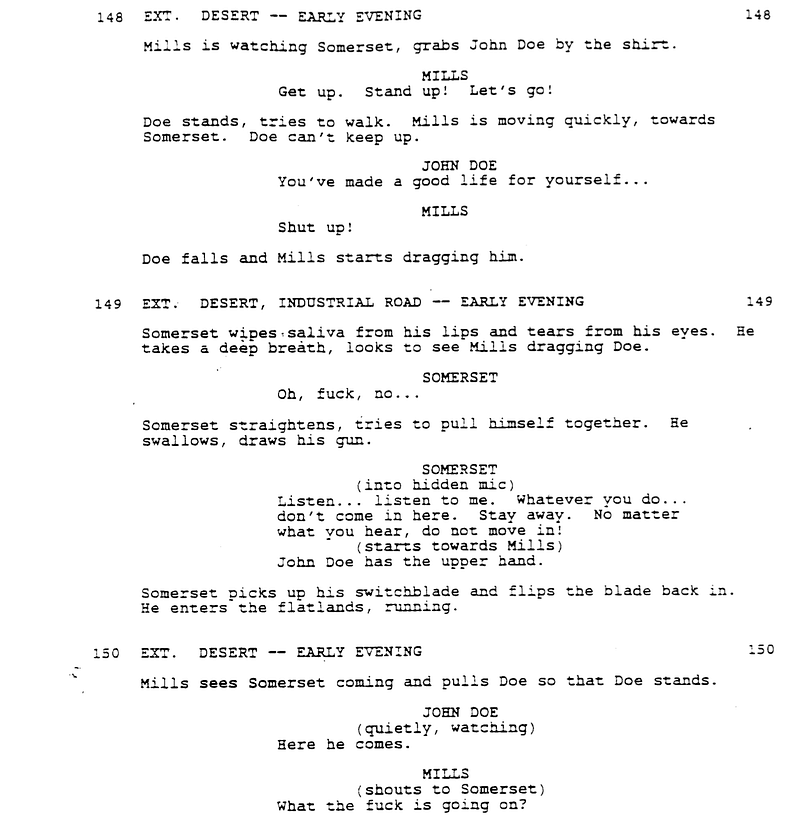
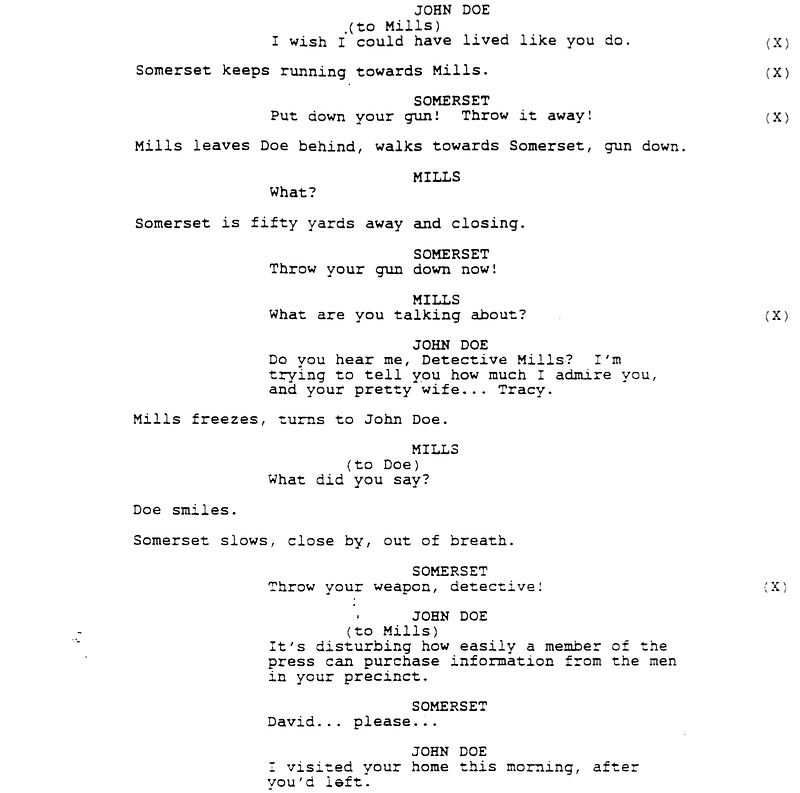
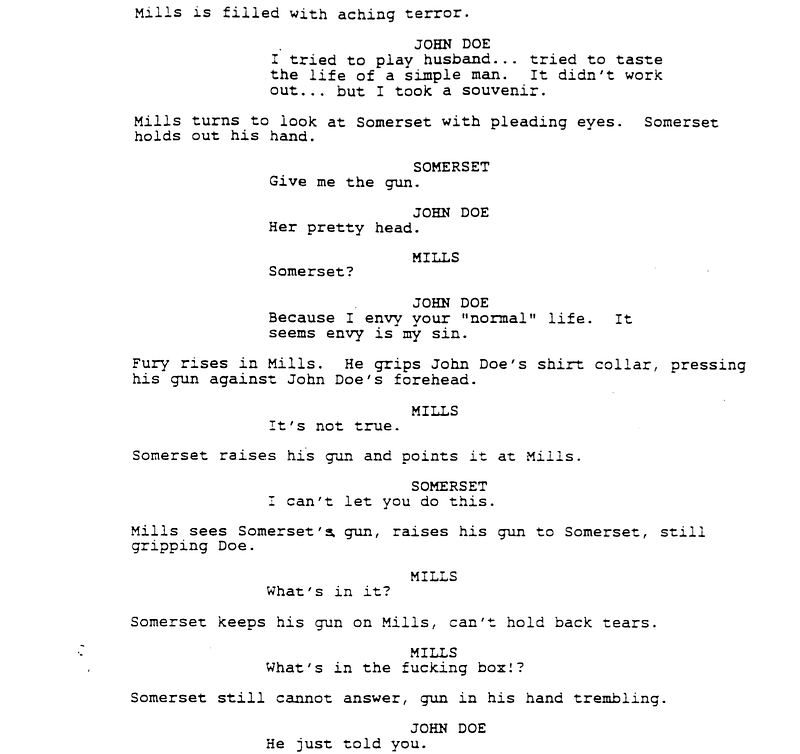
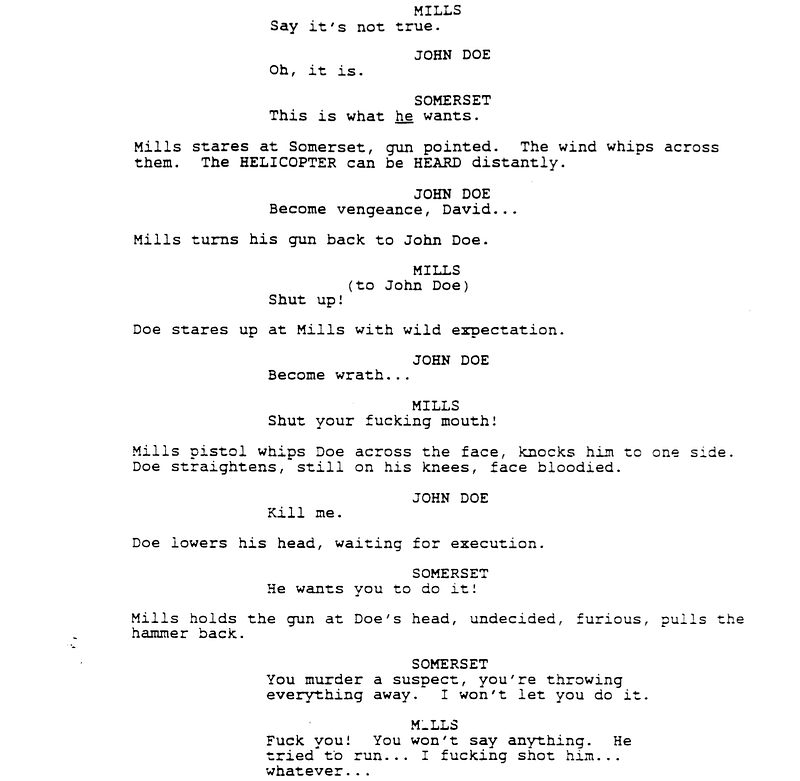
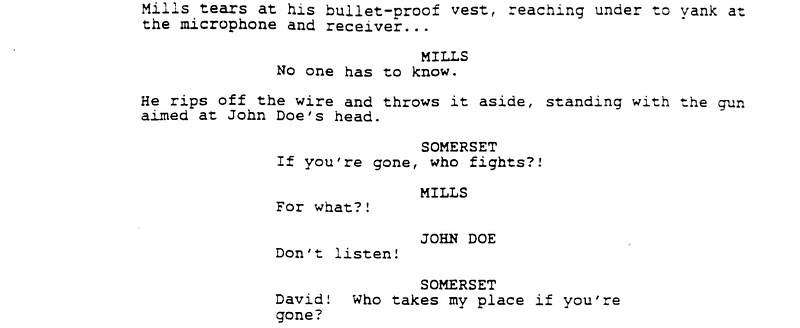

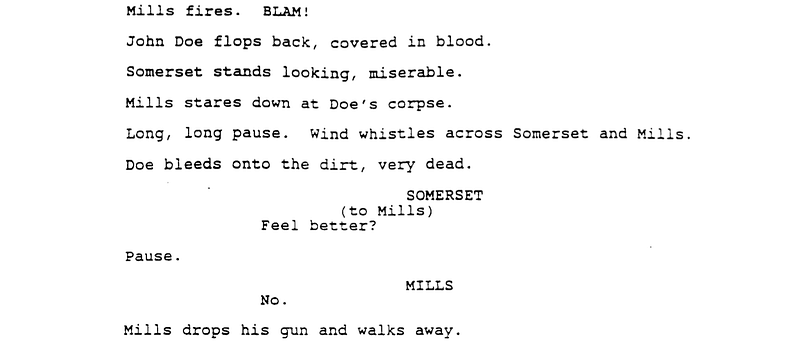
Some powerful moments in this sequence, underscored by the tone of and approach to scene description. Let’s look at three of them, extracting all dialogue and only tracking the scene description.
SOMERSET’S DISCOVERY [what’s in the box]
Somerset turns. He walks, kneels in front of the
package, reholstering his gun, talking into his
microphone.
Somerset pulls his switchblade, clicks it open.
He cuts across the top of the box, hands shaking,
cuts quickly.
He fumbles with the thick tape, ripping it.
He pulls the box open, pulls at some bubble-wrap
inside.
Somerset stumbles backwards, away from the open box.
He is horribly shaken, eyes filled with numb fear.
He leans against the van for support, wretches, sick,
holds the back of his hand to his mouth.
MILLS’ REALIZATION [John Doe killed his wife / her head in the box]
Mills is filled with aching terror.
Mills turns to look at Somerset with pleading eyes.
Somerset holds out his hand.
Fury rises in Mills. He grips John Doe’s shirt collar,
pressing his gun against John Doe’s forehead.
Somerset keeps his gun on Mills, can’t hold back tears.
Somerset still cannot answer, gun in his hand trembling.
Mills stares at Somerset, gun pointed. The wind whips
acrossthem. The HELICOPTER can be HEARD distantly.
MILLS’ INTERNAL STRUGGLE [Kill John Doe or not]
Mills pistol whips Doe across the face, knocks him to
one side. Doe straightens, still on his knees, face
bloodied.
Doe lowers his head, waiting for execution.
Mills hold the gun at Doe’s head, undecided, furious,
pulls the hammer back.
Mills tears at his bullet-proof vest, reaching under
to yank at the microphone and receiver…
He rips off the wire and throws it aside, standing with
the gun aimed at John Doe’s head.
Somerset edges toward them, gun leveled at Mills all
the while.
Mills’ face fills with confusion — then a wave of horror.
Doe’s eyes register shock.
Somerset lowers his gun, not pointing it anymore, tears in
his eyes.
Mills gags, tears welling up, both hands on his gun, trying
to bring himself to pull the trigger.
John Doe closes his eyes.
A pause. Mills is trembling.
Mills fires. BLAM!
John Doe flops back, covered in blood.
Somerset stands looking, miserable.
Mills stares down at Doe’s corpse.
Long, long pause. Wind whistles across Somerset and Mills.
Doe bleeds onto the dirt, very dead.
Pause.
Mills drops his gun and walks away.
These three moments represent the Beginning, Middle and Ending beats in the scene, moving the action from the outside in: First with Somerset (not the victim), then with Mills (the victim of his wife’s murder), and finally his internal struggle (what to do with his fury versus his job as a cop). Each beat has language that drives home the feeling of the moment:
Somerset (Beginning): hands shaking… fumbles… stumbles… horribly shaken… numb fear… wretches, sick…
The horror of what Somerset is seeing in the box manifest in his reactions.
Mills (Middle): aching terror… pleading eyes… fury rises… pressing his gun… can’t hold back tears… hand trembling…
Dual emotions — terror and fury — welling up in Mills as the awful truth of what Doe has done to his wife sinks in.
Mills and Doe (Ending): pistol whips… face bloodied… waiting for execution… undecided, furious… tears… yank at… rips off the wire… face fills with confusion… a wave of horror… shock… gags, tears welling up… trying to bring himself to pull the trigger… Mills is trembling… BLAM… flops… covered in blood… stares… Doe’s corpse… very dead…
I don’t know about you, but these powerful words enable me to feel the war waging inside Mills — because I can so easily imagine myself feeling those same emotions if I were in Mills’ place.
Pay particular attention to the verbs in this scene’s SD, so many of them strong, one-syllable words, like a series of gut-punches thrown at the reader, one after the other.
Finally, there are two bits of business in SD that stand out as snapshot moments in this sequence. The first is when the realization of what’s happened to his wife really hits Mills.
Mills stares at Somerset, gun pointed. The wind whips
across them. The HELICOPTER can be HEARD distantly.
It’s like the writer (Walker) provides this brief few seconds for everything that’s happening to settle in. It’s almost as if this is the turning point, Mills taking a moment to step outside his rising grief, and see something else is going on: he has to do something about Doe.
And then, of course, this:
Mills drops his gun and walks away.
How else could you possibly end this scene? Killing Doe is no victory for Mills because in shooting him, Mills is giving in to Doe’s desire to be executed. So nothing else is called for but the simple and stark SD. Note: Each word is one-syllable. Could have been written by a 2nd grader. But brutally honest — and leaves what Mills is feeling, and what we think Mills is feeling, out there, roiling around in the unknown of Mill’s pyrrhic victory.
The brutal emotions swirling through this scene could very easily tilt toward melodrama by overwriting the scene description. But Walker purposefully uses simple and direct descriptors that not only convey a strong visual sense of what’s transpiring, they also provide a blunt and honest interpretation of the emotions as well.
For more Scene Description Spotlight articles, go here.