Scene Description Spotlight: “Inglourious Basterds”
Today let’s consider the narrative voice of a drama: Inglourious Basterds (2009), written and directed by Quentin Tarantino.
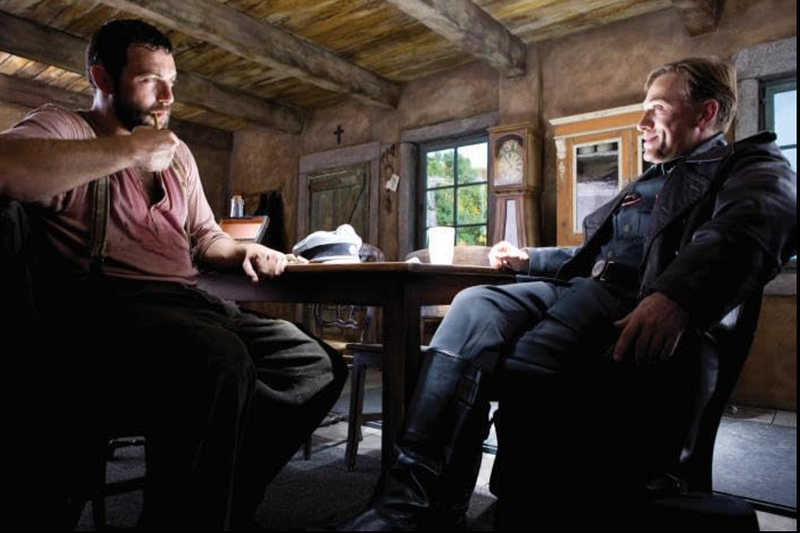
Today let’s consider the narrative voice of a drama: Inglourious Basterds (2009), written and directed by Quentin Tarantino.
This excerpt comes at the end of the opening sequence. German Colonel Landa has calmly and coolly scared the crap out of French farmer Perrier. For as the pair have been having their … ahem … cordial conversation, both know they are sitting directly above the Dreyfus family, Jews hidden beneath the farm house floor. Note: All misspellings are present in the actual script.
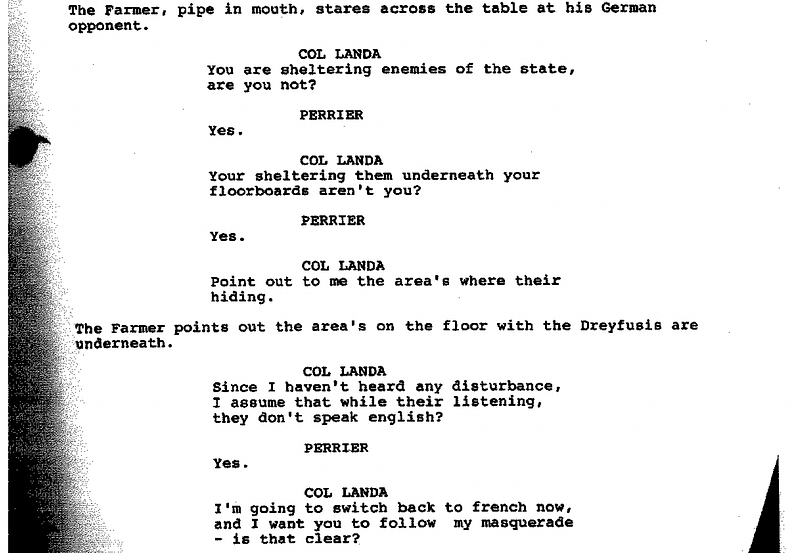
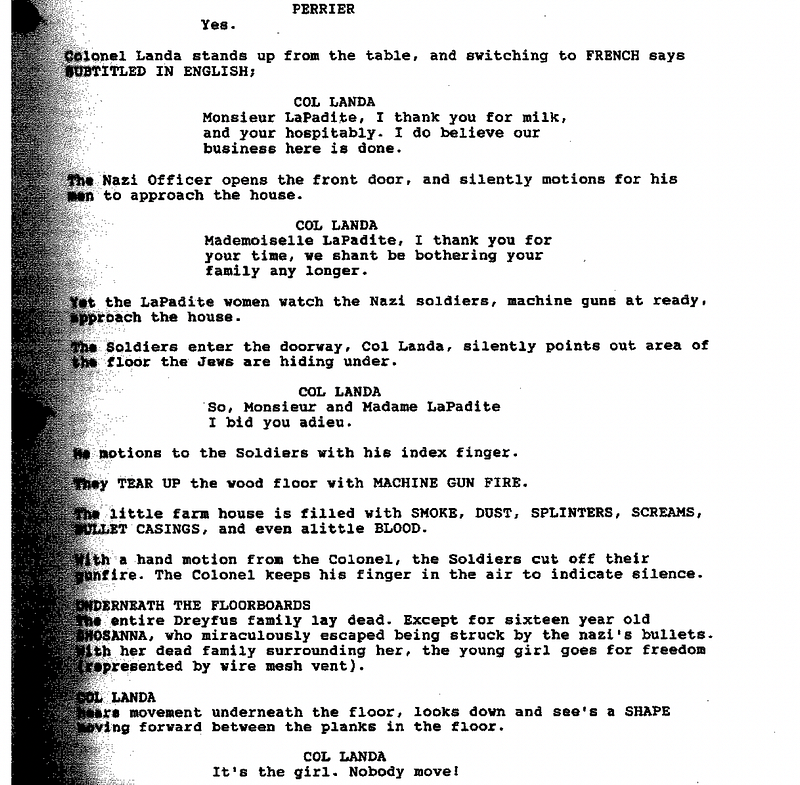

Landa goes about his business with an air of dignity and cool, which underscores the cruelty of the moment, rather like a simple business transaction than a decision about the fate of human lives. All of that is reflected in the restrained, almost documentary-style approach to the scene’s initial description.
The Farmer, pipe in mouth, stares across the table at his German opponent.
The Farmer points out the area’s on the floor with the Dreyfusis are
underneath.
Colonel Landa stands up from the table, and switching to FRENCH says
SUBTITLED IN ENGLISH:
The Nazi Officer opens the front door, and silently motions for his
men to approach the house.
Four simple lines of scene description which lead the reader to an awful conclusion: The Dreyfus family is as good as dead. And for that moment, Tarantino ramps up the imagery.
He motions to the Soldiers with his index finger.
They TEAR UP the wood floor with MACHINE GUN FIRE.
The little farm house is filled with SMOKE, DUST, SPLINTERS, SCREAMS,
BULLET CASINGS, and even alittle BLOOD.
Then the scene tops itself: Shosanna miraculously survives the fusillade and she tries to escape. Again Tarantino ratchets up the visuals, using a series of secondary slugs to pivot the action from one point of focus to another
SHOSANNA
FILTHY BAREFEET
CU SHOSANNA’S FACE
SHOSANNA’S POV
COL LANDA
COL LANDA’S POV
CU COL LANDA
PROFILE CU SHOSANNA
COL LANDA
SHOSANNA
Catch the imagery and building drama of the moment in the scene description.
A DOOR KICKED OPEN, the girl springs out.
…as he crosses the floor, he see’s the young girl RUNNING towards the
cover of the woods. He unlatches the window, and opens it. Shoshanna
is perfectly FRAMED in the window sill.
…RUNNING towards woods. Farm house and Col in the window in B.G.
…SLAPPING against wet grass.
…same as a animal being chased by a predator FLIGHT — PANIC — FEAR
…the safety of tree’s, getting closer.
…Framed by the window, takes his LUGAR, and straight arm aims at the
fleeing Jew, cocking back the hammer with his thumb.
…of the fleeing Shosanna.
…SLOW ZOOM into his eyes as he aims.
…mad dash for life.
… changes his mind. He yells to the rat fleeing the trap, heading for the
safety of the wood pile…
As I say, pure drama.
Now a few points about style. Observant eyes will notice the use of camera shots (i.e., CU, POV, PROFILE, SLOW ZOOM). And yet haven’t I stated on this very site that there has been a definite shift away from using directing lingo in contemporary screenplays?
Two things. First, remember the distinction between a selling script and a shooting script. This is a shooting script, so it is written with production specifically in mind. A selling script, which is what almost all of us here are concerned with writing is not focused on production, but rather ‘selling’ the story to a reader in the hopes that a script reader will give it good coverage, a producer will think they could set up the script, a studio exec will feel like the script could turn into a hit movie, an actor will fall in love with their character, a director will connect with the material so much they’re willing to commit 12 months of their life to making the film. For a selling script, we’re trying to pull readers into our story and keep them there, not remind them with every CU, SMASH CUT TO, POV, and ANGLE ON that we’re talking about a movie.
Second, this is Quentin Tarantino we’re talking about. He is a writer-director. Therefore he can put down whatever he wants in the script — including specific camera shots — because he’s going to direct it.
So again, do not use camera shots / directing lingo in your scene description.
The final thing is all the misspellings — and there are a ton in this script. I’ve read Reservoir Dogs and Pulp Fiction. I don’t remember those scripts being strewn with misspellings. So I’m wondering if that is something Tarantino did intentionally in this script. Hell, he misspells both words in the movie’s title: Inglourious Basterds.
I don’t have time to go back through his other scripts, but if anybody does or has recently, what are your thoughts about the misspellings? Is that a reflection of Tarantino’s spelling acumen (or lack thereof) or is he playing around with that conceit in the script? And if so, why?