Scene Description Spotlight: “Chinatown”
The screenplay for the 1974 movie Chinatown is considered one of the best scripts ever written. Its writer Robert Towne received an Academy…
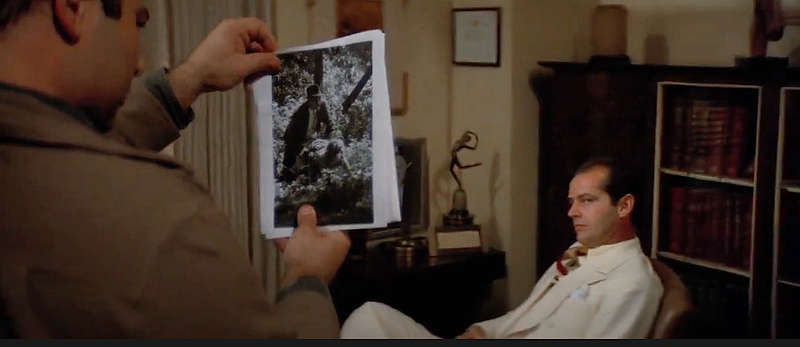
The screenplay for the 1974 movie Chinatown is considered one of the best scripts ever written. Its writer Robert Towne received an Academy Award for Best Original Screenplay and the script ranks #3 on the WGA 101 List of top screenplays of all time.
Whether you consider the movie film noir or neo-noir, as some have called it, Chinatown has a specific mood throughout — and that mood begins on Page 1, Scene 1:
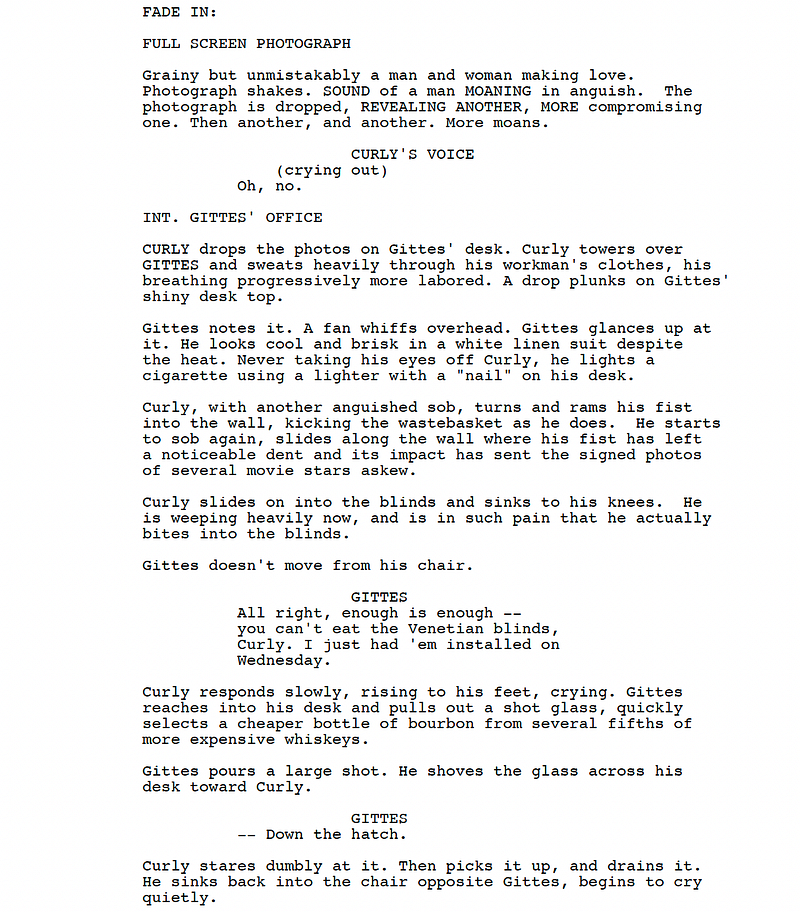

How does Towne achieve the mood? Certainly the subject matter of the scene: Gittes (Jack Nicholson), a private investigator revealing
to a client Curly (Burt Young) that his wife has been having an affair. Gittes’ reserved reaction in contrast to Curly’s visceral pain and
tears. But there are moments in this scene, captured by Towne’s description, that evoke and underscore the scene’s mood:
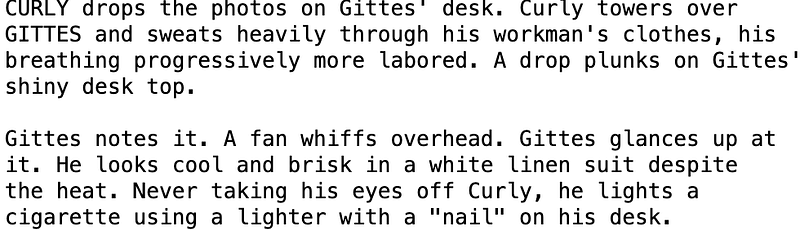


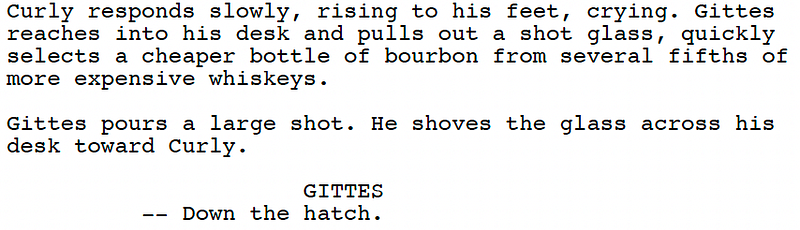
The description is specific, observant, but cool, even detached, perfectly in sync with Gittes’ character. A private investigator is trained to
pick up small, but important details, and the scene description does that — everything from a drop of sweat to a whiffing fan, a dent in the
wall to photos of movie stars moved askew. But a P.I. also learns how to keep their emotions out of their business, and Towne does that, too, conveying Curly’s pain accurately, yet keeping the tenor of the scene at an arm’s length from the poor man’s trauma.
Thus, right from the start of the screenplay, Chinatown sets a mood in sync with the personality of the story’s Protagonist Jake Gittes — and that personality is also reflected in the narrative voice of the scene description.
For more Scene Description Spotlight articles, go here.