Scene Description Spotlight: “Butch Cassidy and the Sundance Kid”
The ending sequence includes a most interesting sentence…

The ending sequence includes a most interesting sentence…
Arguably the dean of contemporary American screenwriters William Goldman sold the first spec script in the modern era: Butch Cassidy and the Sundance Kid (1969). That combined with Goldman’s involvement in numerous movies, both credited and as a script doctor, leads me to one inescapable conclusion: Any study of scene description must include Goldman because anybody that successful must be doing something right on all fronts of the screenwriting trade.
Here’s a great example: An action sequence at the end of Butch Cassidy.
CUT TOBUTCH streaking, diving again, then up, and the bullets
landing around him aren’t even close as—CUT TOSUNDANCE, whirling and spinning, continuing to fire and—CUT TOSEVERAL POLICEMEN dropping for safety behind the wall andCUT TOBUTCH really moving now, dodging, diving, up again andCUT TOSUNDANCE flinging away one gun, grabbing another from his
holster, continuing to turn and fire andCUT TOTWO POLICEMEN falling wounded to the ground andCUT TOBUTCH letting out a notch, then launching into another
dive forward andCUT TOSUNDANCE whirling, but you never know which way he’s
going to spin andCUT TOTHE HEAD POLICEMAN cursing, forced to drop for safety
behind the wall andCUT TOBUTCH racing to the mules, and then he is there,
grabbing at the near mule for ammunition andCUT TOSUNDANCE throwing the second gun away, reaching into
his holster for another, continuing to spin and fire
andCUT TOBUTCH and he has the ammunition now andCUT TOANOTHER POLICEMAN screaming as he falls andCUT TOBUTCH, his arms loaded, tearing away from the mules
and they’re still not even coming close to him as
they fire and the mules are behind him now as he
runs and cuts and cuts again, going full out and—CUT TOTHE HEAD POLICEMAN cursing incoherently at what is
happening and—CUT TOSUNDANCE whirling faster than ever andCUT TOBUTCH dodging and cutting and as a pattern of bullets
rips into his body he somersaults and lies there,
pouring blood andCUT TOSUNDANCE running toward him andCUT TOALL THE POLICEMEN rising up behind the wall now, firing andCUT TOSUNDANCE as he falls.
Here is the entire ending sequence as it appears in the movie:
Setting aside Goldman’s use of CUT TO — his way of designating a specific camera shot — two things to note here. First the use of Secondary Slugs or Shots is a great way to ‘direct’ the action without using production lingo. We could get rid of the CUT TO’s and write it this way:
BUTCH
streaking, diving again, then up, and
the bullets landing around him aren’t
even close as —
SUNDANCE
whirling and spinning, continuing to fire —
SEVERAL POLICEMEN
dropping for safety behind the wall —
The second thing is this: 293. That’s how many words are in this action description. Or rather a 293 word sentence. The entire string of scene description is one long sentence, Goldman’s way of conveying the fact that this is continuous action. No breaks, no time to breathe, the effect is to pull us into the moment — along with the characters — and experience the increasing frenzy straight through.
As a screenwriter, we do whatever we can in scene description to create a powerful sense of the moment in order to immerse the reader in the experience.
Final note: This is one of my favorite moments in the script:
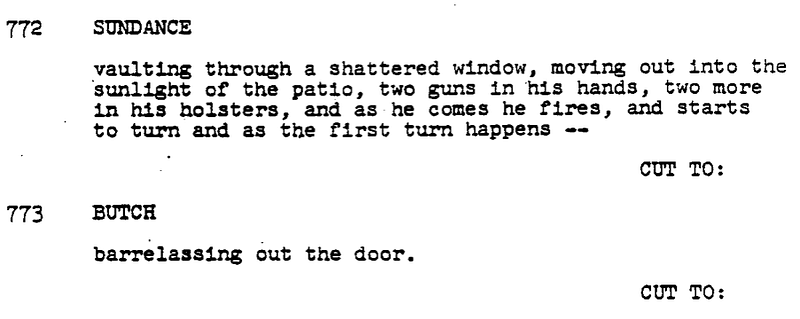
As Goldman wrote: “Screenplays don’t have to read like an instruction manual for a refrigerator. You can write them as a pleasurable read.” And you have to admit that the made-up verb barrelassing makes for a more entertaining read!
Scene Description Spotlight is a Go Into The Story series that focuses on that most fundamental aspect of screenwriting: describing the environment of and what happens in a scene. It is critical to know how to do this well, using images, atmosphere and style, not only to convey clearly what transpires, but also pull the reader into the story universe.
For more Scene Description Spotlight articles, go here.