Scene Description Spotlight: “Avatar”
There are many reasons to read and analyze the script to Avatar (2009), at last count about 2.7 billion of them by one measure.
There are many reasons to read and analyze the script to Avatar (2009), at last count about 2.7 billion of them by one measure.

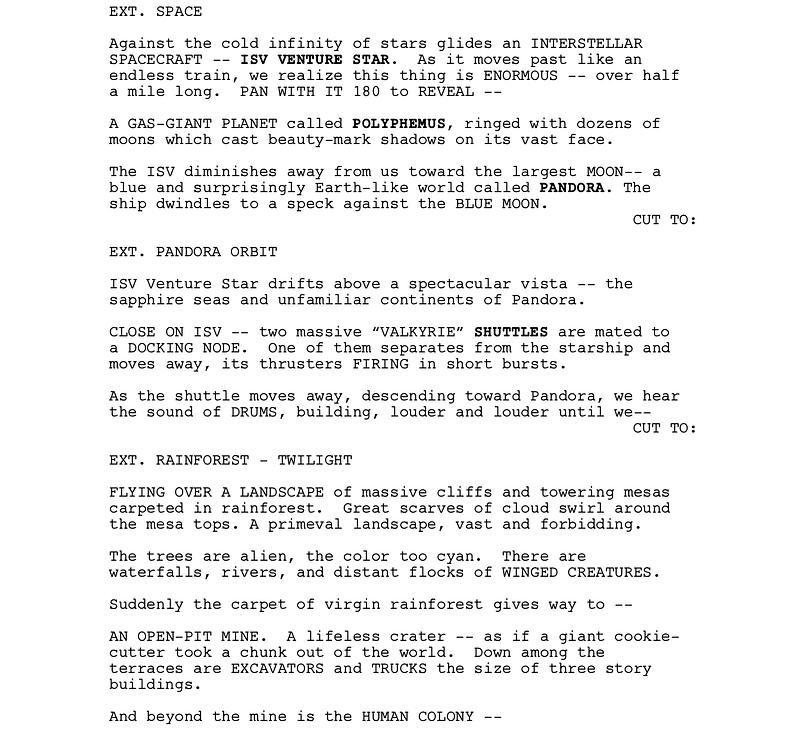
Today, let’s focus on what screenwriter-director James Cameron does with scene description, specifically how he introduces us to a new world — Pandora.

One of a screenwriter’s tasks is to create a specific sense of time and place in the story world they describe. And this is a significant challenge when that world is a different planet. It requires the reader to make a transition in their mind’s eye — from this world to that.
Cameron starts that transition as soon as he identifies Pandora by describing it as “a surprisingly Earth-like world.” That gives the reader a reference point. The next description:

Spectacular… sapphire… unfamiliar. That conveys both beauty… and a world that is different and strange. Cameron underscores both of these impressions with his next scene description:
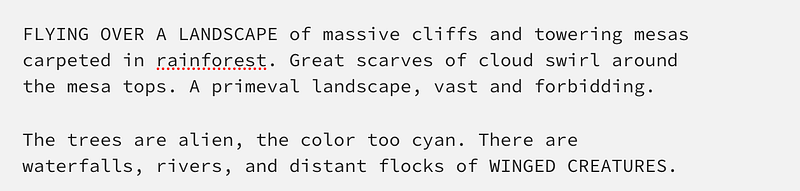
Massive cliffs… towering mesas carpeted in rainforest… great scarves of cloud… that projects beauty. A primeval landscape, vast and forbidding… the trees are alien… distant flocks of WINGED CREATURES… that reinforces the sense that we are a stranger in this world. And then:
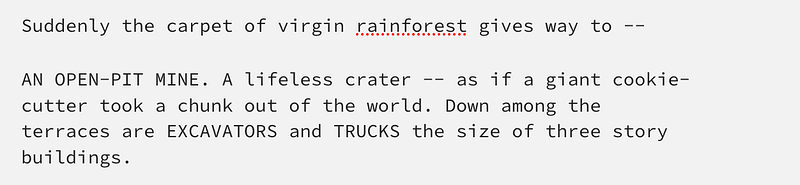
Open-pit mine… excavators… trucks… evidence of human industry, allowing us to touch base with part of a world with which we’re familiar. But it feels unsettling, doesn’t it, amidst this beautiful planet? That sense is driven home here:
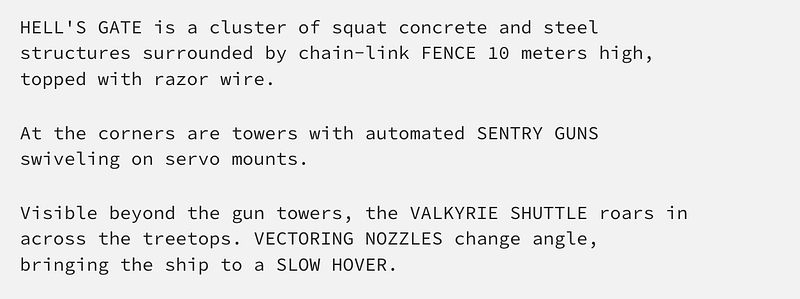
Cluster… squat… concrete… steel… chain-link fence… razor wire… towers… sentry guns… all the descriptors and even the name — Hell’s Gate — a stark contrast to the natural landscape. And so straightaway, Cameron establishes a conflict that is central to the drama: Two distinctive views toward nature — one at harmony with it, one attempting to master it.
Then Cameron does something that both tantalizes the reader and personalizes the story:
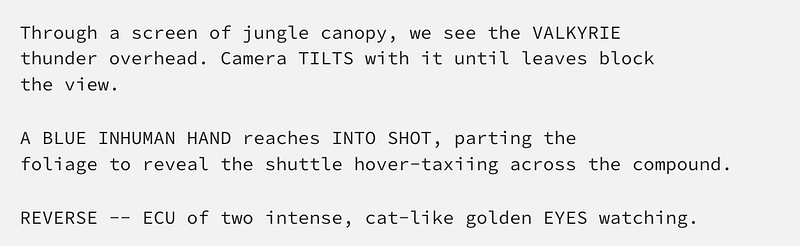
Again a contrast, only starting with the human perspective — the Valkyrie — and ending this time with a representative of Pandora. Who is this creature? What is this creature? And what do its “cat-like golden eyes” see? How do they perceive what humans are doing to Pandora?
In a mere 1 1/2-pages, Cameron manages to transition us into this planet, creating a specific sense of time and place, setting into motion the central conflict of the story, and teasing us about the planet’s inhabitants.
That’s good scene description.
For more Scene Description Spotlight articles, go here.