Saturday Hot Links
Time for the 365th installment of Saturday Hot Links, your week’s essential reading about movies, TV, streaming, Hollywood, and other…

Time for the 365th installment of Saturday Hot Links, your week’s essential reading about movies, TV, streaming, Hollywood, and other things of writerly interest.
WGA members say ‘Yes’ to credit revision.
The Hollywood Reporter: The Producer Roundtable.
LA Film Festival to End After 18-Year Run.
Hollywood Film Awards: ‘Black Panther,’ ‘Incredibles 2’ Among Latest Honorees.
How E! Is Remaking the People’s Choice Awards for 2018.
‘Star Wars’: Why Hopes for a Boba Fett Movie Won’t Die.
WarnerMedia’s FilmStruck Subscription-Streaming Service to Shut Down.
Propagate Acquires Indie Production Company Electus and Majority Stake in Artist First.
Cinemark Third-Quarter Earnings Beat Estimates.
California’s Film & TV Tax Credit Program Boosts In-State Production.
Bold Films’ Walters Talks About Forces Changing Indie Market.
SFFILM Rainin Grants For Indie Narrative Films Set, Funding Ten Teams.
The Blood List: Hollywood Executives Name Their Favorite Unproduced Horror Projects.
Lionsgate, Sony Liv Sign Multi-Year Content Deal in India.
China’s Documentary Film Production Is on the Increase.
Robert Rodriguez, Vice Media to Target Hispanic Audience With Creative Agency La Reyna.
How ‘Sharknado’ Went From AFM Pitch Session to Global Sensation.
Lena Dunham To Write A Syrian Refugee Film For Producers Steven Spielberg & J.J. Abrams.
Natalie Portman Regrets Her Manic Pixie Dream Girl Roles And Finds The Trope “Upsetting”.
Jennifer Lawrence Launches Excellent Cadaver Producing Shingle.
How Robin Wright Took Charge of ‘House of Cards’ and Saved the Final Season.
Hayao Miyazaki’s Cursed Worlds.
The Wachowskis Are Selling Their Studios As Rumors Of Retirement Swirl.
Majority of Americans Think Cable TV Has Become “Unaffordable”.
‘Chilling Adventures of Sabrina’ Is Being Sued by the Satanic Temple for Its Use of a Baphomet Statue.
HBO Goes Dark on Dish Network Amid Carriage Dispute.
HBO Sex Scenes Will Be Monitored by “Intimacy Coordinators” From Now On.
Vice’s Adult in the Room: Nancy Dubuc’s Plan to Fix a Media Pioneer.
Netflix to Give 3 Award Contenders Exclusive Runs in Select Theaters.
Working at Netflix Doesn’t Sound Very Fun, According to Employees.
Ava DuVernay Is Working with Netflix on a Prince Documentary.
Barry Jenkins Inks First-Look Deal With Amazon Studios.
The killing of FilmStruck shows that AT&T’s defense of its Time Warner takeover was a lie.
Google Employees Walk Out to Protest Company’s Treatment of Execs Accused of Sexual Misconduct.
Snap Partners With 17 British Brands to Launch 20+ Shows.
Fortnite, Twitch… Will Smith? 10 Digital Players Disrupting Traditional Hollywood.
Esports Is Getting Bigger Every Year — So Where Are All The Women?
Apple is using 100 percent recycled aluminum in new Macs.
Apple Market Cap Slips Below $1 Trillion, Then Stabilizes at the Trillion-Dollar Mark.
Spotify Reaches 87 Million Paid Subscribers.
SoundCloud Revises Premier Contract in Response to Criticism.
How a For-Profit Developer Could Help Create a Hollywood Ending for Homelessness in L.A.
Listen: 3rd & Fairfax (WGA podcast).
Watch: A History of Horror.
Screenwriting Master Class tip of the week
Every time we sit down to write a script, we are faced with a scene. This can be a daunting task considering a script may have 50, 60, 70 scenes or more. In a very real way, screenwriting is at its core scene-writing.
Therefore, it is essential for you to know how to handle writing scenes.
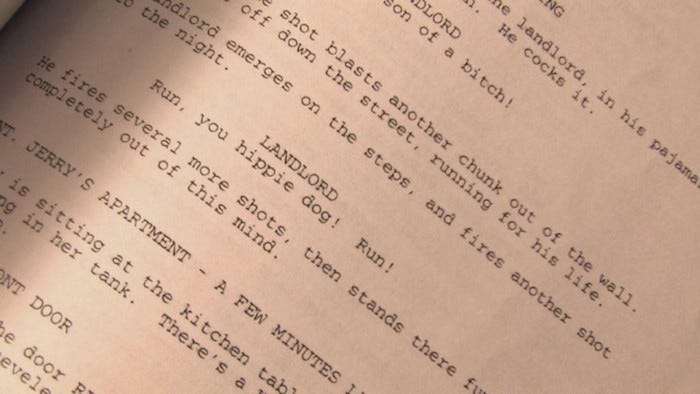
Beginning next Monday, November 5, I will be offering my 1-week online screenwriting course, Core VI: Scene. It is one of an 8-part Core curriculum which comprises the basis of the screenwriting theory I teach in The Quest.
Any scene must have a point, a narrative function to justify its presence. As a building block, a scene exists to contribute to the emerging story and add to the foundation of that story’s structure. If it does not, the scene has no business being in your story.
Here are six questions a screenwriter can use to hone in on the point of any scene:
- What type of scene is it?
- What is the structural goal and emotional goal of the scene?
- What is the scene’s beginning, middle and end?
- What is the purpose of these characters in the scene?
- What is the conflict in the scene?
- What are the themes in the scene?
The first three questions zero in on the physical structure of the scene.
The last three questions focus on the psychological structure of the scene.
In Core VI: Scene, we will explore each of these six questions, giving you the foundation to be able to write effective scenes.
In addition, we will consider six scene-writing tips which will enable you to craft an effective scene that is an entertaining one as well.
Plus, you will have an opportunity to engage in a series of scene-writing exercises to put theory into practice and upgrade your writing chops.

“Of all the classes I’ve sampled around the web, NOBODY draws the crowd Scott does, and NOBODY gives as much useful information.”
~ Cyd Madsen
Six lectures written by Scott Myers
Special insider tips
24/7 daily forum interaction
Workshop writing exercises with peer and instructor feedback
A 90-minute live teleconference between instructor and class members
So go here and sign up now.
I look forward to the opportunity to work with you!