Saturday Hot Links
Time for the 339th installment of Saturday Hot Links, your week’s essential reading about movies, TV, streaming, Hollywood, and other…

Time for the 339th installment of Saturday Hot Links, your week’s essential reading about movies, TV, streaming, Hollywood, and other things of writerly interest.
Entertainment Education Report: The Best Film Schools in 2018 Including DePaul University School of Cinematic Arts.
Academy Sets 2019 Oscar Dates And Avoids Nominations During Sundance.
BAFTA Sets Date for 2019 Film Awards.
CinemaCon 2018: Tom Cruise Makes Studio Chiefs Afraid to Watch Dailies.
CinemaCon 2018: Universal Is Revisiting Old Favorites and Leaning Into Horror.
The Oscars Change Rules for Documentaries, Music, and Campaigning.
Digital Disruptors Could Save the Theater Business.
Why Hasn’t Marvel Announced Doctor Strange 2 Yet?
John Krasinski’s ‘A Quiet Place’ Is Now Paramount’s Biggest US Hit Since Summer 2016.
‘A Quiet Place’ Sequel Moving Ahead at Paramount.
Paramount Continues Hunting for Franchises with ‘A Quiet Place 2’ and More ‘Cloverfield’.
How Summer Box Office Can Reverse the 2017 Curse.
A Guide to Horror Movies That Will Make You Cry.
Baby Boomers Show Low Interest in Premium Moviegoing.
Theater Chief Questions Whether Subscription Plans Like MoviePass Are Sustainable.
MoviePass Poll: Subscribers See Far More Films; Many Go Alone and Midweek.
MoviePass May Have Removed Its Popular “One Movie Per Day” Plan For Good.
Theater Chains Reportedly Working On Their Own Subscription Services To Combat MoviePass.
How the New LED Cinema Screen Could Change Filmmaking and Moviegoing.
The road to ‘Infinity’ is paved with good storytelling.
Marvel is Skipping Hall H at Comic-Con This Year.
Kevin Feige Says Fox Characters Won’t Join MCU For A “Handful Of Years” After Deal Is Done.
Kevin Feige’s Oral History of the Marvel Cinematic Universe.
How Marvel Bounced Back From Bankruptcy to Become Hollywood’s Biggest Brand.
What’s Next For The Marvel Cinematic Universe?
To Save the Future, Marvel Studios Must Forget Its Past.
James Cameron Says He Hopes We’ll Get ‘Avengers’ Fatigue Soon.
James Cameron Slammed Online for ‘Avengers’ Criticism, but Marvel’s Kevin Feige Is Staying Positive About It.
What James Cameron’s Controversial Comments Get Right and Wrong About Marvel Movies and Studio Sci-Fi.
James Cameron Talks Plans for Five ‘Avatar’ Films & More ‘Terminator’.
“He Who Must Not Be Named”: Can John Lasseter Ever Return to Disney?
Legal Fight Over Aaron Sorkin’s ‘To Kill a Mockingbird’ Adaptation Reaches “Emergency”.
The ‘Mad Max’ Legal Battle Is the Viking Funeral This Franchise Deserves.
Agencies, Writers Guild on Collision Course Over Fees and More.
Some Kind of Robert Rodriguez Cinematic Universe Project is in the Works.
A Brief History of Cinematic Crossovers.
Every upcoming video game movie for 2018 and beyond.
Saudi Arabia’s First New Movie Theaters Welcome Women — But Only With Chaperones (For Now).
Shanghai Disneyland Opens ‘Toy Story’ Land.
What the ‘Before’ Trilogy Gets Right About Relationships.
Steph Curry Signs Production Deal With Sony Pictures.
Will cryptocurrency fund the next indie film hit?
How Technicolor changed movies.
No, Your Female Characters Don’t Just Need More Dialogue.
With ‘Westworld’, Lisa Joy Is Rewriting Women’s Power Story Line in Hollywood and Beyond.
From ‘Gilligan Cuts’ to ‘Goatf*ckers,’ Twitter is Unveiling the Secret Language of TV Writing Rooms.
Why Netflix Needs More Money (Again).
Netflix Raises $1.9 Billion in Debt Financing, Its Biggest Round Ever.
Netflix Stock Slips After Streamer Announces $1.9 Billion Junk-Bond Offering.
Why Netflix Might Want Its Own Movie Theaters.
Elizabeth Olsen: Netflix Isn’t Killing Cinema, It’s Helping Indie Films Find Their Audience.
Amazon Boosts The Price of Prime To $119.
YouTube Deleted 8 Million Videos in Q4, Mostly Porn and Spam, With 5 Million Blocked by Computers.
Facebook Up 9 Percent on Wall Street After Posting Record Profit.
As Vinyl Surges, a Boutique Pressing Plant Helps Smaller Indies Get an In.
Major Labels in New Legal Fight With SiriusXM Over Pre-1972 Works.
The 2018 Edgar® Winners, Nominees.
Screenwriting Master Class tip of the week
My popular one week Pixar and the Craft of Storytelling online class begins Monday, May 14th.
18 feature length movies produced. 17 movies #1 at the box office. Worldwide B.O. gross over $11 billion. Average B.O. per film: $675M+ by far the highest average per film of any studio in Hollywood history.
It’s not just dollars and cents, it’s also quality storytelling. 27 Academy Awards, 7 Golden Globes, 3 Grammys. Indeed 9 of Pixar’s 18 films are in the IMDB Top 250 Movies of all time.
No disrespect to Disney, but I think the real Magic Kingdom lies 397.8 miles north of Anaheim in a city called Emeryville, California where you’ll find this:
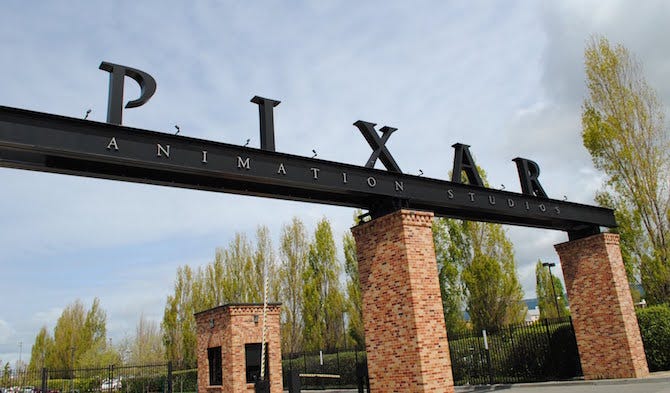
Longtime GITS readers know of my fascination with Pixar having blogged about them dozens of times. Due to having two sons who quite literally have grown up in what someday is likely to be called the Pixar Era, I have seen every one of the company’s movies, most of them several times.
In my estimation, the filmmakers at Pixar are master storytellers.
But how do they successfully wrangle magic time after time in their films? Are there lessons we can learn from Pixar to inspire and upgrade our own writing?

Those are two key questions I undertook in creating the online course Pixar and the Craft of Storytelling which begins Monday, May 14. My answer: An emphatic yes!
First off, there are the practices Pixar uses in developing, breaking, writing and rewriting a script. In our 1-week class, we go through that process step by step, then see how we can adapt that approach to our own writing.
Then there are several narrative principles evident in Pixar movies, six of them we focus in our online class: Small Story / Substantial Saga, Special Subculture, Strange Sojourners, Separation, Sentimentality, and Surprise. Going through every Pixar movie, we explore how these dynamics work in the context of each narrative and their overall applicability to storytelling.
There are 7 lectures, each of which I wrote, the content buttressed by an exclusive interview I conducted with Mary Coleman, Senior Development Executive at Pixar since the days of Toy Story 2, so we get a real inside look the outfit’s creative process.
IMPORTANT UPDATE: I am expanding this class to teach it at DePaul University and have added two more principles: Sires and Siblings, Stumbles and Switches. If you take my SMC online class, you will be the first people to explore that content with me!
The class also has a Logline Workshop where you can post a story idea and revise per peer feedback. And teleconferences to accommodate peoples’ schedules where participants get a chance to dig into the course content with me as well as discuss anything related to writing, screenwriting, and movies.
Here are some nice comments from just a few folks who’ve taken the class:
“I was lucky enough to be able to take Scott’s Pixar and the Craft of Storytelling class. It was my first class and a wonderful experience. I learned a ton and now have some important utensils that will help make all my stories better. Scott’s a great teacher and it was a pleasure learning from him!” — Valencia Stokes
“This course is awesome. I refer to these notes and lessons all the time.” — Traci Nell Peterson
“A course on Pixar movies? Apart from legitimately letting out my inner child and renting Up ‘for research purposes, I learnt about the ethos of the Pixar Brain Trust and the essential elements contained in all of their movies. Scott took us on an all-inclusive week long journey into why Pixar are so successful and how to practically apply this to your own script.” — Camilla Castree
“I recommend this course wholeheartedly. Plus you get to watch Pixar films as homework.” — TheQuietAct
“Scott Myers is a brilliant teacher and unites his knowledge and experience, insight and depth of thought in his lectures as well as he is providing help and support to his students. I highly recommend the class.” — Eva Brandstätter
A few words about the format: I’ve been teaching online since 2002, worked with over 1000 writers in that context, and honestly believe it is superior to the onsite class environment in many ways:
- You can do virtually everything on your own time: Download lectures, read forum conversations, add your own comments, upload writing exercises and assignments. In your pajamas. In bed. Drinking coffee. However you want to access online course content, you can do it.
- As opposed to listening to a teacher present lectures verbally, you get to download lectures and read them. Again at your leisure, but even more importantly, instead of feverishly trying to jot down notes from a verbal presentation, here you get everything laid out for you. I take great pride in my lectures, as they not only provide great content, they also have a narrative flow to them. Yes, they tell a little story.
- Feedback and conversations online tend to be much more thoughtful and therefore beneficial than onsite settings. Why? Because instead of off-the-cuff, random comments, participants online tend to spend more time and reflection in composing posts for online.
- Finally, I’m constantly amazed at how much of a community emerges in online class environments. Writers from all around the world and somehow we bind together into remarkably vibrant learning communities, time and time again.
So if you’ve never tried an online screenwriting class, come on in! The virtual water’s fine!
For more information on Pixar and the Craft of Storytelling which begins May 14, go here.

TO INFINITY AND BEYOND!