Saturday Hot Links
Time for the 363rd installment of Saturday Hot Links, your week’s essential reading about movies, TV, streaming, Hollywood, and other…

Time for the 363rd installment of Saturday Hot Links, your week’s essential reading about movies, TV, streaming, Hollywood, and other things of writerly interest.
Annapurna President of Film Is Out; Jennifer Lopez Stripper Film the Latest to Be Dropped.
Megan Ellison Mystery: What’s Going on at Annapurna Pictures?
Marvel Fires Star Wars Author Chuck Wendig for Not Being Civil.
Scarlett Johansson Lands $15 Million Payday for Black Widow Movie.
Will Smith and Marc Forster’s Telepool Backs Defiant Studios Horror Film Slate.
Peter Jackson Restored and Colorized 100 Hours of World War I Footage, and the Final Results are Remarkable.
Lionsgate CEO Jon Feltheimer Talks Expansion, Courting Entrepreneurial Talent.
Lionsgate Sets Scripted Series Development Pact With BBC.
Rupert Murdoch Earns Massive Payday Amid Fox Sale.
87 Countries Officially Vying For Foreign Language Film Oscar.
Sony Consumer Products Boss on ‘Ghostbusters,’ ‘Cobra Kai,’ Tapping Into ’80s Nostalgia.
Bringing Mongolian Culture to the World Through Film.
Working Title, Heyday Films, Eon Productions Launch London Film and TV College.
Busan: Asian Film Market Sets Records as IP Deals Take Center Stage.
Jeffrey Katzenberg’s Shortform Video Venture Gets New Name, Lines Up Projects From Guillermo del Toro, Antoine Fuqua
Diversity of TV Directors Ticks Up in DGA Study: “The Compass Is Pointing in the Right Direction.”
The Year The Networks Finally Embraced Diversity.
‘Crazy Ex-Girlfriend’ Showrunner: “It’s Amazing” to End the Show As Planned.”
‘True Detective’ Season 3: Everything You Need to Know.
What’s Behind Netflix’s Sky-High Employee Salaries: “It’s Like Play Money.”
Netflix Buys New Mexico Production Hub: Why Hollywood Is Sinking Billions Into Albuquerque.
How Data Science at Netflix Turned Hollywood on its Head.
WarnerMedia Prepping Streaming Service Featuring HBO, Other Entertainment Brands.
In Battle With Amazon, Walmart Pushes Deeper Into Entertainment.
Apple Hit With False Advertising Suit Over iTunes TV Bundles.
Advertiser Appetite for Snapchat Discover Spikes by More Than 400 Percent.
Snapchat Sets Slate of New Scripted Originals and Docu-Series, Doubling Down on Mobile TV.
Can Snapchat’s Shows Keep Users From Disappearing?
Screenwriting Master Class tip of the week
There are many intangibles about the craft of screenwriting. Much of that derives from the fact that story itself is organic. Stories — good ones, at least — are not formulas. They are not widgets. Rather they are living, breathing entities with a heart, soul, and even will of their own. They slip and slide as we develop and write them, creating a series of challenges as we try our best to solve their mysteries.
Perhaps nowhere is this more apparent than with dialogue. When I pose the question, “How do you write dialogue” to professional screenwriters, the most common response is basically this: I don’t know.

Common advice as to how to learn to write good dialogue:
- Listen to real-life conversations to get a sense of how people talk.
- Read scripts and watch movies — or better yet listen to movies — in order to grasp the feel and flow of film characters talking.
- Simply keep writing, that the more you pound out pages and knock out original screenplays, you will develop your ear for dialogue.
All of those are reasonable points. But aren’t there principles and practices we can learn to help bring into focus a writer’s ability to craft compelling, entertaining and effective dialogue?
That was my thinking when I sat down to create the fifth class in the Core curriculum — Core V: Dialogue, which begins Monday, October 22.
As with everything I teach about screenwriting, it starts with character. Isn’t it obvious the more you know and understand about your story’s characters, the more likely their respective voices will emerge into your consciousness?
Beyond that, it’s not just about hearing them, it’s about choosing the most impactful dialogue to support the point of each scene and drive the plot forward.
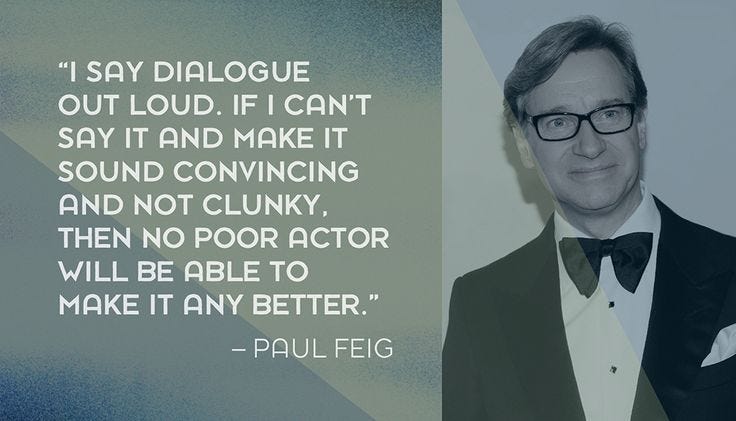
Hence the fifth Essential Screenwriting Principle: Dialogue = Purpose.
In a screenplay, there is almost zero room for extraneous dialogue, rather every line should tie into the Plotline and/or Themeline.
In Core V: Dialogue, we dig deep into this subject through 6 lectures I have written:
Lecture 1: Introduction to Dialogue
Lecture 2: Finding Your Character’s Voice — Inward Journey
Lecture 3: Finding Your Character’s Voice — Outward Expression
Lecture 4: Subtext
Lecture 5: What Is Not Said
Lecture 6: Realistic Dialogue
In addition there are several Insider Tips, analysis of several movie scripts, opportunities to workshop dialogue in some of your own original scenes, a 75-minute teleconference, and much more.
A testimonial from a writer:
“Scott is so generous with sharing his knowledge and it’s a great blessing to those of us who are just starting off/been doing it for years/need a reminder/need inspiration. I just completed the Core Dialogue course and I can honestly say he delivers back your investment threefold.” — Sabina Giado
There is no right way to write. Every writer is different. Every story is different. And you can learn everything you need to know about the craft of screenwriting by doing three things: Watch movies. Read scripts. Write pages.
However if you want to explore the subject of dialogue in an immersive fashion and from a distinct character-based perspective, I invite you to join me for this 1-week online class which begins Monday, October 22.
For more information, go here.