Saturday Hot Links
Time for the 377th installment of Saturday Hot Links, your week’s essential reading about movies, TV, streaming, Hollywood, and other…

Time for the 377th installment of Saturday Hot Links, your week’s essential reading about movies, TV, streaming, Hollywood, and other things of writerly interest.
A Changing Film Market Raises the Pressure for Sundance Indies to Succeed
Sundance 2019 Market: 20 Movies That Could Sell Big
Sundance: Female-Directed Features at Fest Rose 20 Percent Since 2009
Sundance Reports Gains for Women Directors in Submitted Movies
Inclusive Film Festival Programming Initiative Programmers of Colour Launches at Sundance
Sundance Film Festival ups the ante for representation within the film industry
Sundance: Minhal Baig-Directed ‘Hala’ Adopted Inclusion Rider
Fox Searchlight Acquires Matthew Puccini’s ‘Lavender’ Short Film
Documentaries the Hot Ticket at Sundance This Year
A&E IndieFilms, Sundance Institute Announce First Recipients of Documentary Film Grants
Oscars 2019 Nominations Full List: ‘The Favourite’ and ‘Roma’ Land 10 Noms Each
Academy’s Failure to Nominate Women Directors Reinforces the Status Quo
KU professor Kevin Willmott, who co-wrote ‘BlacKkKlansman,’ nominated for screenwriting Oscar
‘Glass’ to Top Slow Box Office Weekend With $16 Million
Box Office: Inside ‘Bohemian Rhapsody’s’ $800M Champion World Tour
Participant Media Ups Trio Of Execs
DC Publishing Laying Off 3 Percent of Its Workforce
Sony’s Uphill Climb to Build Bankable Film Franchises
Kevin Smith’s ‘Jay and Silent Bob Reboot’ Acquired by Saban Films
Netflix Swoops On Ron Howard’s Film Version Of ‘Hillbilly Elegy’ In Whopping $45M Deal
‘Detective Pikachu’ Sequel in the Works With ’22 Jump Street’ Writer
Paramount Was Hollywood’s ‘Mountain.’ Now It’s a Molehill.
Spike Lee Credits #OscarsSoWhite Movement For His ‘BlacKkKlansman’ Nominations
The Big Twist M. Night Shyamalan Needs: He Should Stop Writing His Own Scripts
‘Glass’: M. Night Shyamalan on an Ending He Dreamed Up Years Ago
Wonder Woman Director Patty Jenkins on Her New TV Drama I Am the Night
Variety Announces 10 Brits to Watch for 2019
Why 2014 Was a Watershed Year for TV Crime
Netflix Becomes First Streamer to Join the Motion Picture Association of America
Netflix Expected to Spend as Much as $15 Billion on Content This Year
What Made the TV Show ‘You’ a Hit? Netflix
Netflix Price Increase Could Result in 27% of Subscribers Cancelling
New Streaming Strategies From Comcast, Viacom Target Subscribers Who Don’t Need Netflix
Could An Amazon With Sports Be Pay TV’s Waterloo
Ad-Supported Streaming Services Find New Footing in Hollywood
Does Every Content Company Need to Launch a Streaming Service
NBCU Boss Says Upcoming Streaming Service Will Better Monetize Its Own Shows
‘Broad City’ Duo Ilana Glazer and Abbi Jacobson “Bare Their Souls” in Final Season
YouTube TV Expands Nationwide Ahead of Super Bowl
Patreon Now Has Over 3 Million Patrons, Expects to Pay $500M to Creators in 2019
Video Games Took Twitter By Storm in 2018, Amassing 1 Billion Tweets
‘Hamilton’ Helps Drive London Theater Attendance, Box Office to Record Levels
Condé Nast to Paywall All Websites by End of 2019
Screenwriting Master Class tip of the week: Keys to Handling Exposition
Take my 1-week online class to learn ways to make exposition entertaining.
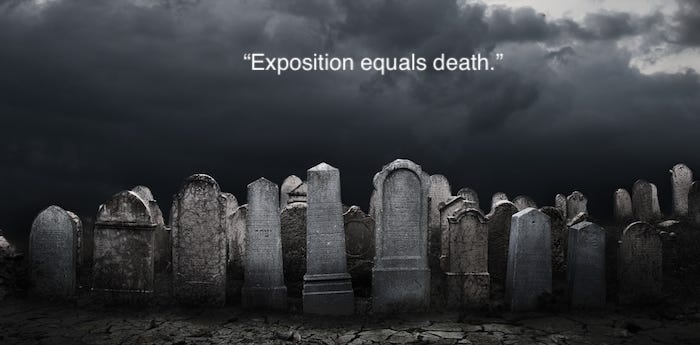
In Hollywood, there is a saying: “Exposition = Death.” Why? Check out these comments:
Taylor Sheridan (“Hell or High Water”) said he learned how to write by taking note of what didn’t work. And he confessed, as a former actor, that he had plenty of practice working through bad material.
“I spent most of my time on TV shows kind of spewing exposition,” he said. “When I write I almost never use dialogue to move the plot forward because I understand painfully the traps. I try to have the lines tell you something about the character.”
The “traps” to which Sheridan refers are, I suspect, largely about the fact that nothing can slow down a story or cause a script reader’s eyes to glaze over more than reading a scene or scenes chock full of exposition: setting, information, data, backstory. I am reminded of David Mamet’s infamous memo to his writing staff on the TV series ‘The Unit’:
THERE IS NO MAGIC FAIRY DUST WHICH WILL MAKE A BORING, USELESS, REDUNDANT, OR MERELY INFORMATIVE SCENE AFTER IT LEAVES YOUR TYPEWRITER. YOU THE WRITERS, ARE IN CHARGE OF MAKING SURE EVERY SCENE IS DRAMATIC.
THIS MEANS ALL THE “LITTLE” EXPOSITIONAL SCENES OF TWO PEOPLE TALKING ABOUT A THIRD. THIS BUSHWAH (AND WE ALL TEND TO WRITE IT ON THE FIRST DRAFT) IS LESS THAN USELESS, SHOULD IT FINALLY, GOD FORBID, GET FILMED.
IF THE SCENE BORES YOU WHEN YOU READ IT, REST ASSURED IT WILL BORE THE ACTORS, AND WILL, THEN, BORE THE AUDIENCE, AND WE’RE ALL GOING TO BE BACK IN THE BREADLINE.
Nothing can bore readers more than the delivery of setting, information, data and backstory. Yet every script, play or story you write requires you to include exposition. What to do?
That’s why I created the Screenwriting Master Class course Handling Exposition. In this unique 1-week online class, we will break down exposition into various types, then by analyzing numerous examples from well known movies, delve into six key principles and techniques on how to best handle it:
- Exposition as Fascination
- Exposition as Mystery
- Exposition as Revelation
- Exposition as Conflict
- Exposition as Action
- Exposition as Humor
Plus 7 insider tips on working with exposition.
In addition, you can workshop exposition in your own stories using the principles and tips you learn in the course.
And the always popular Logline Workshop.
Thanks a million, Scott, for being there for us inspiring writers and for the practical, real and valuable learning experience that was hands down the best writing class I have ever taken. I was blown away by the creative and practical tools imparted from you in the Exposition Craft Class.
— Katalin Szonyi
This class definitely expanded my ability to deal with exposition in ways that I hadn’t considered before. The lectures, along with the accompanying examples, are a fantastic resource if you either struggle with exposition or are just looking for a new perspective.
— Calvin Starnes
The class consists of:
Seven lectures written by Scott Myers
Special insider tips
Daily forum Q&As
Workshop writing exercises with instructor and class feedback
A 90-minute live teleconference between instructor and class members
Trust me, you need to know how to handle exposition. That’s why I created this course. And this is the only time I’ll be teaching it in 2019!
That’s right, I’m offering this class just once this year.
So join me beginning Monday, February 4 for Handling Exposition, a 1-week immersion in this critical aspect of the screenwriting craft.
Enroll here!
Or have access to all 10 Craft Classes for nearly 60% off the regular price in The Craft Package.