Reader Question: Who is the Nemesis in “character driven” films?
Is it necessary for more character-oriented movies to feature a specific Antagonist figure?

Is it necessary for more character-oriented movies to feature a specific Antagonist figure?
Via email from Tom B:
Scott,
First time I’ve emailed you; enjoy your blog immensely!
My question is: Who is the nemesis/antagonist in “character driven” films? For example, it is unclear to me who/what is the nemesis in film such as “500 days of Summer,” “Juno,” or “Little Miss Sunshine.”
In “Sideways” it might be the Thomas Haden Church character (Jack), who continually throws a monkey-wrench into Miles (Paul Giamatti’s) relaxing bachelor week, but Jack doesn’t seem like a traditional antagonist, a la “Star Wars” and bigger genre movies.
In Juno or Up in the Air, it might be “society’s expectations” of “accepted behavior,” but this example goes against traditional screenplay dramatic structure. Going further, in Super Bad, the boys meet various obstacles/bad guys along the way, but there isn’t one clear antagonist; the antagonist keeps changing. Is it foolhardy to develop a screenplay without a clear antagonist?!
Tom, you’ve assembled a collection of films that do support your main point — movies that don’t seem to have a specific Nemesis / Antagonist character (although I’ll suggest that’s not necessarily the case with Sideways). Let’s start the discussion with this concept:
Character = Function
Screenplays are a unique narrative form. They are a blueprint to produce a movie. Therefore when you look at characters in this light, you see that each character has their own specific role to play in relation to the story’s plot. We can call that narrative function.
Typically, there will be a Protagonist (or multiple Protagonists) who have a goal that basically defines the plot by providing an end-point. And in most screenplays, there is a Nemesis who shares an interest in the Protagonist’s goal, but with a different intention that conflicts with the Protagonist. So in effect, what you have in the Protagonist — Nemesis relationship is an oppositional dynamic.
Per your point, let’s state it like this: There needs to be some sort of ‘nemesis’ function — a specific character or otherwise — that provides opposition to the Protagonist.
In the case of three of the movies you list — (500) Days of Summer, Juno, Little Miss Sunshine — there isn’t a typical Nemesis character in that they are an actual flesh-and-blood character, however each of them does have a ‘nemesis’ function in the form of an oppositional force standing in the way of each Protagonist’s respective transformation-journey.
(500) Days of Summer: The Protagonist is Tom Hansen (Joseph Gordon-Levitt) and the root of his ‘nemesis’ is articulated clearly on P. 3–4 of the screenplay:
INT CONFERENCE ROOM — DAY
The boy is TOM HANSEN. He sits at a very long rectangular
conference table. The walls are lined with framed blow-up
sized greeting cards. Tom, dark hair and blue eyes, wears a t-
shirt under his sports coat and Adidas tennis shoes to
balance out the corporate dress code. He looks pretty bored.
NARRATOR
The boy, Tom Hansen of Margate, New
Jersey, grew up believing that he’d
never truly be happy until the day
he met his… “soulmate.”
CUT TO:
INT LIVING ROOM — 1989
PRE-TEEN TOM sits alone on his bed engrossed in a movie. His
walls are covered in posters of obscure bands. From the TV,
we hear: “Elaine! Elaine!”
NARRATOR
This believe stemmed from early
exposure to sad British pop music
and a total misreading of the
movies, “The Graduate.”
Tom’s nemesis is not a physical character, but rather an internal psychological dynamic — his overly romanticized view of love. Seeing the end sequence of The Graduate, culminating when Ben and Elaine race out of the church to ‘escape’ her wedding and onto the back of a conveniently located bus, Tom doesn’t notice that lingering moment at the end where the couple’s smiles fade, replaced by a rising look of terror in their faces:
The subtext of their expressions: “Holy shit! What the hell did we just do?” Tom doesn’t see that. The ‘message’ Tom got was, “And they lived happily ever after.” Hence his “total misreading” of the movie.
In (500) Days of Summer, Tom’s romanticized view of love is underscored time and again, most notably in this scene after he and Summer (Zooey Deschanel) have had sex for the first time:
The entire movie centers around Tom and his struggle with and against his infantile notion of love, seemingly crushed at the end when Summer tells him that she — the cynic — actually did fall in love and married another guy. I say “seemingly” because in the denouement where Tom meets Autumn, it’s not clear at all whether he will go right back into infantile romanticism mode with this new woman — as I suggested here.
So even though from time to time, Summer’s character dons an opposition “mask,” the real nemesis of (500) Days of Summer is, I would argue, Tom’s own psychological dynamic — his infantile and romanticized view of love.
For more analysis of the script, go here
I did an article on Juno here. Let me quote from that:
Per the question re Juno: Who’s the Nemesis in that story? Here’s my character archetype breakdown of that movie:
Protagonist — Juno
Attractor — Paulie
Mentor — Juno’s father / Juno’s step-mother / The baby
Trickster — Mark Loring (dark) / Vanessa Loring (light)
And the Nemesis? Let’s look at the two big questions that typically help to define the Protagonist character:
What does Juno want? To make sure her baby finds a good home.
What does Juno need? To be a teenager.
In my view of the movie, all that snarky slanguage that Juno uses and her cooler-than-cool attitude she adopts is a response to her shadow, arising from this key factor — she was rejected by her mother:
She [her mother] lives on a Havasu reservation in Arizona and three replacement kids. Oh, and she inexplicably mails me a cactus every Valentine’s Day. And I’m like, “Thanks a heap, Coyote Ugly. This cactus gram stings worse than your abandonment.” [P. 16]
Juno has never recovered from that hurt. This one side of dialogue is the only overt sign of that pain, but if you look at Juno from a macro perspective, throughout the first two acts of the movie, it’s clear — at least to me — that she has tried her best to jump past and out of her youth into adulthood. Over and over, she attempts to distinguish herself from her peers — through her attire, habits, language and, her likes / dislikes (e.g., weird horror movies, early 80s punk bands). In my view, she has ‘grown up’ quickly to put as much distance as she can from the experience of her mother’s rejection, and therefore as a means to avoid dealing with that pain. And so I think what she needs is to give up her pseudo-adult ‘mask,’ and be what by rights she ought to be: a teenage girl.
I believe this is borne out in the Denouement: We see her riding a bike (not driving a car), pulling out a guitar to sing a silly little duet with Paulie (innocence), then chastely kisses Paulie on the cheek. In contrast to the opening scene where we see her dropping her panties and initiating sex with Paulie, the whole tone of the ending scene is spring, innocence, and youth — she’s a happy teenager.
So I would see the Nemesis in Juno being the mask of her adult-self, eventually ripped away when Mark Loring — an adult who ends up acting like a child — betrays her, combined with the very real and very raw experience of childbirth.
Another case where the Nemesis function is filled by a character’s internal psychological dynamic.

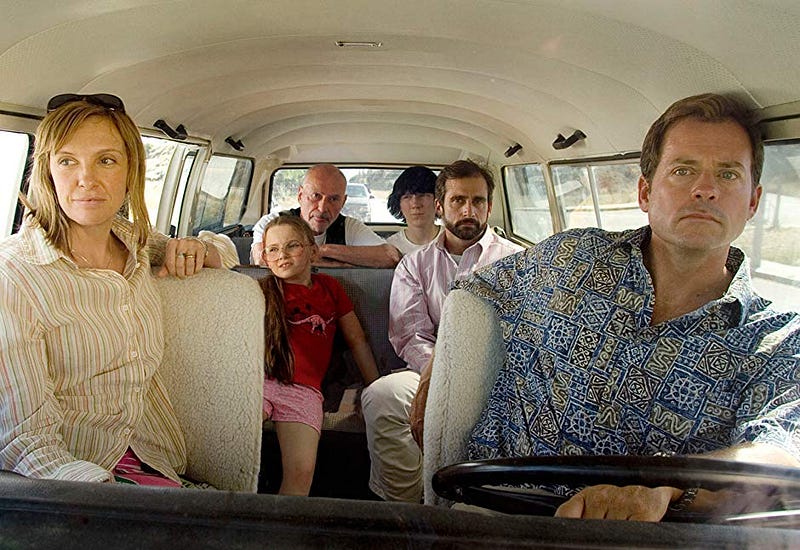
Little Miss Sunshine is distinctive in some respects. First, while Olive (Abigail Breslin) provides the end-point of the plot (her desire to perform in the “Little Miss Sunshine” competition) — typically one defining aspect of a Protagonist character — she doesn’t go through any sort of significant transformation. On that front, which is often a more telling indicator of Protagonist characters, I’d suggest that there are three P’s in this story:
- Richard Hoover (Greg Kinnear)
- Dwayne (Paul Dano)
- Frank Ginsberg (Steve Carrell)
- Each of these characters has to confront their own ‘nemesis’ in the form of an internal psychological dynamic:
- Akin to Juno’s character, Richard has tried to jump out of his real life circumstance and believe himself to be something he isn’t: A successful motivational speaker. His transformation-journey involves bashing up against the harsh reality that his book is not going to get published and that his pipe dream of that money saving the family from financial peril is a false one.
- One could argue that Dwayne’s Nemesis is his family. After all, once he discovers that he is color blind and can’t become a pilot — his goal (symbolically to fly away as far as he can from home), Dwayne spews these invectives:
DWAYNE
You’re not my family! I don’t want
to be your family! I hate you
fucking people! I hate you!
(he points at them)
Divorce! Bankrupt! Suicide!
You’re losers! You’re fucking
losers!
But instead, I think it’s fair to suggest that it’s not his family per se which is his ‘nemesis,’ but rather his disgust with his family that haunts him. And by story’s end after all that he and the others go through, Dwayne discovers a connection with his family.
- At first, Frank’s ‘nemesis’ might seem a littler harder to discern. Clearly he has his ego tied up in two things: academia (the #1 scholar of Marcel Proust) and his former lover. The story delves into neither very deeply. There is the chance meeting at the gas station / convenience store with the Young Man — Frank’s former lover — who has taken up with Larry, the world’s #2 Proust scholar, but that scene is mostly played for laughs as Frank, who has bought some heterosexual porn magazines for Grandpa, tries in vain to hide them from his former gay lover. But we do get some clues because clearly the experiences Frank has with the family on the journey to Redondo Beach turn him around, perhaps most clearly detailed in these comments to Dwayne on the pier:
DWAYNE
Sometimes I wish I could just go to
sleep until I was eighteen. Just
skip all this crap — high school
and everything. Just skip it…
He shakes his head.
FRANK
Y’ever hear of Marcel Proust?
DWAYNE
He’s the guy you teach?
FRANK
Yeah. French writer. Total loser.
Never had a real job. Unrequited
love affairs. Gay. Spent twenty
years writing a book almost no one
reads. But…he was also probably
the greatest writer since
Shakespeare. Anyway, he gets down
to the end of his life, he looks
back and he decides that all the
years he suffered — those were the
best years of his life. Because
they made him who he was. They
forced him to think and grow, and
to feel very deeply. And the years
he was happy? Total waste. Didn’t
learn anything.
Dwayne grins.
FRANK
So, if you sleep til you’re
eighteen…
(scoffs)
…Think of the suffering you’d’
miss! High school’s your prime
suffering years. You don’t get
better suffering than that! Unless
you go into academia, but that’s a
different story.
Here Frank finds a satisfying role — as teacher. Which, I think, spotlights his psychological dynamic as nemesis: Inflated sense of self.
In fact, look at all three of these Protagonist characters, and each of them shares that dynamic: Inflated sense of self:
- Richard: A successful motivational speaker
- Dwyane: A pilot
- Frank: A respected academic and beloved lover
All of them living with their own shadow and the weight of those expectations, that ‘nemesis’ constantly contrasting where they ought to be with the rather mundane and insipid lives they are actually leading. Once they get beyond that inflated sense of self, they can see that, indeed, they are part of something bigger than them — their family. And as flawed as it is, there they will find love and acceptance amidst all the day-to-day crap of family life.
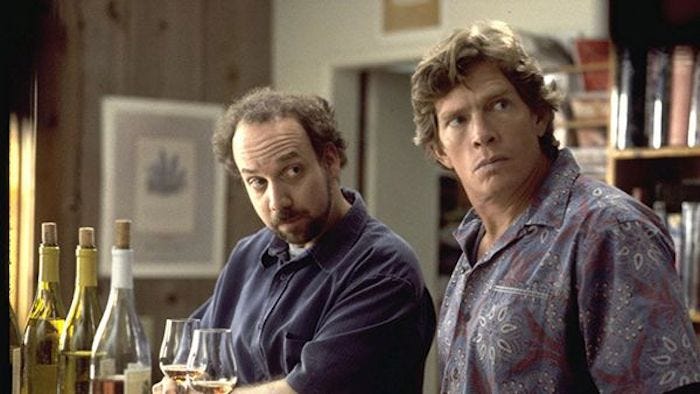
Finally, there is Sideways with its deeply flawed Protagonist Miles (Paul Giamatti). Here’s how I see the character archetypes:
Protagonist — Miles
Attractor — Maya (Virginia Madsen)
Mentor — Wine
Trickster — Jack (Thomas Haden Church), Miles’ novel
And the Nemesis? I would assert that it is his ex-wife Victoria (Jessica Hecht). Granted her character is only in the movie twice: Once when she is drunk dialed by Miles, the second time at Jack’s wedding where she reveals to Miles that she is pregnant. And I will also grant that most of the oppositional dynamic is about Miles’ fixation on Victoria and his refusal to give her up. So one could make the argument that like the other three movies, the ‘nemesis’ is an internal psychological state. However unlike the other movies, Victoria actually exists. She is a physical character. And given the fact that the story’s All Is Lost moment — in my view — is when she announces her pregnancy to Miles, I’m inclined to look at her as the story’s Nemesis.
Now having gone through all that, I think it’s clear that it’s possible to write screenplays that have vibrant and dramatic conflict without an actual physical Nemesis character. Perhaps that’s an interesting way to think about what are commonly called “character driven” films, the ‘nemesis’ sometimes more of an internal psychological dynamic rather than an actual physical Nemesis.
Per your last question: “Is it foolhardy to develop a screenplay without a clear antagonist?” I think it’s fair to say that most studio executives feel more comfortable with Protagonist and Nemesis characters for many reasons including (a) it’s the easiest way to create conflict and drama and (b) a great Nemesis character can be as or even more interesting than a Protagonist, therefore offering an excellent opportunity for casting a star.
However, if you’ve got a great story and that has no physicalized Nemesis character, it’s not foolhardy. It’s just harder to pull off. But if you do it well, like (500) Days of Summer, Juno, and Little Miss Sunshine, you can write a compelling screenplay — and hopefully one that sells.
UPDATE: I forgot to discuss Up in the Air, which I think is a superb movie. The Protagonist is Ryan Bingham (George Clooney) and Tom, you are right to ask where is the ‘nemesis’ in this movie. Again I would suggest that it is an internal psychological dynamic, but here we have a specific symbolic ‘vessel,’ if you will, into which Ryan — unconsciously — funnels that dynamic: his seminar and book proposal “Unpacking Your Backpack.” Per IMDB:
Ryan gives a motivational speech, “Unpacking Your Backpack,” where he admonishes a thin crowd in a non-descript hotel meeting room to consider how uncomplicated their lives would be if they didn’t have responsibility for so many things: knick-knacks, photos, furniture, homes, and relationships. “Imagine waking up tomorrow with nothing. It’s kinda exhilarating, isn’t it?”
At first, Ryan sees this as an ideal state. And in fact, it is a reflection of how Ryan lives his life — his apartment in Kansas City is symbolically linked to his backpack, both bereft of stuff, or what the rest of us might call “signs of life.” In other words, Ryan’s ‘nemesis’ is his commitment to living in the clouds, sort of floating above life as opposed to entering vitally into life.
Ryan meets two women who force him to confront his ‘nemesis’: Alex (Vera Farmiga) and Natalie (Anna Kendrick), both fantastic performances to match Clooney’s. I would argue that Natalie functions as the story’s Mentor character, as she is the one who challenges Ryan about romance, love, and family, none of which Natalie can possibly imagine living without. Despite Ryan scoffing at the young woman’s romantic ideals, Ryan finds himself veering in the direction of Natalie’s ‘wisdom’ when he meets and establishes a relationship with the story’s Attractor character Alex: she is the character most connected with Ryan’s emotional development, but ultimate a Dark Attractor when it turns out she is not just his “fuck buddy,” but a married woman with a family. Ryan’s experience attending his niece’s wedding actually feeds Ryan’s move toward the idea of romantic commitment; his discovery that Alex has her own family is a gut punch that derails his plans.
And about the backpack. Remember how we see Ryan doing his seminar thing, I believe, twice in which he neatly goes through his spiel. But after he’s connected with Alex and starts to think he could have, indeed, is having a committed relationship, Ryan shows up to do his backpack presentation at that super important conference… and he can’t go through with it. The words which once meant something to him now ring as hollow as his backpack-for-life metaphor.
Thus, Ryan confronts his ‘nemesis’ and is seemingly en route to ‘defeating’ it — by getting into a committed relationship — then gets crushed by Alex’s revelation, leaving his character at the very end of the movie, standing in an airport, peering up at all that departure flight information, symbolically ‘up in the air’ — what will he do now? Defy his ‘nemesis’ or go back to living an empty backpack life?

Up in the Air is another example where an internal psychological dynamic fills the story’s nemesis function.