Reader Question: What’s the scoop on writer’s residuals?
Residuals! We LOVE residuals! It’s like free money!
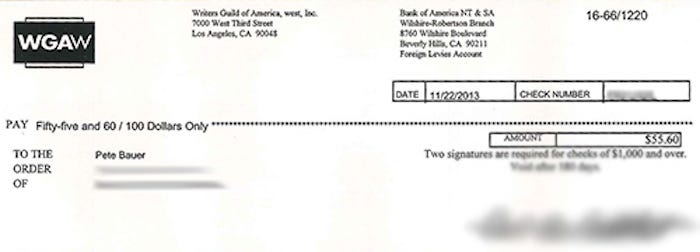
Residuals! We LOVE residuals! It’s like free money!
Justin asks:
Hi Scott, could you talk about writer residuals in a real world sense, sort of break it down?
The first thing you need to know is residuals are awesome! Seriously. Every three months, screenwriters get these pale green envelopes with checks inside and accompanying statements for any movie or TV show they’ve written that got produced. You open up the envelope and look! There it is! Free money! Even for a guy like me with three nominal movie credits, residuals can translate into a significant amount of income. In fact, I’ve made hundreds of thousands of dollars in residuals over the years. Somebody like James Cameron must have made millions off Titanic and Avatar. Granted, nothing compared to his salary and bonuses, but still his residuals probably pay for his cigars or whatever other vice he might have.
So pragmatically that’s all the ‘real world’ info you need to know. Every three months = free money. Now there are all sorts of formalities re residuals which you can dig into here courtesy of the WGA. To wit:
What Are Residuals?
Residuals are compensation paid for the reuse of a credited writer’s work. When you receive credit on produced Guild covered material, you are entitled to compensation if the material is reused. It is important to understand that the compensation is for reuse, and not the original use. For example, if you are hired to write an episode of a network prime time television series, the compensation you are paid for writing services includes the episode’s initial broadcast. However, when that episode reruns on a network, in syndication, or in any other market, the Company must pay you for that reuse.
Similarly, for theatrical motion pictures, the compensation you are paid for your script, either as a purchase or employment, covers the exhibition of the film theatrically, including all foreign theatrical releases. However, when your movie is released to other markets, such as videocassette or pay television, you are due residuals.
Who Receives Residuals?
The credited writer(s) on a produced project receive(s) the residual compensation. Regardless of how much you are paid or what you contribute to the final shooting script on a project, you only receive MBA residuals if you receive writing credit.
Note: MBA = Minimum Basic Agreement
The following Guild determined credits generate residuals for writers under the MBA:
For theatrical motion pictures:
Written by
Story by
Screen Story by
Screenplay by
Adaptation by
Narration Written by
Note: Now you know one of the reasons why credit determinations are such a big freaking deal.
Residuals for theatrical and television motion pictures, including episodic programs, are allocated as follows: “Written by” — 100%; “Screenplay/Teleplay by” — (if a “Story by” or “Screen/Television Story by” credit is accorded) — 75%; Story by” or “Screen/Television Story by” — 25%. In general, if no form of “Story by” credit is accorded, 100% goes to the writer(s) receiving “Screenplay/Teleplay by” credit. The residual for minor credits such as “Adaptation by” is 10%. In that instance, the residual is allocated as follows: “Adaptation by” — 10%; “Screenplay/Teleplay by” — 65%; “Story by” — 25%.
Reuse Market Residual Payment Owed & Due Date
Theatrical: No residuals are due for worldwide theatrical release, including in-flight, which is covered under the initial compensation.
Free Television: 1.2% of distributor’s gross receipts for worldwide free television reuse.
For network television reuse, residuals are due within 30 days of the Company’s receipt of payment from the network.
For syndicated or foreign television reuse, residuals are due within 60 days of the end of the quarter in which gross receipts or licensing fees are received by the Company.
Pay Television: 1.2% of distributor’s gross receipts for worldwide reuse.
Residuals are due within 60 days of the end of the quarter in which gross receipts or licensing fees are received by the Company.
Here is the kicker:
Videocassette and DVD: For theatrical projects that commenced production on or before February 28, 1985: 1.2% of the Company’s reportable gross.
For theatrical projects that commenced production after February 28, 1985: 1.5% of the first million dollars of the Company’s reportable gross (or “producer’s gross”); 1.8% thereafter.
Residuals are due within 60 days of the end of the quarter in which gross receipts or licensing fees are received by the Company.
Basic Cable 1.2% of distributor’s gross receipts for worldwide reuse.
Residuals are due within 60 days of the end of the quarter in which gross receipts or licensing fees are received by the Company.
Those videocassette and DVD figures are a source of major pain to writers. Back in the early 80s, the studios basically said this: “WGA, this whole videocassette thing, we’d like to try to grow it as a business, but we can’t with the current residual percentages. We propose a temporary rollback in the rate, enabling us to use those extra dollars to expand that market. Then when it’s really a viable thing, we’ll revisit the percentages.”
They never revisited the percentages. Which means that writers, including myself, have been out zillions (well, maybe not that much) of dollars of revenue which in the original agreement would have gone to us, but disappeared into the studios’ pockets. And as we all know, they made a shit-ton of money off DVDs for more than a decade.
That should provide you some context for the 2007–2008 WGA strike re Web content where the AMPTP said the exact same thing: “We don’t know if this is going to be a viable market, let us see where it goes, then we’ll figure out a percentage blah blah blah.”
Okay, so what started out as a happy little post about pretty green envelopes with checks in the mail has become mired down in Guild politics. There’s an object lesson here I think… not sure what it is other than perhaps if you talk to any screenwriter or TV writer long enough, they will invariably start to kvetch about the business.
But warts and all, there you have it: some ‘real world’ answers re residuals.
For more articles in the Go Into The Story Reader Question series, go here.