Reader Question: What’s the biggest challenge novelists face when switching to screenwriting?
While closely related, there are significant differences between these two narrative forms.
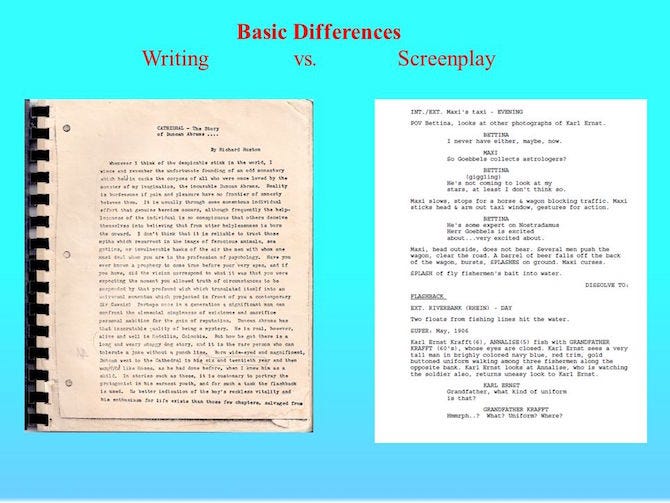
While closely related, there are significant differences between these two narrative forms.
A question from Dylan:
I’ve only written novels, however, I have a story which feels more like a movie to me. I’m a bit concerned ‘coz I’ve never written a screenplay before. What’s the biggest challenge I may face switching from writing a novel to a screenplay?
Upfront let me say, I’ve never written a novel (although I’m working on one now). However, I have taught hundreds of novelists in my screenwriting classes, so I’m quite familiar with the challenges they face.
One more thing: I assume, Dylan, you’re talking about a novelist writing a screenplay, not attempting to switch careers. Per the latter, I’ll just say it’s probably harder because whereas a novelist has (potentially) tens or hundreds of thousands of buyers for a book, which they can even self-publish, a screenwriter has only several dozen production companies and financiers, and six major studios. My advice on this front: Continue to do both. Write novels and screenplays.
As far as a novelist trying their hand at writing a screenplay, the first thing is to understand it’s a unique narrative form. A screenplay is not a short novel. It is its own thing. Here is a list of some of the challenges the novelists I’ve taught face when writing a screenplay:
- A screenplay is written in the present tense, whereas most novels are in the past tense. This may seem rather insignificant. It isn’t. Movies happen in the here and now, and so one of the screenwriter’s tasks is to write scenes which play out very much in the moment. There is an immediacy of action a novelist needs to grasp when writing a screenplay. Sometimes that can be a hurdle for a new screenwriter.
- A screenplay exists in a largely externalized reality. This reflects the fact that characters in movies convey who they are through Action and Dialogue. A novelist can go inside characters and explore their inner psyche for pages and pages. In a screenplay, unless the writer uses voice-over narration to hear a character describe their inner state of being — a practice generally frowned upon in Hollywood — we have to be mindful of telling a story which an audience can see and hear.
- William Goldman famously said, “Screenplays are structure.” This has multiple levels of meaning. Here are two. First, we may think of a screenplay as a pre-movie. At some point, if we’re lucky, a script gets green lit, and a cast and crew of anywhere from a few dozen to hundreds uses it to produce that film. This is why we often see the word ‘blueprint’ used in reference to a screenplay. To some outside the movie business, that may seem to diminish the artistic merit of a screenplay. To those who work in the business, it does not. Rather that designation simply means at some point, the script gets broken down for purposes of casting, locations, budgeting, scheduling, art departments, etc.
- There is a second way in which Goldman’s observation is relevant, especially to actual act of screenwriting. Over the years, for whatever number of contributing factors, there is a kind of ‘paradigm’ of movement which most mainstream, commercial movies have. In the beginning part, the story universe gets established, characters are introduced, and central conflict set into motion. Something happens and the plot kicks into gear. There are complications and roadblocks in the middle of the story, generally speaking in escalating order until a major reversal. Finally in the end, some sort of final struggle and resolution. This has come to be known as Three Act Structure and while there may be a zillion variations floating around in screenwriting guru land, a writer has to be conscious of the expectations of people who work in the industry of certain things happening in certain ways, even down to page count. These are not rules, but conventions nonetheless. Whereas a novelist may generally be in the ballpark of telling a story with a Beginning, Middle, and End, there is much less freedom for a screenwriter to explore anything other than the primary and secondary characters, the central plot and key subplots, while always being mindful of the narrative throughline.
- A contributing factor to this last point: Typically screen time is relentless, a screenplay just goes and goes and goes, one scene to the next, boom-boom-boom. Whereas a novelist may be used to writing 10, 15, 20 page chapters, screenwriters work with 1–2 page scenes and/or combinations of scenes often referred to as sequences. Even in intimate character-driven dramas, there is a pace to things, and a screenwriter has use scenes to push the plot forward.
- Even when it comes to something as basic as scene description, a screenwriter approaches the task differently than a novelist. Whereas the latter can use language in an expansive way to paint visual and emotional tableaus, screenwriters embrace the mantra: “Minimum words, Maximum impact.” Indeed, I tell my students it’s best to think of scene description as poetry, rather than prose. We don’t need to write complete sentences, rather our task in finding the story’s narrative voice is to look for evocative, but short bursts of visuals, what I call imagematic writing. Sometimes even one word does the job.
- We can get even more fundamental when talking about the actual look of a screenplay page. Depending on the genre, narrative voice, and type of scene we’re dealing with, generally speaking we want to have as much white space on the page as possible. This makes for a more readable script, the result of editing the draft to be as tight and lean as possible. I can’t begin to count the number of times I’ve talked with colleagues about how we obsess over orphans and widows, cutting words to save extra line-spaces. Or trimming description or dialogue to cut some black ink on the page to give it a more balanced look. Or working and reworking the first page of the script to have whatever dramatic event we’ve written for an opening incident end on the very last line, our way of hooking the reader, so they’ll flip to the next page in order to jump-start that forward-moving energy.
- But perhaps the single biggest challenge is this: The business of making movies is a collaborative process. Practically speaking that means there are many voices who express opinions about our scripts. Managers, agents, producers, studio execs (Creative Executives, Directors of Development, Vice Presidents), directors, actors, the latter who may have their own writers to punch up their roles. Bottom line: If you, as a creative, cannot stand to have a bunch of people poking your story, raising concerns, making suggestions, or simply telling you point blank, “You have to change this,” then you probably should stick to being a novelist.
There are other things such as turnaround time for a draft, typically 10–12 weeks, being rewritten by other writers, and so forth, but the items noted above are the big ticket challenges confronting novelists who turn their attention to writing screenplays.
Of course, there are pluses. A screenplay is typically shorter than a novel. You can write a complete story in a matter of a few months as opposed to a year or more. If you’re successful, you get to hang out in the Hollywood scene, if you’re into that sort of thing.
But while writing a novel has its own set of unique challenges, so, too, does writing a screenplay.
How about you, readers? Have you tried your hand at novels and screenplays? What have you found to be some big challenges in writing both? Post a RESPONSE and let’s see what you have to say.
For 100s more Go Into The Story Reader Question articles, go here.