Reader Question: What guidelines are there for using scene headings / primary slug lines?
“If you read, say, 20 screenplays by working, contemporary screenwriters — and you should be reading scripts anyhow! — you will note…
“If you read, say, 20 screenplays by working, contemporary screenwriters — and you should be reading scripts anyhow! — you will note different approaches to the use of slug lines as well as most other screenplay style elements.”
Question from Matt:
Hey Scott,I have another question for you. So one of my biggest problems, and maybe just more of an annoyance, is when to determine a new scene. To explain, let’s say I have a guy running through the woods alright? So it starts as EXT. WOODS — DAY correct? Then after some running he emerges onto a lake. So is this a new scene as in EXT. LAKE — DAY? Or is it still the same scene as WOODS? The going further he runs along the shore and up to a shed, and he enters. Now would this be INT. SHED — DAY? So many questions but really just one. How would you format it? Is a format set in stone or more of a personal preference?
Hope you can help with this as it makes me “stutter” while writing to decide when to start a new scene.
As a rule of thumb, you should use scene headings / primary slug lines to indicate when you are starting a new scene. Once you are in that scene and need to shift the action around, two guidelines:
(1) If the action is within the context of the primary location, then indicate the shift by using a shot / secondary slug line. For instance per your question:
EXT. FOREST — DAY
Matt races through the woods, bloodied… gasping for breath. Finally
stumbles out and dives into —
A LAKE
Matt churning through the water.
You do not use a primary slug line to indicate the lake — remember use them primarily to signify the beginning of a new scene — but rather use a secondary slug line to shift the action.
(2) If you need to shift the action away from the primary scene location, you can use a primary slug line. Picking up on the previous scene:
EXT. FOREST — DAY
Matt races through the woods, bloodied… gasping for breath. Finally
stumbles out and dives into —
A LAKE
Matt churning through the water.
INT. CHURCH — CONTINUOUS
Matt’s bride-to-be Brenna sits alone in a pew, her gown wet with tears —
THE LAKE
Matt flails in the water… turns to see —
THE AXE MAN
Storming into the lake, heading directly for Matt —
Caveat: If you read, say, 20 screenplays by working, contemporary screenwriters — and you should be reading scripts anyhow! — you will note different approaches to the use of slug lines as well as most other screenplay style elements.
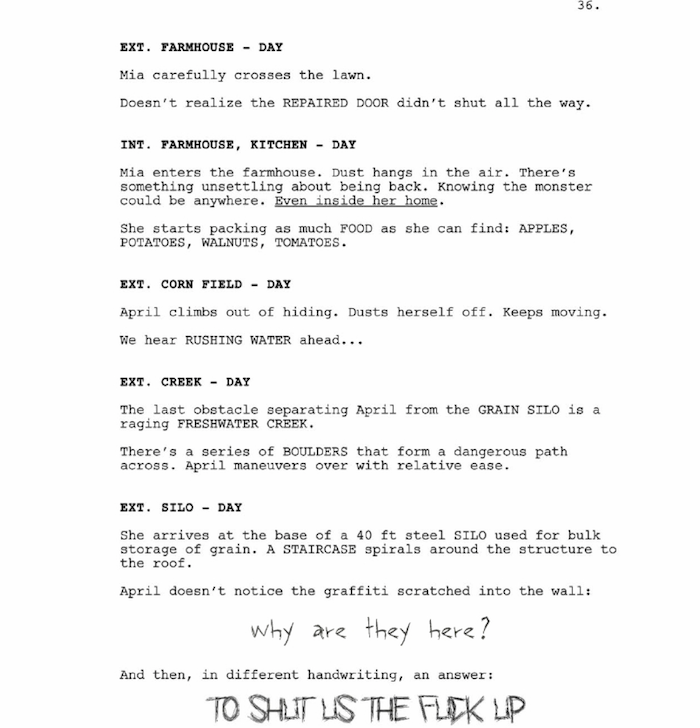
For example, here is a script page from a draft of A Quiet Place written by Scott Beck and Bryan Woods:
Note how they use scene headings to relocate the action even though it’s one continuous. Compare to the 2015 Nicholl Fellowships in Screenwriting winning script “Great Falls” written by Andrew Friedhof:
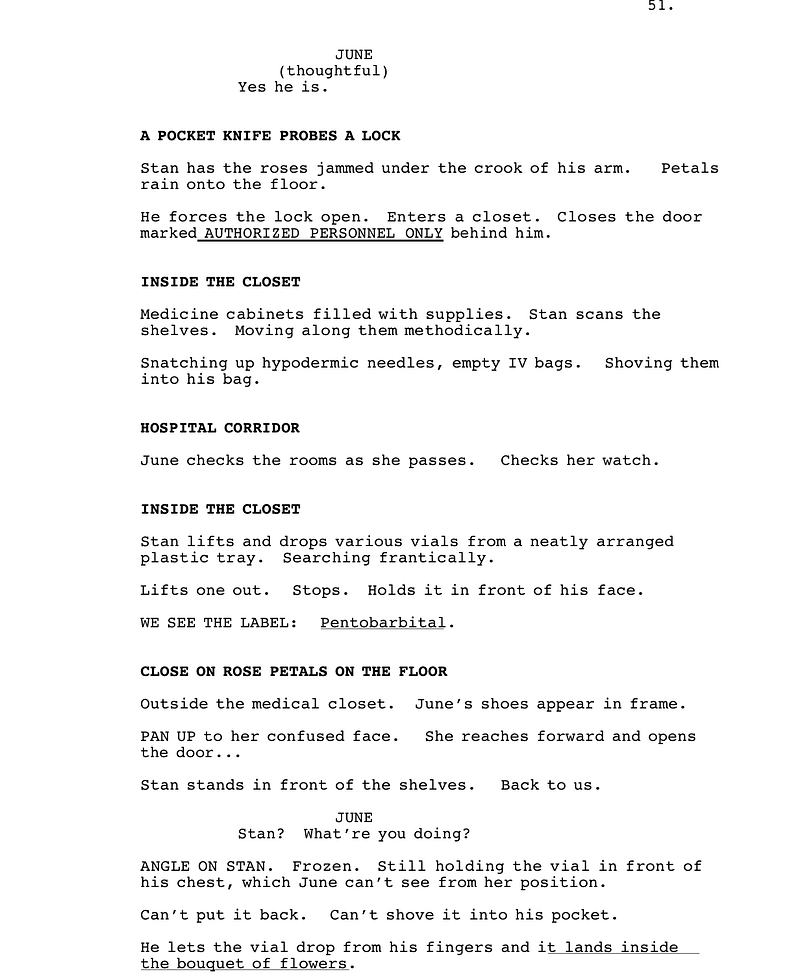
Andy uses NO scene headings throughout the entire script, instead relying on secondary slug lines to shift the action whether a new scene or not. We got into the subject why Andy made this creative choice in my interview with him:
Scott: Speaking of a visual medium, that’s one thing that’s very striking about the script, is your embrace of that in seeing the scripts. It’s a very strong visual sensibility and lots of specific and vivid images. How aware are you of that and how much of that is just instinctive?
Andy: That’s something that’s developed over time. You probably noticed for example that I don’t use conventional sluglines in my script.
Scott: Yes.
Andy: I think it’s an act of folly to write a screenplay as though you’re going into production tomorrow. The first thing you should aim for is to provide a fun and enjoyable reading experience for the reader.
What I really want to do with my scripts is take people through the experience of watching the movie. You might have noticed that I often start scenes with close‑ups on objects or specific details in the scene. That’s how films are shot, basically. When a film is edited together they generally don’t start scenes with wide shots of the interior of a room. So it doesn’t really make much sense to start every scene with some variation on INT. ROOM — DAY. For me, it’s really important to capture the energy, movement and spirit of film.
There are quite a few screenwriters who do that already. Those are the screenwriters I admire and those are the screenwriters I’m always excited to read. I want people to look forward to reading the scripts I write.
So no matter what you may have read or who has been pontificating what, you can get away with just about anything with regard to style as long as it clearly conveys what you want the reader to see in their mind.
Just one example is P. 1 of the Coen brothers screenplay True Grit:
White letters on a black screen:
The wicked flee when none pursueth.
The quotation fades.
A woman's voice:
Voice-Over
People do not give it credence that a young
girl could leave home and go off in the
wintertime to avenge her father's blood, but
it did happen.
The street of a western town, night. The street is deserted.
Snow falls.
We track slowly forward.
I was just fourteen years of age when a coward
by the name of Tom Chaney shot my father down
in Fort Smith, Arkansas, and robbed him of his
life and his horse and two California gold
pieces that he carried in his trouser band.
A shape lies in the street below the busted-out porch railing
of a two-story building. A sign identifies the building as the
Monarch Boarding House.
Papa was a Cumberland Presbyterian and a Mason.
He'd hired Chaney--for paid wages, not on
shares--when Chaney was "down on his luck." If
Papa had a failing it was his kindly
disposition; I did not get my mean streak from
him.
The crumpled shape is a body. We hear the thunder of
approaching hooves.
He had taken Chaney up to Fort Smith to help
lead back a string of mustang ponies he'd just
bought from a stock trader named Stonehill. In
town, Chaney had fallen to drink and cards, and
lost all his money. He got it into his head
he'd been cheated and went back to the boarding
house for his Henry rifle. Papa remonstrated,
and Chaney shot him in the breast.
A galloping horse enters frame and recedes, whipped on by a
bareback rider. A long-barreled rifle is tied across the
rider's back with a sash cord.
He disappears into the falling snow.
Chaney fled. He could have taken the time to
saddle the horse--or hitched up three spans of
mules to a Concord stagecoach and smoked a pipe,
as it seems that no one in that city was
inclined to give chase. Chaney had mistaken its
citizens for men.
Observant eyes will notice a few things. Specific to the question of scene headings, note there are none in this scene. Moreover after Voice-Over is established, there are no further character names in the subsequent dialogue sides, even though it is Mattie talking throughout. There’s not even a FADE IN.
The Coens can get away with this for three reasons: (1) They are the Coen brothers, well-established filmmakers who can do basically anything they want at this point; (2) They are writing a movie they will direct, so in effect they are writing for themselves, therefore whatever shorthand style they need or want to use, they can do it; (3) What they have written makes it entirely clear what is going on.
The last point is the focus on my caveat which I repeat: As long you convey clearly to the reader what you intend for them to see in their mind, you can pretty much get away with anything you want to do in terms of screenplay style elements.
Now do I recommend veering dramatically from the conventional wisdom of screenplay style? If you are not an established screenwriter, no, I do not. If what you write is substantially different in terms of generally accepted screenplay style, a script reader may perceive that you are an amateur who has yet to master the craft. The reaction will be even worse if what you write isn’t clear.
But consider this one more blow against screenwriting formula: The fact is a story, even in script form, is an organic entity. Eventually you will have the freedom to do what you must to tell your story the way you feel it should be told. Until you establish yourself, it’s best to stick to the standard guidelines.
For more articles in the Go Into The Story Reader Question series, go here.